
- Forums
- Product Forums
- General Purpose MicrocontrollersGeneral Purpose Microcontrollers
- i.MX Forumsi.MX Forums
- QorIQ Processing PlatformsQorIQ Processing Platforms
- Identification and SecurityIdentification and Security
- Power ManagementPower Management
- Wireless ConnectivityWireless Connectivity
- RFID / NFCRFID / NFC
- Advanced AnalogAdvanced Analog
- Neural Processing UnitsNeural Processing Units
- MCX Microcontrollers
- S32G
- S32K
- S32V
- MPC5xxx
- Other NXP Products
- S12 / MagniV Microcontrollers
- Powertrain and Electrification Analog Drivers
- Sensors
- Vybrid Processors
- Digital Signal Controllers
- 8-bit Microcontrollers
- ColdFire/68K Microcontrollers and Processors
- PowerQUICC Processors
- OSBDM and TBDML
- S32M
- S32Z/E
-
- Solution Forums
- Software Forums
- MCUXpresso Software and ToolsMCUXpresso Software and Tools
- CodeWarriorCodeWarrior
- MQX Software SolutionsMQX Software Solutions
- Model-Based Design Toolbox (MBDT)Model-Based Design Toolbox (MBDT)
- FreeMASTER
- eIQ Machine Learning Software
- Embedded Software and Tools Clinic
- S32 SDK
- S32 Design Studio
- GUI Guider
- Zephyr Project
- Voice Technology
- Application Software Packs
- Secure Provisioning SDK (SPSDK)
- Processor Expert Software
- Generative AI & LLMs
-
- Topics
- Mobile Robotics - Drones and RoversMobile Robotics - Drones and Rovers
- NXP Training ContentNXP Training Content
- University ProgramsUniversity Programs
- Rapid IoT
- NXP Designs
- SafeAssure-Community
- OSS Security & Maintenance
- Using Our Community
-
- Cloud Lab Forums
-
- Knowledge Bases
- ARM Microcontrollers
- i.MX Processors
- Identification and Security
- Model-Based Design Toolbox (MBDT)
- QorIQ Processing Platforms
- S32 Automotive Processing Platform
- Wireless Connectivity
- CodeWarrior
- MCUXpresso Suite of Software and Tools
- MQX Software Solutions
- RFID / NFC
- Advanced Analog
- Neural Processing Units
-
- NXP Tech Blogs

Hello everyone,
I have a CRANK signal in .csv format that was obtained from an oscilloscope. Is it possible to analyze this CRANK signal using the ASH WARE eTPU2p DevTool program? I mean, I want to import .csv file into the ASH WARE program. I have done some research, but I couldn't find anything related to this. I hope you will clerify the topic for me.
Best regards,
Mert.
已解决! 转到解答。

Some ASH WARE users develop timing data in spreadsheets and then output it into the form of the test vector language for use in the simulation tool (see examples and documentation for details on the test vector language that can be used to drive input signals). Certainly the same technique can be used for .csv files. Large (many MB) test vector files have been used to exercise some very long simulations (hours to days) in the past. This is a fairly straightforward technique.
Newer scripting capabilities support reading of .csv files into the script environment where the data could then be used to control timing and pin values via script commands. Almost for sure this would need to be done in its own script file, separate from the one that configures the eTPU and stimulates it via HSRs and memory writes. This is easy to do if a dual-engine (eTPU-A and B) simulation is set up - the main script file would be associated with eTPU-A, and the signal generation script would be associated with eTPU-B (but it could still drive pins on eTPU-A). What is the format of your .csv data?
Some ASH WARE users develop timing data in spreadsheets and then output it into the form of the test vector language for use in the simulation tool (see examples and documentation for details on the test vector language that can be used to drive input signals). Certainly the same technique can be used for .csv files. Large (many MB) test vector files have been used to exercise some very long simulations (hours to days) in the past. This is a fairly straightforward technique.
Newer scripting capabilities support reading of .csv files into the script environment where the data could then be used to control timing and pin values via script commands. Almost for sure this would need to be done in its own script file, separate from the one that configures the eTPU and stimulates it via HSRs and memory writes. This is easy to do if a dual-engine (eTPU-A and B) simulation is set up - the main script file would be associated with eTPU-A, and the signal generation script would be associated with eTPU-B (but it could still drive pins on eTPU-A). What is the format of your .csv data?
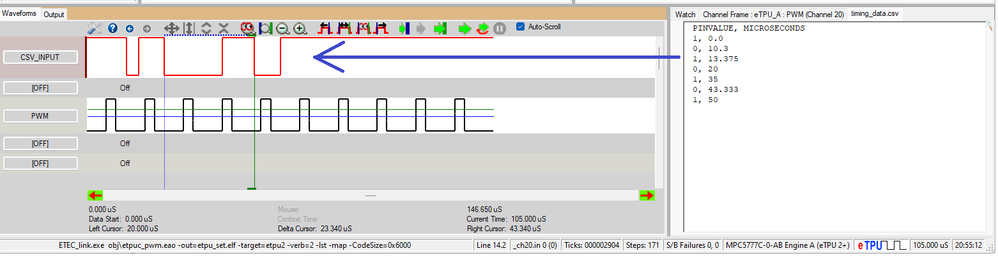
Hi @johndiener,
Thanks for the answers. The .csv file that I wanted to create in simulator is simple. Every row includes the value of 0 or 5 which they shows the logic level of the CRANK signal as high or low.
Now, with your help, I can create the signal in CRANK channel however the simulator is shut down after some time without any information. The .csv file includes nearly 5000000 point and period of every point is 20 us.
Is the point number too large for the program or what? Do you have any idea?
Best regards,
Mert.
Based on the behavior it appears that exceeds capacity, that will need to be looked at in more detail. But based on your description, the data probably contains a lot of unnecessary information. Only points when the input changes are needed - I suspect you could filter the data down to a tenth of what it currently is (depending upon tooth configuration and RPM). You would need to add actual time data to each remaining row, of course, as the 20us increment per row would no longer apply. For now that is the best recommendation I have. The secondary recommendation would be to try converting the data to vector language format, as that was specifically designed for stimulating eTPU inputs.

 davidtosenovjan
Hi @johndiener , would you please help in this topic? Thanks
