
- Forums
- Product Forums
- General Purpose MicrocontrollersGeneral Purpose Microcontrollers
- i.MX Forumsi.MX Forums
- QorIQ Processing PlatformsQorIQ Processing Platforms
- Identification and SecurityIdentification and Security
- Power ManagementPower Management
- Wireless ConnectivityWireless Connectivity
- RFID / NFCRFID / NFC
- Advanced AnalogAdvanced Analog
- Neural Processing UnitsNeural Processing Units
- MCX Microcontrollers
- S32G
- S32K
- S32V
- MPC5xxx
- Other NXP Products
- S12 / MagniV Microcontrollers
- Powertrain and Electrification Analog Drivers
- Sensors
- Vybrid Processors
- Digital Signal Controllers
- 8-bit Microcontrollers
- ColdFire/68K Microcontrollers and Processors
- PowerQUICC Processors
- OSBDM and TBDML
- S32M
- S32Z/E
-
- Solution Forums
- Software Forums
- MCUXpresso Software and ToolsMCUXpresso Software and Tools
- CodeWarriorCodeWarrior
- MQX Software SolutionsMQX Software Solutions
- Model-Based Design Toolbox (MBDT)Model-Based Design Toolbox (MBDT)
- FreeMASTER
- eIQ Machine Learning Software
- Embedded Software and Tools Clinic
- S32 SDK
- S32 Design Studio
- GUI Guider
- Zephyr Project
- Voice Technology
- Application Software Packs
- Secure Provisioning SDK (SPSDK)
- Processor Expert Software
- Generative AI & LLMs
-
- Topics
- Mobile Robotics - Drones and RoversMobile Robotics - Drones and Rovers
- NXP Training ContentNXP Training Content
- University ProgramsUniversity Programs
- Rapid IoT
- NXP Designs
- SafeAssure-Community
- OSS Security & Maintenance
- Using Our Community
-
- Cloud Lab Forums
-
- Knowledge Bases
- ARM Microcontrollers
- i.MX Processors
- Identification and Security
- Model-Based Design Toolbox (MBDT)
- QorIQ Processing Platforms
- S32 Automotive Processing Platform
- Wireless Connectivity
- CodeWarrior
- MCUXpresso Suite of Software and Tools
- MQX Software Solutions
- RFID / NFC
- Advanced Analog
- Neural Processing Units
-
- NXP Tech Blogs
- Home
- :
- 汎用マイクロコントローラ
- :
- Kinetisマイクロコントローラ
- :
- Re: SPI and DMA - only transfers once.
SPI and DMA - only transfers once.
- RSS フィードを購読する
- トピックを新着としてマーク
- トピックを既読としてマーク
- このトピックを現在のユーザーにフロートします
- ブックマーク
- 購読
- ミュート
- 印刷用ページ

- 新着としてマーク
- ブックマーク
- 購読
- ミュート
- RSS フィードを購読する
- ハイライト
- 印刷
- 不適切なコンテンツを報告
I have custom hardware that consists of an MK22FN512VMP12 processor connected to a sensor through a GPIO for power and four lines for SPI.
I am trying to trigger DMA SPI transfers through a PIT interrupt. The problem I'm seeing is that the DMA transfer happens only on the first PIT interrupt. For subsequent interrupts, nothing happens. At this point, I don't care if the sensor is seeing it or not, I just want to get the DMA transfers working. After I get transmit working, I want to get receive working.
I have the DMA error interrupt handler declared, but it is not currently used. When I had it enabled, I never got any interrupts.
I've been following this example:
Here's my code. I've attached the file also.
/*
* Copyright (c) 2015, Freescale Semiconductor, Inc.
* All rights reserved.
*
* Redistribution and use in source and binary forms, with or without modification,
* are permitted provided that the following conditions are met:
*
* o Redistributions of source code must retain the above copyright notice, this list
* of conditions and the following disclaimer.
*
* o Redistributions in binary form must reproduce the above copyright notice, this
* list of conditions and the following disclaimer in the documentation and/or
* other materials provided with the distribution.
*
* o Neither the name of Freescale Semiconductor, Inc. nor the names of its
* contributors may be used to endorse or promote products derived from this
* software without specific prior written permission.
*
* THIS SOFTWARE IS PROVIDED BY THE COPYRIGHT HOLDERS AND CONTRIBUTORS "AS IS" AND
* ANY EXPRESS OR IMPLIED WARRANTIES, INCLUDING, BUT NOT LIMITED TO, THE IMPLIED
* WARRANTIES OF MERCHANTABILITY AND FITNESS FOR A PARTICULAR PURPOSE ARE
* DISCLAIMED. IN NO EVENT SHALL THE COPYRIGHT HOLDER OR CONTRIBUTORS BE LIABLE FOR
* ANY DIRECT, INDIRECT, INCIDENTAL, SPECIAL, EXEMPLARY, OR CONSEQUENTIAL DAMAGES
* (INCLUDING, BUT NOT LIMITED TO, PROCUREMENT OF SUBSTITUTE GOODS OR SERVICES;
* LOSS OF USE, DATA, OR PROFITS; OR BUSINESS INTERRUPTION) HOWEVER CAUSED AND ON
* ANY THEORY OF LIABILITY, WHETHER IN CONTRACT, STRICT LIABILITY, OR TORT
* (INCLUDING NEGLIGENCE OR OTHERWISE) ARISING IN ANY WAY OUT OF THE USE OF THIS
* SOFTWARE, EVEN IF ADVISED OF THE POSSIBILITY OF SUCH DAMAGE.
*/
#include <stdint.h>
#include <stdbool.h>
#include "MK22F51212.h"
/*
* Macros
*/
#define SPI_PUSHR_CTAS_CTAR0 (0x0)
/*
*
*/
#define EnableInterrupts __asm(" CPSIE i");
#define DisableInterrupts __asm(" CPSID i");
/*
* Data array - WHOAMI register from sensor
*/
#define SENSOR_FRAME_READ_WHOAMI (0x40000091)
#define SENSOR_TRANSMIT_READ_WHOAMI_COUNT (8)
static uint32_t SENSOR_TRANSMIT_READ_WHOAMI[SENSOR_TRANSMIT_READ_WHOAMI_COUNT] =
{
SPI_PUSHR_CONT_MASK | SPI_PUSHR_CTAS_CTAR0 | SPI_PUSHR_PCS(1) | SPI_PUSHR_TXDATA((SENSOR_FRAME_READ_WHOAMI >> 24) & 0xFF),
SPI_PUSHR_CONT_MASK | SPI_PUSHR_CTAS_CTAR0 | SPI_PUSHR_PCS(1) | SPI_PUSHR_TXDATA((SENSOR_FRAME_READ_WHOAMI >> 16) & 0xFF),
SPI_PUSHR_CONT_MASK | SPI_PUSHR_CTAS_CTAR0 | SPI_PUSHR_PCS(1) | SPI_PUSHR_TXDATA((SENSOR_FRAME_READ_WHOAMI >>
解決済! 解決策の投稿を見る。

- 新着としてマーク
- ブックマーク
- 購読
- ミュート
- RSS フィードを購読する
- ハイライト
- 印刷
- 不適切なコンテンツを報告
Hi
Below is the code to do this in the uTasker project:
#define SPI_DMA_LENGTH    11
#define SPI_DMA_CHANNEL   7

// PIT 0 interrupt callback
//
static __callback_interrupt void _startTx(void)
{
    static unsigned long ulSPI_TxBuffer[SPI_DMA_LENGTH] = {0};           // tx buffer

    unsigned char ucByteValue = (unsigned char)ulSPI_TxBuffer[0];
    WRITE_ONE_TO_CLEAR(SPI1_SR, (SPI_SR_EOQF));                          // clear the end of queue flag
    while (i < (SPI_DMA_LENGTH - 1)) {                                   // prepare a tx data pattern
        ulSPI_TxBuffer[i++] = (SPI_PUSHR_CONT | SPI_PUSHR_CTAS_CTAR0 | SPI_PUSHR_PCS0 | ++ucByteValue);
    }
    ulSPI_TxBuffer[i] = (SPI_PUSHR_EOQ | SPI_PUSHR_CTAS_CTAR0 | SPI_PUSHR_PCS0 | ++ucByteValue); // negate CS line after final bytes is sent
    // Configure Tx DMA (buffer to SPI, single buffer with no interrupt on termination)
    //
    fnConfigDMA_buffer(SPI_DMA_CHANNEL, DMAMUX0_CHCFG_SOURCE_SPI1_TX, sizeof(ulSPI_TxBuffer), &ulSPI_TxBuffer[0], (void *)SPI1_PUSHR_ADDR, (DMA_LONG_WORDS | DMA_DIRECTION_OUTPUT | DMA_SINGLE_CYCLE), 0, PRIORITY_DMA10);
    fnDMA_BufferReset(SPI_DMA_CHANNEL, DMA_BUFFER_START);                // start the transfer
}

// PIT and SPI configuration
//
static void fnConfigurePIT_SPI(void)
{
    PIT_SETUP pit_setup;                                                 // PIT interrupt configuration parameters
    // Configure SPI
    //
    POWER_UP_ATOMIC(6, SPI1);
    _CONFIG_PERIPHERAL(D, 4, (PD_4_SPI1_PCS0 | PORT_SRE_FAST | PORT_DSE_HIGH));
    _CONFIG_PERIPHERAL(D, 5, (PD_5_SPI1_SCK | PORT_SRE_FAST | PORT_DSE_HIGH));
    _CONFIG_PERIPHERAL(D, 7, (PD_7_SPI1_SIN | PORT_SRE_FAST | PORT_DSE_HIGH));
    _CONFIG_PERIPHERAL(D, 6, (PD_6_SPI1_SOUT));
    SPI1_MCR = (SPI_MCR_MSTR | SPI_MCR_DCONF_SPI | SPI_MCR_CLR_RXF | SPI_MCR_CLR_TXF | SPI_MCR_PCSIS_CS0 | SPI_MCR_PCSIS_CS1 | SPI_MCR_PCSIS_CS2 | SPI_MCR_PCSIS_CS3 | SPI_MCR_PCSIS_CS4 | SPI_MCR_PCSIS_CS5);
    SPI1_CTAR0 = (SPI_CTAR_DBR | SPI_CTAR_FMSZ_8 | SPI_CTAR_PDT_7 | SPI_CTAR_BR_2);
    SPI1_RSER = (SPI_SRER_TFFF_DIRS | SPI_SRER_TFFF_RE);                 // enable DMA request when tx fifo not full

    pit_setup.int_type = PIT_INTERRUPT;
    pit_setup.mode = PIT_PERIODIC;                                       // PIT periodic interrupt
    pit_setup.ucPIT = 0;                                                 // use PIT0
    pit_setup.int_handler = _startTx;                                    // PIT interrupt callback
    pit_setup.int_priority = PIT0_INTERRUPT_PRIORITY;
    pit_setup.count_delay = PIT_FREERUN_FREQ(64000);                     // 64kHz interrupt rate
    fnConfigureInterrupt((void *)&pit_setup);                            // configure and start the PIT
}
This is the output showing 11 bytes sent 64000 times a second:
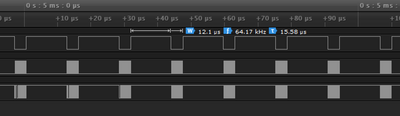
Closer look:

Some notes:
It is not absolutely necessary to use a DMA completion interrupt since the PIT interrupt can simply configure everything needed each time it starts the transfer.
It IS IMPORTANT to clear the EOQF flag in the status register otherwise it will not transmit a second time.
There is no need to enable and disable the SPI since if the DMA is not active it won't send anything anyway.
Although only a detail it is not recommended to clear flags with
SPI0_SR |= SPI_SR_EOQF_MASK | SPI_SR_TCF_MASK | SPI_SR_RFDF_MASK | SPI_SR_TFFF_MASK | SPI_SR_RFDF_MASKbut correctly they should be cleared with (not ORing with what is read)
SPI0_SR = SPI_SR_EOQF_MASK | SPI_SR_TCF_MASK | SPI_SR_RFDF_MASK | SPI_SR_TFFF_MASK | SPI_SR_RFDF_MASKAlthough the DMA API you are using needs a lot of careful setup (and error prone due to this) I didn't actually spot anything that was incorrectly configured. Therefore check that the EOQF clear is not somehow being optimised away and try not disabling/enabling the SPI between transfers.
Regards
Mark
[uTasker project developer for Kinetis and i.MX RT]
Contact me by personal message or on the uTasker web site to discuss professional training, solutions to problems or rapid product development requirements
For professionals searching for faster, problem-free Kinetis and i.MX RT 10xx developments the uTasker project holds the key: https://www.utasker.com/iMX/RT1064.html
- 新着としてマーク
- ブックマーク
- 購読
- ミュート
- RSS フィードを購読する
- ハイライト
- 印刷
- 不適切なコンテンツを報告
It was the setting of the HALT bit in the SPI MCR register that was causing the problem. I don't know how they got away with it in the demo...
Thanks!
- 新着としてマーク
- ブックマーク
- 購読
- ミュート
- RSS フィードを購読する
- ハイライト
- 印刷
- 不適切なコンテンツを報告
Hi
Below is the code to do this in the uTasker project:
#define SPI_DMA_LENGTH    11
#define SPI_DMA_CHANNEL   7

// PIT 0 interrupt callback
//
static __callback_interrupt void _startTx(void)
{
    static unsigned long ulSPI_TxBuffer[SPI_DMA_LENGTH] = {0};           // tx buffer

    unsigned char ucByteValue = (unsigned char)ulSPI_TxBuffer[0];
    WRITE_ONE_TO_CLEAR(SPI1_SR, (SPI_SR_EOQF));                          // clear the end of queue flag
    while (i < (SPI_DMA_LENGTH - 1)) {                                   // prepare a tx data pattern
        ulSPI_TxBuffer[i++] = (SPI_PUSHR_CONT | SPI_PUSHR_CTAS_CTAR0 | SPI_PUSHR_PCS0 | ++ucByteValue);
    }
    ulSPI_TxBuffer[i] = (SPI_PUSHR_EOQ | SPI_PUSHR_CTAS_CTAR0 | SPI_PUSHR_PCS0 | ++ucByteValue); // negate CS line after final bytes is sent
    // Configure Tx DMA (buffer to SPI, single buffer with no interrupt on termination)
    //
    fnConfigDMA_buffer(SPI_DMA_CHANNEL, DMAMUX0_CHCFG_SOURCE_SPI1_TX, sizeof(ulSPI_TxBuffer), &ulSPI_TxBuffer[0], (void *)SPI1_PUSHR_ADDR, (DMA_LONG_WORDS | DMA_DIRECTION_OUTPUT | DMA_SINGLE_CYCLE), 0, PRIORITY_DMA10);
    fnDMA_BufferReset(SPI_DMA_CHANNEL, DMA_BUFFER_START);                // start the transfer
}

// PIT and SPI configuration
//
static void fnConfigurePIT_SPI(void)
{
    PIT_SETUP pit_setup;                                                 // PIT interrupt configuration parameters
    // Configure SPI
    //
    POWER_UP_ATOMIC(6, SPI1);
    _CONFIG_PERIPHERAL(D, 4, (PD_4_SPI1_PCS0 | PORT_SRE_FAST | PORT_DSE_HIGH));
    _CONFIG_PERIPHERAL(D, 5, (PD_5_SPI1_SCK | PORT_SRE_FAST | PORT_DSE_HIGH));
    _CONFIG_PERIPHERAL(D, 7, (PD_7_SPI1_SIN | PORT_SRE_FAST | PORT_DSE_HIGH));
    _CONFIG_PERIPHERAL(D, 6, (PD_6_SPI1_SOUT));
    SPI1_MCR = (SPI_MCR_MSTR | SPI_MCR_DCONF_SPI | SPI_MCR_CLR_RXF | SPI_MCR_CLR_TXF | SPI_MCR_PCSIS_CS0 | SPI_MCR_PCSIS_CS1 | SPI_MCR_PCSIS_CS2 | SPI_MCR_PCSIS_CS3 | SPI_MCR_PCSIS_CS4 | SPI_MCR_PCSIS_CS5);
    SPI1_CTAR0 = (SPI_CTAR_DBR | SPI_CTAR_FMSZ_8 | SPI_CTAR_PDT_7 | SPI_CTAR_BR_2);
    SPI1_RSER = (SPI_SRER_TFFF_DIRS | SPI_SRER_TFFF_RE);                 // enable DMA request when tx fifo not full

    pit_setup.int_type = PIT_INTERRUPT;
    pit_setup.mode = PIT_PERIODIC;                                       // PIT periodic interrupt
    pit_setup.ucPIT = 0;                                                 // use PIT0
    pit_setup.int_handler = _startTx;                                    // PIT interrupt callback
    pit_setup.int_priority = PIT0_INTERRUPT_PRIORITY;
    pit_setup.count_delay = PIT_FREERUN_FREQ(64000);                     // 64kHz interrupt rate
    fnConfigureInterrupt((void *)&pit_setup);                            // configure and start the PIT
}
This is the output showing 11 bytes sent 64000 times a second:
Closer look:
Some notes:
It is not absolutely necessary to use a DMA completion interrupt since the PIT interrupt can simply configure everything needed each time it starts the transfer.
It IS IMPORTANT to clear the EOQF flag in the status register otherwise it will not transmit a second time.
There is no need to enable and disable the SPI since if the DMA is not active it won't send anything anyway.
Although only a detail it is not recommended to clear flags with
SPI0_SR |= SPI_SR_EOQF_MASK | SPI_SR_TCF_MASK | SPI_SR_RFDF_MASK | SPI_SR_TFFF_MASK | SPI_SR_RFDF_MASKbut correctly they should be cleared with (not ORing with what is read)
SPI0_SR = SPI_SR_EOQF_MASK | SPI_SR_TCF_MASK | SPI_SR_RFDF_MASK | SPI_SR_TFFF_MASK | SPI_SR_RFDF_MASKAlthough the DMA API you are using needs a lot of careful setup (and error prone due to this) I didn't actually spot anything that was incorrectly configured. Therefore check that the EOQF clear is not somehow being optimised away and try not disabling/enabling the SPI between transfers.
Regards
Mark
[uTasker project developer for Kinetis and i.MX RT]
Contact me by personal message or on the uTasker web site to discuss professional training, solutions to problems or rapid product development requirements
For professionals searching for faster, problem-free Kinetis and i.MX RT 10xx developments the uTasker project holds the key: https://www.utasker.com/iMX/RT1064.html
