
- Forums
- Product Forums
- General Purpose MicrocontrollersGeneral Purpose Microcontrollers
- i.MX Forumsi.MX Forums
- QorIQ Processing PlatformsQorIQ Processing Platforms
- Identification and SecurityIdentification and Security
- Power ManagementPower Management
- Wireless ConnectivityWireless Connectivity
- RFID / NFCRFID / NFC
- Advanced AnalogAdvanced Analog
- MCX Microcontrollers
- S32G
- S32K
- S32V
- MPC5xxx
- Other NXP Products
- S12 / MagniV Microcontrollers
- Powertrain and Electrification Analog Drivers
- Sensors
- Vybrid Processors
- Digital Signal Controllers
- 8-bit Microcontrollers
- ColdFire/68K Microcontrollers and Processors
- PowerQUICC Processors
- OSBDM and TBDML
- S32M
- S32Z/E
-
- Solution Forums
- Software Forums
- MCUXpresso Software and ToolsMCUXpresso Software and Tools
- CodeWarriorCodeWarrior
- MQX Software SolutionsMQX Software Solutions
- Model-Based Design Toolbox (MBDT)Model-Based Design Toolbox (MBDT)
- FreeMASTER
- eIQ Machine Learning Software
- Embedded Software and Tools Clinic
- S32 SDK
- S32 Design Studio
- GUI Guider
- Zephyr Project
- Voice Technology
- Application Software Packs
- Secure Provisioning SDK (SPSDK)
- Processor Expert Software
- Generative AI & LLMs
-
- Topics
- Mobile Robotics - Drones and RoversMobile Robotics - Drones and Rovers
- NXP Training ContentNXP Training Content
- University ProgramsUniversity Programs
- Rapid IoT
- NXP Designs
- SafeAssure-Community
- OSS Security & Maintenance
- Using Our Community
-
- Cloud Lab Forums
-
- Knowledge Bases
- ARM Microcontrollers
- i.MX Processors
- Identification and Security
- Model-Based Design Toolbox (MBDT)
- QorIQ Processing Platforms
- S32 Automotive Processing Platform
- Wireless Connectivity
- CodeWarrior
- MCUXpresso Suite of Software and Tools
- MQX Software Solutions
- RFID / NFC
- Advanced Analog
-
- NXP Tech Blogs
- Home
- :
- i.MX Forums
- :
- i.MX Processors
- :
- Re: iMX6 screen tearing artifacts when using Linux/X11/Chromium
iMX6 screen tearing artifacts when using Linux/X11/Chromium
- Subscribe to RSS Feed
- Mark Topic as New
- Mark Topic as Read
- Float this Topic for Current User
- Bookmark
- Subscribe
- Mute
- Printer Friendly Page

- Mark as New
- Bookmark
- Subscribe
- Mute
- Subscribe to RSS Feed
- Permalink
- Report Inappropriate Content
Hello,
when using Linux/X11/Chrome on a SABRE Dual Lite board, screen tearing artifacts are encountered within the broswer. Following setup is used:
- Yocto Release 1.5, including
- Linux imx6dlsabresd 3.0.35-4.1.0+yocto+gbdde708 ( only one cpu activated )
- X.Org X Server 1.14.0
- Chrome Version 32.0.1664.3 ( 227606 ), with all GPU acceleration options enabled
When the Video Tearing test - YouTube is displayed inside the browser, tearing artifacts are visible. Tearing artifacts are also visible when swiping html5 pages.
If the same URL ( the YouTube tearing video ) is displayed on the SABRE Dual Lite board using an Android 4.2.2 image + Chrome 29.0.1547.59 no tearing artifacts are visible.
Is this behaviour known ? Are there any hints available, regarding the configuration of the subsystems preventing the tearing artifacts mentioned above ?
Any help would be highly appreciated.
Kind regards,
Gabriel.
Solved! Go to Solution.

 andre_silva
- Mark as New
- Bookmark
- Subscribe
- Mute
- Subscribe to RSS Feed
- Permalink
- Report Inappropriate Content
Hi Gabriel,
Unfortunately if the issue is not GPU releated I am afraid we are not able to help in this case, Since it works in Android as you said, maybe it is a problem with the Chrome port for Arm Linux.
Maybe you can get more information here: LinuxChromiumArm - chromium - Building Chromium for ARM - An open-source project to help move the we...
or trying to contact google for more information.
regards,
Andre
- Mark as New
- Bookmark
- Subscribe
- Mute
- Subscribe to RSS Feed
- Permalink
- Report Inappropriate Content
Hi Gabriel.
If the stream is coming from youtube (which is a flash container), the VPU is the one to be used. Do you know if VPU is somehow used? check the log and see if there is any gstreamer trace. If not, the all decoding is being done by SW. Can you try firefox?
Leo
- Mark as New
- Bookmark
- Subscribe
- Mute
- Subscribe to RSS Feed
- Permalink
- Report Inappropriate Content
Hi Leo,
the artifacts I mentioned above are also visible when displaying a local stored html page in the browser and performing horizontal scrolling actions. In this case no VPU is involved.
I have attached two links to this entry. The first link shows a short video with the mentioned tearing artifacts. The second link includes the html package I used on the SABRE board to record the video.
1. https://www.dropbox.com/s/2kv0mnj1vhcsaow/Tearing.MOV
2. https://www.dropbox.com/s/f47mzhsp6md8pgz/public_html_swiper_lib_eval.7z
Installing the public_html_swiper_lib_eval package:
1. Uncompress the public_html_swiper_lib_eval.7z file
2. copy the public_html_swiper_lib_eval folder in the root directory of the SABRE board
3. start the shell script /public_html_swiper_lib_eval/start.sh on the SABRE board
As result of the start.sh script, a Chrome instance is launched and the file:///public_html_swiper_lib_eval/layout.html URL is displayed inside the browser. The page can be scrolled horizontally by using swiping gestures or with a mouse attached to the USB OTG connector of the SABRE Dual Lite board. The tearing artifacts are immediately visible.
As alternative the public_html_swiper_lib_eval can be exposed through a Web server to the browser running on the SABRE board.
I rather assume the behaviour is related to the fact that the display content is updated during v-sync.
Also attached a third link, showing the behaviour on an Android 4.2.2 image running on the same SABRE Dual Lite board https://www.dropbox.com/s/e0n4kptjehigmt8/No_Tearing_Android_4.2.2.MOV , where no screen tearing artifacts are visible.
Kind regards,
Gabriel.
andre_silva
- Mark as New
- Bookmark
- Subscribe
- Mute
- Subscribe to RSS Feed
- Permalink
- Report Inappropriate Content
Hi Gabriel,
could you disable all the GPU in this application and use the software fallback to see if the issue still persists ?
thanks,
Andre
- Mark as New
- Bookmark
- Subscribe
- Mute
- Subscribe to RSS Feed
- Permalink
- Report Inappropriate Content
Hi Andre,
I've disable the GPU, but the tearing artifacts are still there.
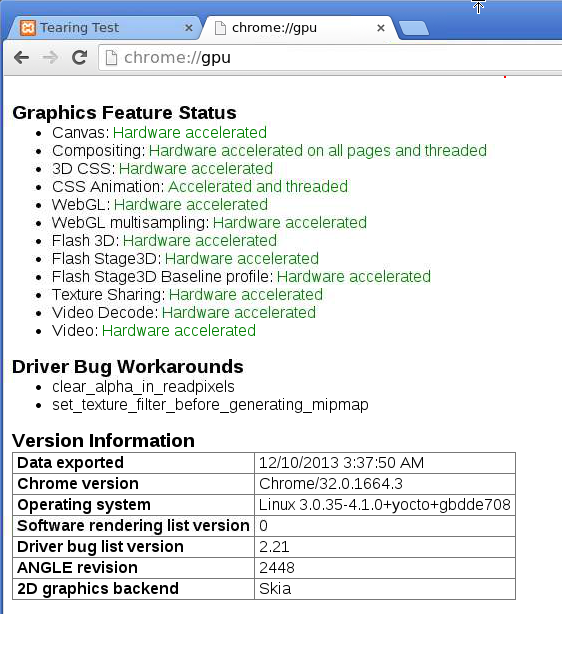
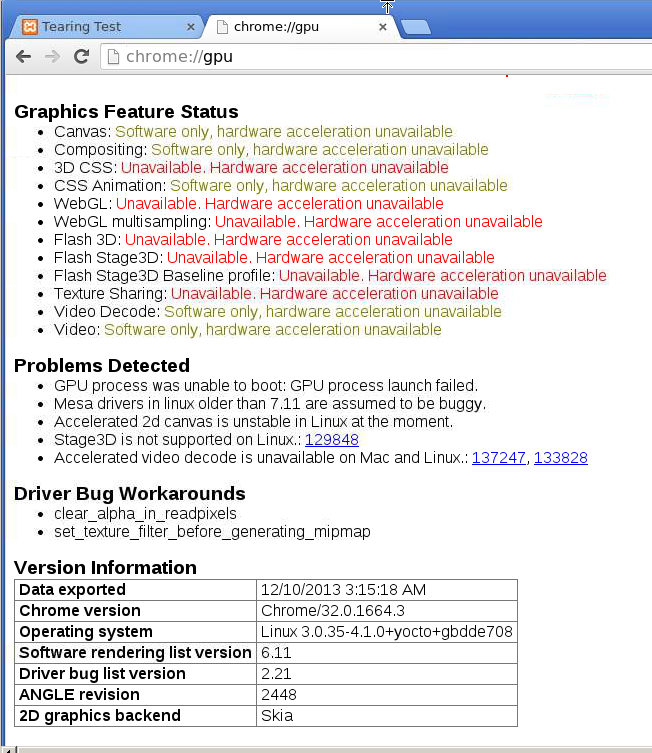
Attached 2 screenshots showing the GPU flags used by Chromium. The first with GPU enabled, the second with GPU disabled. As already mentioned, no changes regarding the tearing artifacts between these two options.
.
Kind regards,
Gabriel.
- Mark as New
- Bookmark
- Subscribe
- Mute
- Subscribe to RSS Feed
- Permalink
- Report Inappropriate Content
Hi Gabriel,
I am Pratik. I am using Imx6q based sabrelite board. I am building chromium browser for sabrelite board. I have build fsl-image-gui image from yocto(dylan). Then run chromium browser on top of that. If I go chrome://gpu on URL bar, I didn't get graphics feature for Flash Stage3D,Flash Stage 3D Baseline Profile, Panel Fitting.
I have attached Gpu.html file which I saved by writing chrome://gpu on URL bar . will you please help me in this issue.
& are WebGL based apps on chrome experiment website are working on your browser?
BTW I also got same tearing issue when I test it on my board.
Thanks & Regards,
Pratik
,
andre_silva
- Mark as New
- Bookmark
- Subscribe
- Mute
- Subscribe to RSS Feed
- Permalink
- Report Inappropriate Content
Hi Gabriel,
Unfortunately if the issue is not GPU releated I am afraid we are not able to help in this case, Since it works in Android as you said, maybe it is a problem with the Chrome port for Arm Linux.
Maybe you can get more information here: LinuxChromiumArm - chromium - Building Chromium for ARM - An open-source project to help move the we...
or trying to contact google for more information.
regards,
Andre
 karina_valencia
- Mark as New
- Bookmark
- Subscribe
- Mute
- Subscribe to RSS Feed
- Permalink
- Report Inappropriate Content
AndreSilva can you help on this case?
