
- Forums
- Product Forums
- General Purpose MicrocontrollersGeneral Purpose Microcontrollers
- i.MX Forumsi.MX Forums
- QorIQ Processing PlatformsQorIQ Processing Platforms
- Identification and SecurityIdentification and Security
- Power ManagementPower Management
- Wireless ConnectivityWireless Connectivity
- RFID / NFCRFID / NFC
- Advanced AnalogAdvanced Analog
- Neural Processing UnitsNeural Processing Units
- MCX Microcontrollers
- S32G
- S32K
- S32V
- MPC5xxx
- Other NXP Products
- S12 / MagniV Microcontrollers
- Powertrain and Electrification Analog Drivers
- Sensors
- Vybrid Processors
- Digital Signal Controllers
- 8-bit Microcontrollers
- ColdFire/68K Microcontrollers and Processors
- PowerQUICC Processors
- OSBDM and TBDML
- S32M
- S32Z/E
-
- Solution Forums
- Software Forums
- MCUXpresso Software and ToolsMCUXpresso Software and Tools
- CodeWarriorCodeWarrior
- MQX Software SolutionsMQX Software Solutions
- Model-Based Design Toolbox (MBDT)Model-Based Design Toolbox (MBDT)
- FreeMASTER
- eIQ Machine Learning Software
- Embedded Software and Tools Clinic
- S32 SDK
- S32 Design Studio
- GUI Guider
- Zephyr Project
- Voice Technology
- Application Software Packs
- Secure Provisioning SDK (SPSDK)
- Processor Expert Software
- Generative AI & LLMs
-
- Topics
- Mobile Robotics - Drones and RoversMobile Robotics - Drones and Rovers
- NXP Training ContentNXP Training Content
- University ProgramsUniversity Programs
- Rapid IoT
- NXP Designs
- SafeAssure-Community
- OSS Security & Maintenance
- Using Our Community
-
- Cloud Lab Forums
-
- Knowledge Bases
- ARM Microcontrollers
- i.MX Processors
- Identification and Security
- Model-Based Design Toolbox (MBDT)
- QorIQ Processing Platforms
- S32 Automotive Processing Platform
- Wireless Connectivity
- CodeWarrior
- MCUXpresso Suite of Software and Tools
- MQX Software Solutions
- RFID / NFC
- Advanced Analog
- Neural Processing Units
-
- NXP Tech Blogs
- Home
- :
- ワイヤレス接続
- :
- Wireless MCU
- :
- K32W CTUG
K32W CTUG
- RSS フィードを購読する
- トピックを新着としてマーク
- トピックを既読としてマーク
- このトピックを現在のユーザーにフロートします
- ブックマーク
- 購読
- ミュート
- 印刷用ページ
K32W CTUG

- 新着としてマーク
- ブックマーク
- 購読
- ミュート
- RSS フィードを購読する
- ハイライト
- 印刷
- 不適切なコンテンツを報告
Refer to K32WQN9090CTUG.pdf
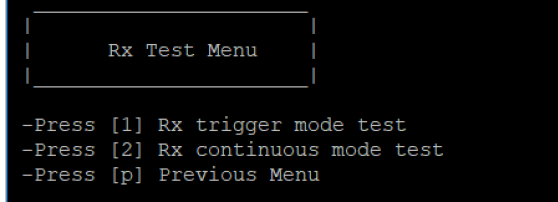
In RX test mode
[ 1 ] RX trigger mode test
What signal generator is used?
No DIO17 pins on the circuit?
When do I need to do this test?

[ 2 ] RX continuous mode test
When do I need to do this test?
 Xiang_Li
- 新着としてマーク
- ブックマーク
- 購読
- ミュート
- RSS フィードを購読する
- ハイライト
- 印刷
- 不適切なコンテンツを報告
>> [ 1 ] RX trigger mode test
>> When do I need to do this test?
>> [ 2 ] RX continuous mode test
>> When do I need to do this test?
Short answer:
If PER measurement required, use trigger mode. Else use continuous mode.
Trigger mode needs a trigger signal from the tester. Continuous mode doesn't.
Long answer:
For Rx continuous mode test, the DUT (device-under-test, aka, your design) just keeps receiving all packets, sent from a reference tester. At the end, software counts how many good packets are received (CRC check ok).
If any packet lost in the air, because of the RF interference or other reasons, in the Rx continuous test we will not know. Because we don't know how many packet in total should be received.
So we need the Rx trigger mode test. When the reference tester sends a packet, it also gives a pulse on a wire. This wire would be connected to the Rx side. By counting how many pulses on the wire, the Rx would know how many packet in total. And then it can calculated how many actual packet it received, as well as the PER (packet error rate).
>> What signal generator is used?
Check the RF tester being used. It probably has a trigger signal output, that will connect to your IUT device.
>> No DIO17 pins on the circuit?
I am not sure on this. I suggest you to check the SW implementation of the Certi tool on K32W and QN9090/30
- 新着としてマーク
- ブックマーク
- 購読
- ミュート
- RSS フィードを購読する
- ハイライト
- 印刷
- 不適切なコンテンツを報告
I have two questions, I will open another topic to ask.
 stephanie_m
- 新着としてマーク
- ブックマーク
- 購読
- ミュート
- RSS フィードを購読する
- ハイライト
- 印刷
- 不適切なコンテンツを報告
Hello,
Please check the posts and the internal answers as well.
Regards,
Estephania
- 新着としてマーク
- ブックマーク
- 購読
- ミュート
- RSS フィードを購読する
- ハイライト
- 印刷
- 不適切なコンテンツを報告
I found two bug.
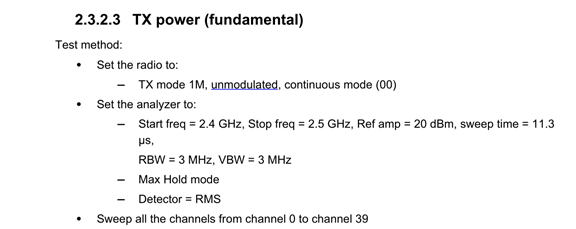
一。Ch2.3.2.3 of AN12798 requires unmodulate signal, but K32W_Certi_Tools does not have this option.
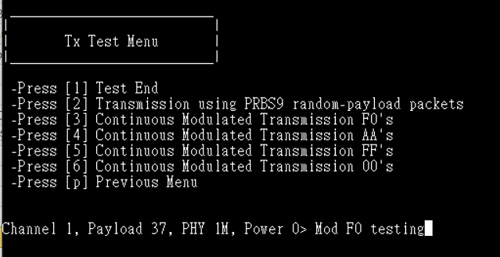
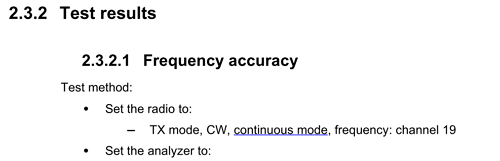
二。Frequency measurement also requires unmodulated continuous signal to be correct
stephanie_m
- 新着としてマーク
- ブックマーク
- 購読
- ミュート
- RSS フィードを購読する
- ハイライト
- 印刷
- 不適切なコンテンツを報告
Hello.
Could you please check the CW mode? it seems that you are referring to the modulated options.
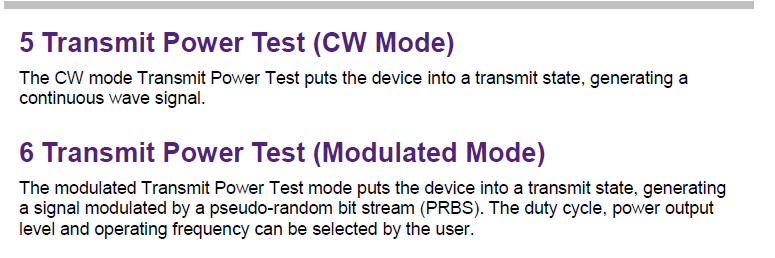
Please refer to the JN-AN-1242-Customer-Module-Eval-Tool
Regards,
Estephania
stephanie_m
- 新着としてマーク
- ブックマーク
- 購読
- ミュート
- RSS フィードを購読する
- ハイライト
- 印刷
- 不適切なコンテンツを報告
Hello,
I believe that to help you clarify the usage of the tool and the connections you are asking for, could you please help me check this application note?
Regards,
Estephania
