
- Forums
- Product Forums
- General Purpose MicrocontrollersGeneral Purpose Microcontrollers
- i.MX Forumsi.MX Forums
- QorIQ Processing PlatformsQorIQ Processing Platforms
- Identification and SecurityIdentification and Security
- Power ManagementPower Management
- Wireless ConnectivityWireless Connectivity
- RFID / NFCRFID / NFC
- Advanced AnalogAdvanced Analog
- Neural Processing UnitsNeural Processing Units
- MCX Microcontrollers
- S32G
- S32K
- S32V
- MPC5xxx
- Other NXP Products
- S12 / MagniV Microcontrollers
- Powertrain and Electrification Analog Drivers
- Sensors
- Vybrid Processors
- Digital Signal Controllers
- 8-bit Microcontrollers
- ColdFire/68K Microcontrollers and Processors
- PowerQUICC Processors
- OSBDM and TBDML
- S32M
- S32Z/E
-
- Solution Forums
- Software Forums
- MCUXpresso Software and ToolsMCUXpresso Software and Tools
- CodeWarriorCodeWarrior
- MQX Software SolutionsMQX Software Solutions
- Model-Based Design Toolbox (MBDT)Model-Based Design Toolbox (MBDT)
- FreeMASTER
- eIQ Machine Learning Software
- Embedded Software and Tools Clinic
- S32 SDK
- S32 Design Studio
- GUI Guider
- Zephyr Project
- Voice Technology
- Application Software Packs
- Secure Provisioning SDK (SPSDK)
- Processor Expert Software
- Generative AI & LLMs
-
- Topics
- Mobile Robotics - Drones and RoversMobile Robotics - Drones and Rovers
- NXP Training ContentNXP Training Content
- University ProgramsUniversity Programs
- Rapid IoT
- NXP Designs
- SafeAssure-Community
- OSS Security & Maintenance
- Using Our Community
-
- Cloud Lab Forums
-
- Knowledge Bases
- ARM Microcontrollers
- i.MX Processors
- Identification and Security
- Model-Based Design Toolbox (MBDT)
- QorIQ Processing Platforms
- S32 Automotive Processing Platform
- Wireless Connectivity
- CodeWarrior
- MCUXpresso Suite of Software and Tools
- MQX Software Solutions
- RFID / NFC
- Advanced Analog
- Neural Processing Units
-
- NXP Tech Blogs
- Home
- :
- Product Forums
- :
- S32K
- :
- S32k3 binary flash
S32k3 binary flash
- Subscribe to RSS Feed
- Mark Topic as New
- Mark Topic as Read
- Float this Topic for Current User
- Bookmark
- Subscribe
- Mute
- Printer Friendly Page
S32k3 binary flash

- Mark as New
- Bookmark
- Subscribe
- Mute
- Subscribe to RSS Feed
- Permalink
- Report Inappropriate Content
Hi,
I am using the eval board S32K312EVB-Q172 with PE micro universal debugger and i want to flash the HSE fw binary to the controller but i dont see any option in s32ds which support this feature.
I also tried the debug configuration changes and replaced the .elf file by .bin file but its not working.
Can you please provide any help to flash the binary file to the controller with the debugger.

 lukaszadrapa
- Mark as New
- Bookmark
- Subscribe
- Mute
- Subscribe to RSS Feed
- Permalink
- Report Inappropriate Content
Pemicro does not support raw binary files. It supports elf/hex/srec:
As a workaround, you can use the same way as in example S32K344_HSE_FW_INSTALL mentioned in previous thread. The bin file is included to the project via linker file. Or use some different programmer/debugger which support this feature.
Regards,
Lukas
- Mark as New
- Bookmark
- Subscribe
- Mute
- Subscribe to RSS Feed
- Permalink
- Report Inappropriate Content
Hi Lucas,
I am trying to import a simple binary of toggle led in one of the project , there no use of hse, i just need to flash this binary with some simple code, can you please help.
please fins the image of the linker file of the project which is importing the binary.
I need support for the code to be written in the project main function so that program can jump to the application binary address to execute it and we can see the toggle led on the board.
Kindly help

lukaszadrapa
- Mark as New
- Bookmark
- Subscribe
- Mute
- Subscribe to RSS Feed
- Permalink
- Report Inappropriate Content
Let me re-use text about jumping from bootloader to application I wrote earlier - see below. In addition, be aware that it's necessary to de-initialize all the features used by bootloader, especially it is necessary to disable interrupts on all levels - in the core, by local enable bits in peripherals, clear pending interrupts...
*********
In case of ARM devices, stack pointer is initialized automatically after reset using “Initial SP value” in the vector table:
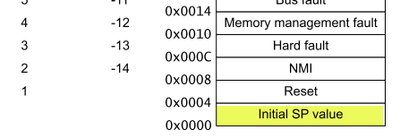
So, bootloader’s code should initialize the stack pointer as a first step and then it can jump to the application.
Here is an example from application note AN12218 S32K1xx Bootloader:
/* Start address for the application received by the bootloader
* application vector table should start at this address
* */
#define APP_START_ADDRESS 0x1000
/**
* Used to jump to the entry point of the user application
* The Vector table of the user application must be located at 0x1000
*
* */
void JumpToUserApplication( unsigned int userSP, unsigned int userStartup)
{
/* Check if Entry address is erased and return if erased */
if(userSP == 0xFFFFFFFF){
return;
}
/* Set up stack pointer */
__asm("msr msp, r0");
__asm("msr psp, r0");
/* Relocate vector table */
S32_SCB->VTOR = (uint32_t)APP_START_ADDRESS;
/* Jump to application PC (r1) */
__asm("mov pc, r1");
}
And here is an example from application note AN12323 S32K1xx Firmware updates:
void JumpToApplication(uint32_t start_address)
{
void (*entry)(void);
uint32_t pc;
uint32_t __attribute__((unused)) sp;
S32_SCB->VTOR=(uint32_t)(start_address); /*Relocate interrupt table ptr*/
sp = *((volatile uint32_t*)start_address);
asm(" ldr sp, [r0,#0]");
pc = *((volatile uint32_t *)(start_address + 4));
entry = (void (*)(void))pc;
entry();
}
