
- Forums
- Product Forums
- General Purpose MicrocontrollersGeneral Purpose Microcontrollers
- i.MX Forumsi.MX Forums
- QorIQ Processing PlatformsQorIQ Processing Platforms
- Identification and SecurityIdentification and Security
- Power ManagementPower Management
- Wireless ConnectivityWireless Connectivity
- RFID / NFCRFID / NFC
- Advanced AnalogAdvanced Analog
- Neural Processing UnitsNeural Processing Units
- MCX Microcontrollers
- S32G
- S32K
- S32V
- MPC5xxx
- Other NXP Products
- S12 / MagniV Microcontrollers
- Powertrain and Electrification Analog Drivers
- Sensors
- Vybrid Processors
- Digital Signal Controllers
- 8-bit Microcontrollers
- ColdFire/68K Microcontrollers and Processors
- PowerQUICC Processors
- OSBDM and TBDML
- S32M
- S32Z/E
-
- Solution Forums
- Software Forums
- MCUXpresso Software and ToolsMCUXpresso Software and Tools
- CodeWarriorCodeWarrior
- MQX Software SolutionsMQX Software Solutions
- Model-Based Design Toolbox (MBDT)Model-Based Design Toolbox (MBDT)
- FreeMASTER
- eIQ Machine Learning Software
- Embedded Software and Tools Clinic
- S32 SDK
- S32 Design Studio
- GUI Guider
- Zephyr Project
- Voice Technology
- Application Software Packs
- Secure Provisioning SDK (SPSDK)
- Processor Expert Software
- Generative AI & LLMs
-
- Topics
- Mobile Robotics - Drones and RoversMobile Robotics - Drones and Rovers
- NXP Training ContentNXP Training Content
- University ProgramsUniversity Programs
- Rapid IoT
- NXP Designs
- SafeAssure-Community
- OSS Security & Maintenance
- Using Our Community
-
- Cloud Lab Forums
-
- Knowledge Bases
- ARM Microcontrollers
- i.MX Processors
- Identification and Security
- Model-Based Design Toolbox (MBDT)
- QorIQ Processing Platforms
- S32 Automotive Processing Platform
- Wireless Connectivity
- CodeWarrior
- MCUXpresso Suite of Software and Tools
- MQX Software Solutions
- RFID / NFC
- Advanced Analog
- Neural Processing Units
-
- NXP Tech Blogs
- Home
- :
- 产品论坛
- :
- S12 / MagniV微控制器
- :
- Help with assembly language debugging HCS12
Help with assembly language debugging HCS12
Help with assembly language debugging HCS12

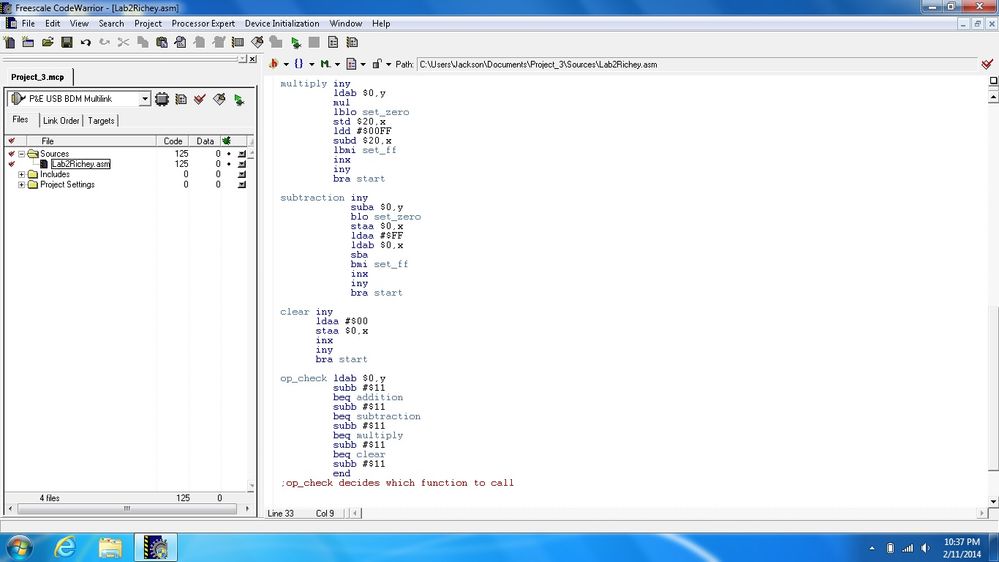
Was hoping someone could help me....I'm having trouble getting my multiplication loop working. I have to perform a check to see if the number is out of range (0-255) and if it is branch to either set_zero or set_ff. I'm storing the input variables in a reg x I have in memory. the two numbers are both positive, but blo flag keeps kicking in. the numbers are loading out of memory right. I think it has something to do with the fact that the result of the operation is a 16bit number, stored in the d reg. I tried adding an l in front of the blo, for long word, but that didn't help. all the other functions work as expected. If anyone has any idea, I'd really appreciate it.


Hi,
what about:
;_______________________________________________________________________________
; variable/data section
;_______________________________________________________________________________
MY_EXTENDED_RAM: SECTION
xa ds.b 1 ; input variable
xb ds.b 1 ; input variable
xc ds.b 1 ; result
ov_f ds.b 1 ; overflow flag for multiplication; result is > 255
z_f ds.b 1 ; zero flag for multiplication
;_______________________________________________________________________________
MyCode: SECTION ; code section
;_______________________________________________________________________________
main: ; routine is called after power on reset
Entry:
;_______________________________________________________________________________
LDS #$F00 ; set STACK; reset status: RAM is placed 800~FFF
;-------------------
MOVB #0,xa ; innitialize variables to be multiplied
MOVB #0,xb ;
MAINLOOP:
LDAA xa ; prepare parameteres for sending to function
LDAB xb
XGDX ; X<=>D; as you wrote you store a,b in X
JSR multiply
INC xa ; modify inputs
INC xb
JMP MAINLOOP ;
;_______________________________________________________________________________
multiply:
CLR z_f ; clear flags
CLR ov_f
XGDX ; X<=>D
MUL ; multiply
STD xc ; store result
; test result for given conditions and set flags
TBEQ D,zero ; result is zero -> go to "zero" for processing
TBNE A,overflow ; result>255 -> go to "overflow" for processing
RTS ; return
zero:
MOVB #1,z_f ; set ctm's zero flag
RTS
overflow:
MOVB #1,ov_f ; set ctm's overflow flag
RTS
;_______________________________________________________________________________
Best regards,
Ladislav
and the operation is not triggering the c flag, the number is well withing range of 64k.

(What the beep you are using picture to show text? )
1. there's no BLO flag, please use correct terminology
2. You should download CPU12 reference manual. 6.7 Glossary explains each instruction in detail. MUL instruction changes only C flag. MUL makes bit 7 of result reg D(B) copied to C flag.
uh yeah, I have the reference manual. and to be precise, when I multiply the positive number in accumulator a with the positive number in accumulator b, the positive result is stored in register d. I cannot figure out why the positive number in register d is branching lower. branch lower checks the n flag in the ccr. if you couldn't tell, I'm new to assembly language programming.
