
- Forums
- Product Forums
- General Purpose MicrocontrollersGeneral Purpose Microcontrollers
- i.MX Forumsi.MX Forums
- QorIQ Processing PlatformsQorIQ Processing Platforms
- Identification and SecurityIdentification and Security
- Power ManagementPower Management
- Wireless ConnectivityWireless Connectivity
- RFID / NFCRFID / NFC
- Advanced AnalogAdvanced Analog
- Neural Processing UnitsNeural Processing Units
- MCX Microcontrollers
- S32G
- S32K
- S32V
- MPC5xxx
- Other NXP Products
- S12 / MagniV Microcontrollers
- Powertrain and Electrification Analog Drivers
- Sensors
- Vybrid Processors
- Digital Signal Controllers
- 8-bit Microcontrollers
- ColdFire/68K Microcontrollers and Processors
- PowerQUICC Processors
- OSBDM and TBDML
- S32M
- S32Z/E
-
- Solution Forums
- Software Forums
- MCUXpresso Software and ToolsMCUXpresso Software and Tools
- CodeWarriorCodeWarrior
- MQX Software SolutionsMQX Software Solutions
- Model-Based Design Toolbox (MBDT)Model-Based Design Toolbox (MBDT)
- FreeMASTER
- eIQ Machine Learning Software
- Embedded Software and Tools Clinic
- S32 SDK
- S32 Design Studio
- GUI Guider
- Zephyr Project
- Voice Technology
- Application Software Packs
- Secure Provisioning SDK (SPSDK)
- Processor Expert Software
- Generative AI & LLMs
-
- Topics
- Mobile Robotics - Drones and RoversMobile Robotics - Drones and Rovers
- NXP Training ContentNXP Training Content
- University ProgramsUniversity Programs
- Rapid IoT
- NXP Designs
- SafeAssure-Community
- OSS Security & Maintenance
- Using Our Community
-
- Cloud Lab Forums
-
- Knowledge Bases
- ARM Microcontrollers
- i.MX Processors
- Identification and Security
- Model-Based Design Toolbox (MBDT)
- QorIQ Processing Platforms
- S32 Automotive Processing Platform
- Wireless Connectivity
- CodeWarrior
- MCUXpresso Suite of Software and Tools
- MQX Software Solutions
- RFID / NFC
- Advanced Analog
- Neural Processing Units
-
- NXP Tech Blogs
- Home
- :
- 汎用マイクロコントローラ
- :
- Kinetisマイクロコントローラ
- :
- Re: Use KW36 as SPI slave
Use KW36 as SPI slave
- RSS フィードを購読する
- トピックを新着としてマーク
- トピックを既読としてマーク
- このトピックを現在のユーザーにフロートします
- ブックマーク
- 購読
- ミュート
- 印刷用ページ
Use KW36 as SPI slave

- 新着としてマーク
- ブックマーク
- 購読
- ミュート
- RSS フィードを購読する
- ハイライト
- 印刷
- 不適切なコンテンツを報告
Hello,
I have two questions related to FRDM-KW36 board
1. I see from user manual that Header is Arduino compatible, but when I see the schematic I got confused because SIN,SOUT,SCLK are from SPI group 0 and only chip select (PSC0) is from SPI group 1. How this combination can be used? In my opinion, if this is compatible to Arduino then at J2 Pin3, it should be the chip select (CS) from the same SPI group.
Below is the image for quick reference
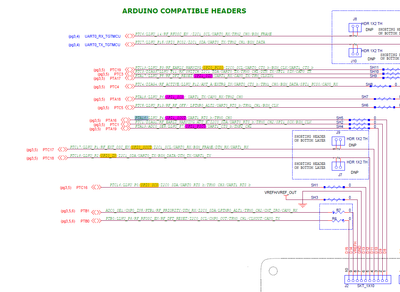
2. Does KW36 need pull up resistor for SPI lines? I see that SPI interface to on board flash has no external pull resistors except for CLK and CS.
Thanks in advance.

- 新着としてマーク
- ブックマーク
- 購読
- ミュート
- RSS フィードを購読する
- ハイライト
- 印刷
- 不適切なコンテンツを報告
Hey @123gmax
I just took a look at the FRDM-KW36-RevB1 Schematic and I can see:
- SPI0_SCK on D13
- SPI0_SIN on D12 (it took a bit of work to find it as it's labeled "SPI0_IN" on the "Arduino" connectors)
- SPI0_SOUT on D11
- SPI0_PCS0 on D2 (although I'm not sure it can be used because the pin is also wired as "RF_EARLY_WARNING"
- SPI0_PCS2 on D1
- SPI1_SCK on D9
- SPI1_SOUT on D8
- SPI1_SIN on D3
- SPI1_PCS0 on D5
And the SPI port pins match the Arudino Uno SPI Reference pinout which are:
- SPI_SCK on D13
- SPI_SOUT on D12 (in Slave Mode)
- SPI_SIN on D11 (in Slave Mode)
- SPI_PCS on D10
The Freedom boards pay lip service to being Arduino pin compatible and not much more. In the case of SPI, maybe it's a good thing that the Freedom board designers don't try to be too pin compatible as they can lead to more difficult problems down the road if people assume that the Freedom boards are pin/signal equivalent to Arduino.
I use the Arduino Uno prototyping shields all the time with Freedom boards. Despite having to understand the pinouts really well when you wire up your prototypes, this approach works quite well (a lot better/easier than using Tower boards).
But, there is an issue and that's if you want to use an pre-defined Arduino shield with a Freedom board - the short answer is that you can't. Maybe there are some that will work with the various Freedom board pinouts (just using DI/DO and Analog pins) and maybe it's worth using them with the aformentioned bit-banging but I think it's best to recognize that you're going to be doing some custom wiring on a prototype shield.
As for your second question, PCS should NOT have a pull up. It's not an Open-Drain bus. It should always be driven high by the master when data is not being sent.
Good luck,
myke
- 新着としてマーク
- ブックマーク
- 購読
- ミュート
- RSS フィードを購読する
- ハイライト
- 印刷
- 不適切なコンテンツを報告
Hello @myke_predko ,
Thank you for your detailed explanation, it really helped. Looks like I have to tinker a bit to make board work for my application.
Best regards,
123gmax
