
- Forums
- Product Forums
- General Purpose MicrocontrollersGeneral Purpose Microcontrollers
- i.MX Forumsi.MX Forums
- QorIQ Processing PlatformsQorIQ Processing Platforms
- Identification and SecurityIdentification and Security
- Power ManagementPower Management
- Wireless ConnectivityWireless Connectivity
- RFID / NFCRFID / NFC
- Advanced AnalogAdvanced Analog
- Neural Processing UnitsNeural Processing Units
- MCX Microcontrollers
- S32G
- S32K
- S32V
- MPC5xxx
- Other NXP Products
- S12 / MagniV Microcontrollers
- Powertrain and Electrification Analog Drivers
- Sensors
- Vybrid Processors
- Digital Signal Controllers
- 8-bit Microcontrollers
- ColdFire/68K Microcontrollers and Processors
- PowerQUICC Processors
- OSBDM and TBDML
- S32M
- S32Z/E
-
- Solution Forums
- Software Forums
- MCUXpresso Software and ToolsMCUXpresso Software and Tools
- CodeWarriorCodeWarrior
- MQX Software SolutionsMQX Software Solutions
- Model-Based Design Toolbox (MBDT)Model-Based Design Toolbox (MBDT)
- FreeMASTER
- eIQ Machine Learning Software
- Embedded Software and Tools Clinic
- S32 SDK
- S32 Design Studio
- GUI Guider
- Zephyr Project
- Voice Technology
- Application Software Packs
- Secure Provisioning SDK (SPSDK)
- Processor Expert Software
- Generative AI & LLMs
-
- Topics
- Mobile Robotics - Drones and RoversMobile Robotics - Drones and Rovers
- NXP Training ContentNXP Training Content
- University ProgramsUniversity Programs
- Rapid IoT
- NXP Designs
- SafeAssure-Community
- OSS Security & Maintenance
- Using Our Community
-
- Cloud Lab Forums
-
- Knowledge Bases
- ARM Microcontrollers
- i.MX Processors
- Identification and Security
- Model-Based Design Toolbox (MBDT)
- QorIQ Processing Platforms
- S32 Automotive Processing Platform
- Wireless Connectivity
- CodeWarrior
- MCUXpresso Suite of Software and Tools
- MQX Software Solutions
- RFID / NFC
- Advanced Analog
- Neural Processing Units
-
- NXP Tech Blogs
- Home
- :
- 汎用マイクロコントローラ
- :
- Kinetisマイクロコントローラ
- :
- USB Composite on Kinetis-L
USB Composite on Kinetis-L
- RSS フィードを購読する
- トピックを新着としてマーク
- トピックを既読としてマーク
- このトピックを現在のユーザーにフロートします
- ブックマーク
- 購読
- ミュート
- 印刷用ページ
USB Composite on Kinetis-L

- 新着としてマーク
- ブックマーク
- 購読
- ミュート
- RSS フィードを購読する
- ハイライト
- 印刷
- 不適切なコンテンツを報告
I have 2 questions rearding the Kinetis-L (Specifically the KL25).
1) I have seen multiple examples of the a USB composite devices on the Kinetis-K series, but have not seen any examples of a composite device on the Kinetis-L series. Specifically, in the USB Stack v5.0 There is a bullet stating that there is a HW endpoint number limitation which causes the msd_cdc example to not work with the HS USB controller. Also, Table 6.1 regarding Composite Mode Demo’s not being available for the FRDM-KL25 seems to indicate there is no support:
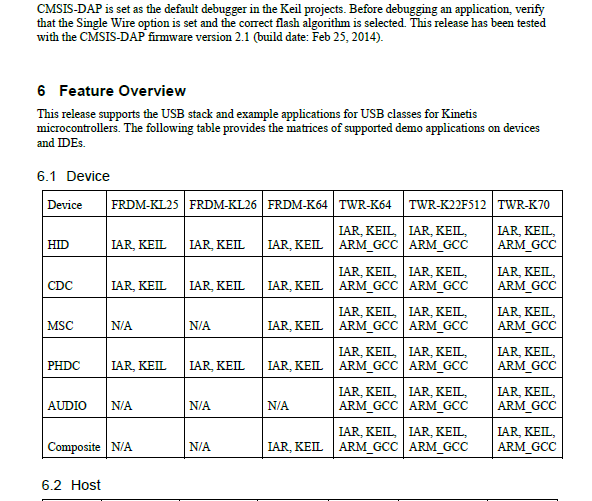
Are there any examples of a USB Composite Device for any of the Kinetis L Series? Is there some hardware limitiation that prevents composite operation on a KL?
Specifically we are looking to support. Specifically we need supoport HID (Mouse) and CDC classes.
- 新着としてマーク
- ブックマーク
- 購読
- ミュート
- RSS フィードを購読する
- ハイライト
- 印刷
- 不適切なコンテンツを報告
Just to report back, we were able to get the composite examples running in the KSDK 1.1 with KDS and the new documentation that accompanied it will make it much easier to produce the composite device we need (CDC/HID).
Another question - Is anyone aware of an example or any type of support for CCID class on Kinetis? Are there any plans to add to KSDK?
Regards,
-Dan

- 新着としてマーク
- ブックマーク
- 購読
- ミュート
- RSS フィードを購読する
- ハイライト
- 印刷
- 不適切なコンテンツを報告
Dan
The KL25 has 16 endpoints like the other devices. I use a 3 x USB-CDC<->UART composite device on the KL25 and the only possible restriction is that there is less RAM than the other devices in the table and so the UART buffers may be restriced in size.
In fact the USB code is identical on the KL25 to any other KL or K device apart from about 4 lines configuring its clock, so you should essentially be able to use code from any of the other devices.
The missing configurations in the v5.0 USB stack are presumably because they haven't been tested or the USB stack/demo uses too much RAM for the smaller devices.
Regards
Mark
- 新着としてマーク
- ブックマーク
- 購読
- ミュート
- RSS フィードを購読する
- ハイライト
- 印刷
- 不適切なコンテンツを報告
Dan
I have attached an HID-mouse/CDC composite binary for the FRDM-KL25Z. There is also a *.inf there for the CDC driver installation (the HID mouse part will immediatly start working since it doesn't need a specified driver).
The mouse is controlled by the accelerometer (tilt) and can be a bit of a nuisance when installing the driver (since it tends to run away) so it can be disabled by connecting the input PTA12 (J1-8 on the FRDM-KL25Z) to GND.
Once the CDC driver is installed a connection to it connects to a command line menu with various menus in it (hit the enter key in a terminal emulator to see the menu); in the USB sub-menu there is a command to move to USB<->UART bridging mode.
In the overview/statistics sub-menu the heap and stack usage shows that there is still about 10k RAM untouched so plenty of room for somewhat more.
Regards
Mark
P.S. I used the uTasker USB stack to configure this and could simulate the operation which saves needing to do any debug work on the real HW. Mixing HID and CDC proved to be quite simple (once the composite descriptors were entered correctly). The result works on all KL and K devices with USB since there is no HW dependency in the code above the HAL (hardware abstractation layer). I built the attached binary using a standalone GCC make file (simply load by mbed bootloader) but it also builds with IAR, Keil, Atollic, CW, KDS, Crossworks, CooCox (and the uTasker VisualStudio based Kinetis simulator).
