
- Forums
- Product Forums
- General Purpose MicrocontrollersGeneral Purpose Microcontrollers
- i.MX Forumsi.MX Forums
- QorIQ Processing PlatformsQorIQ Processing Platforms
- Identification and SecurityIdentification and Security
- Power ManagementPower Management
- Wireless ConnectivityWireless Connectivity
- RFID / NFCRFID / NFC
- Advanced AnalogAdvanced Analog
- Neural Processing UnitsNeural Processing Units
- MCX Microcontrollers
- S32G
- S32K
- S32V
- MPC5xxx
- Other NXP Products
- S12 / MagniV Microcontrollers
- Powertrain and Electrification Analog Drivers
- Sensors
- Vybrid Processors
- Digital Signal Controllers
- 8-bit Microcontrollers
- ColdFire/68K Microcontrollers and Processors
- PowerQUICC Processors
- OSBDM and TBDML
- S32M
- S32Z/E
-
- Solution Forums
- Software Forums
- MCUXpresso Software and ToolsMCUXpresso Software and Tools
- CodeWarriorCodeWarrior
- MQX Software SolutionsMQX Software Solutions
- Model-Based Design Toolbox (MBDT)Model-Based Design Toolbox (MBDT)
- FreeMASTER
- eIQ Machine Learning Software
- Embedded Software and Tools Clinic
- S32 SDK
- S32 Design Studio
- GUI Guider
- Zephyr Project
- Voice Technology
- Application Software Packs
- Secure Provisioning SDK (SPSDK)
- Processor Expert Software
- Generative AI & LLMs
-
- Topics
- Mobile Robotics - Drones and RoversMobile Robotics - Drones and Rovers
- NXP Training ContentNXP Training Content
- University ProgramsUniversity Programs
- Rapid IoT
- NXP Designs
- SafeAssure-Community
- OSS Security & Maintenance
- Using Our Community
-
- Cloud Lab Forums
-
- Knowledge Bases
- ARM Microcontrollers
- i.MX Processors
- Identification and Security
- Model-Based Design Toolbox (MBDT)
- QorIQ Processing Platforms
- S32 Automotive Processing Platform
- Wireless Connectivity
- CodeWarrior
- MCUXpresso Suite of Software and Tools
- MQX Software Solutions
- RFID / NFC
- Advanced Analog
- Neural Processing Units
-
- NXP Tech Blogs
- Home
- :
- Product Forums
- :
- S12 / MagniV Microcontrollers
- :
- Re: Moving Average for ADC
Moving Average for ADC
- Subscribe to RSS Feed
- Mark Topic as New
- Mark Topic as Read
- Float this Topic for Current User
- Bookmark
- Subscribe
- Mute
- Printer Friendly Page
Moving Average for ADC

- Mark as New
- Bookmark
- Subscribe
- Mute
- Subscribe to RSS Feed
- Permalink
- Report Inappropriate Content
Hello,
I am working on moving average code for ADC. I got 8 samples from ADC and as per my knowledge, while moving average: (1+2+.....8)/8 will be first average, (2+3+....9)/8 will be second ...
Is this a correct way of implementation?
If anyone has a sample code, then please provide.
Thank you in advance.
Regards,
Madhura

 lama
lama
- Mark as New
- Bookmark
- Subscribe
- Mute
- Subscribe to RSS Feed
- Permalink
- Report Inappropriate Content
Hi,
really fast idea to make moving average filter, probably, I hope, I am not wrong....not tested....
unsigned int new_conversion_processing(unsigned int new_data)
{
static unsigned int data[8] = { 0,0,0,0,0,0,0,0 }; // data set
static unsigned char p_oldiest_data = 0; // "pointer" to data to be changed
static unsigned int sum; // sum of the data set
sum = sum-data[p_oldiest_data] + new_data; // calculate a new sum by removing the oldest data from it
// and add the newest one
data[p_oldiest_data] = new_data; // replace the oldest value by the the newest one in the buffer
p_oldiest_data = (p_oldiest_data==7) ? 0 :(p_oldiest_data++);
return(sum>>3); // return average value (=sum/8)
}
Process flow description:
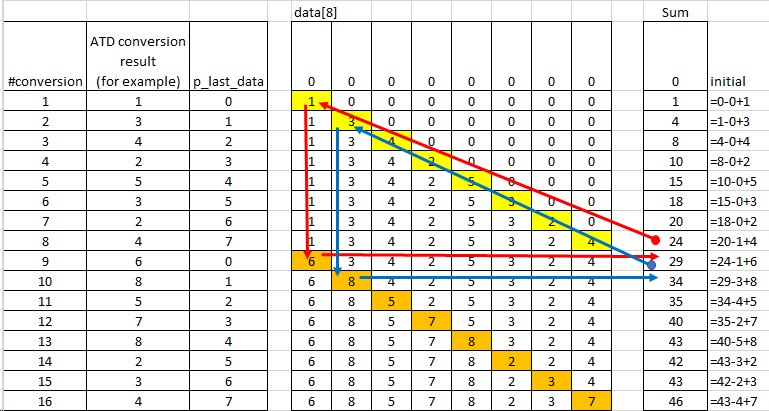
For such calculations, it is good to be XGATE used to store data in continuous background process and you then only share the result to CPU for next processing. Of course, this is a little bit different story.
Best regards,
Ladislav

- Mark as New
- Bookmark
- Subscribe
- Mute
- Subscribe to RSS Feed
- Permalink
- Report Inappropriate Content
Hi Madhura,
I know of two algorithms that might satisfy your requirements, although I do not know what you need to accomplish. Without knowing the processor you wish to use, I can't provide code. The implementations could vary widely - I've implemented the second algorithm one way in an 8-bit MCU, and in a very different way in a DSP.
The first algorithm is what you describe - It's called a Boxcar filter. It is a special case of a FIR filter (finite-impulse response filter), where the coefficients are all the same. It will produce a true average over the most recent N samples. It is computationally inexpensive: For memory, it just uses a table for the most recent N samples and the running average, and the math requires only an add and a subtract and maybe a shift.
The second is called an exponential filter, and is a type of IIR filter (infinite-impulse response filter). It is different than a true average in that the most recent value has the most weight in the final result, the second most recent has less weight, and on down. It's response is identical to an electrical RC filter. For memory, it only needs the new sample and the previous output. It can be implemented as two multiplies and an add, or it can be implemented as a subtract, a shift and an add.
If you describe the problem better, we may be able to help you better.
Mark
- Mark as New
- Bookmark
- Subscribe
- Mute
- Subscribe to RSS Feed
- Permalink
- Report Inappropriate Content
Hey,
Sorry for not providing all the necessary information.
I am using Mc9s12XEP100 microcontroller, and ADC is on chip, having 12 bit resolution. I want to implement it in a embedded C code. So, how these concepts can be applied?
Well thank you for your explaination.
Regards,
Madhura
- Mark as New
- Bookmark
- Subscribe
- Mute
- Subscribe to RSS Feed
- Permalink
- Report Inappropriate Content
Hi Madhura,
Since I don't know the purpose of your filter, I can't suggest which one would be better. If you are using it for a control application, the exponential filter would likely be better (faster step-response and smoother transitions). If you are using it for numerical analysis, the boxcar filter may be better. If you need the filter for decimation, both would work, but I would lean toward the boxcar.
All of my code is written in assembler, for the DSP563xx of for the HC08/S08. But since the exponential filter is so simple to implement in C, here is some code (not verified for syntax):
static float coefficient;        // 0 through 1 for how much filtering to do

/*
    This function implements an exponential filter
    on a sample, returning the filtered value.
*/
float filter( float sample )
{
    static float result;

    result = coefficient*sample + (1-coefficient)*result
    return result;
}

/*
    This function sets the strength of the filter, and
    has a valid range of zero to one. A one will not filter
    at all, returning the sample unmodified, and a zero
    will freeze    the result at its current value.
    If the new coefficient is outside of the valid range,
    then it will remain unmodified.
*/
void setCoefficient ( float newCoefficient )
{
    if ( newCoefficient >= 0  ) && ( newCoefficient <= 1  )
        coefficient = newCoefficient;
}
If you would like the filter to respond similarly to an average of eight samples, then you would want to set the coefficient to one-eighth (1/8, 0r 0.125). With the exponential filter, the filter coefficient can be changed on-the-fly.
If you need a true average, then that code would need a static array of the most recent samples, operated as a ring-buffer. You would also need the ring-buffer index to be static. Rather than adding all samples and the dividing by the number of samples, you should keep a static copy of the first result, and then simply subtract-out the oldest sample and add-in the newest sample with each new sample.
Hope that helps.
Mark
- Mark as New
- Bookmark
- Subscribe
- Mute
- Subscribe to RSS Feed
- Permalink
- Report Inappropriate Content
Hey Mark,
Yes, I am using it for numerical analysis. So, from the methods you have suggested will opt for Boxcar filter.
Well, Thank you so much for such a detailed answer.
Regards,
Madhura
 lisettelozano
- Mark as New
- Bookmark
- Subscribe
- Mute
- Subscribe to RSS Feed
- Permalink
- Report Inappropriate Content
Hello Madhura,
Could you please specify the product that you are using (NXP part number)?
Thank you,
Paulina
- Mark as New
- Bookmark
- Subscribe
- Mute
- Subscribe to RSS Feed
- Permalink
- Report Inappropriate Content
Hey,
Sorry for not providing all the necessary information.
I am using Mc9s12XEP100 microcontroller, and ADC is on chip, having 12 bit resolution.
Regards,
Madhura
