
- Forums
- Product Forums
- General Purpose MicrocontrollersGeneral Purpose Microcontrollers
- i.MX Forumsi.MX Forums
- QorIQ Processing PlatformsQorIQ Processing Platforms
- Identification and SecurityIdentification and Security
- Power ManagementPower Management
- Wireless ConnectivityWireless Connectivity
- RFID / NFCRFID / NFC
- Advanced AnalogAdvanced Analog
- Neural Processing UnitsNeural Processing Units
- MCX Microcontrollers
- S32G
- S32K
- S32V
- MPC5xxx
- Other NXP Products
- S12 / MagniV Microcontrollers
- Powertrain and Electrification Analog Drivers
- Sensors
- Vybrid Processors
- Digital Signal Controllers
- 8-bit Microcontrollers
- ColdFire/68K Microcontrollers and Processors
- PowerQUICC Processors
- OSBDM and TBDML
- S32M
- S32Z/E
-
- Solution Forums
- Software Forums
- MCUXpresso Software and ToolsMCUXpresso Software and Tools
- CodeWarriorCodeWarrior
- MQX Software SolutionsMQX Software Solutions
- Model-Based Design Toolbox (MBDT)Model-Based Design Toolbox (MBDT)
- FreeMASTER
- eIQ Machine Learning Software
- Embedded Software and Tools Clinic
- S32 SDK
- S32 Design Studio
- GUI Guider
- Zephyr Project
- Voice Technology
- Application Software Packs
- Secure Provisioning SDK (SPSDK)
- Processor Expert Software
- Generative AI & LLMs
-
- Topics
- Mobile Robotics - Drones and RoversMobile Robotics - Drones and Rovers
- NXP Training ContentNXP Training Content
- University ProgramsUniversity Programs
- Rapid IoT
- NXP Designs
- SafeAssure-Community
- OSS Security & Maintenance
- Using Our Community
-
- Cloud Lab Forums
-
- Knowledge Bases
- ARM Microcontrollers
- i.MX Processors
- Identification and Security
- Model-Based Design Toolbox (MBDT)
- QorIQ Processing Platforms
- S32 Automotive Processing Platform
- Wireless Connectivity
- CodeWarrior
- MCUXpresso Suite of Software and Tools
- MQX Software Solutions
- RFID / NFC
- Advanced Analog
- Neural Processing Units
-
- NXP Tech Blogs
- Home
- :
- Product Forums
- :
- Other NXP Products
- :
- MRF300 simulation model
MRF300 simulation model
- Subscribe to RSS Feed
- Mark Topic as New
- Mark Topic as Read
- Float this Topic for Current User
- Bookmark
- Subscribe
- Mute
- Printer Friendly Page

- Mark as New
- Bookmark
- Subscribe
- Mute
- Subscribe to RSS Feed
- Permalink
- Report Inappropriate Content
Hello,
I am currently a little puzzled with the ADS simulation model of the MRF300 device.
The datasheet specifies V_ds(on) to be 0.16 V at V_gs = 10 V and I_D = 1A
However, when I connect the model up to V_ds = 0.16 V and V_gs = 10 V, I only see I_D of around 0.75 A.
I tried this when expected power output did not match the datasheets values by around 3 dB.
Am I in error, or does the model not match the parameters as layed out in the datasheet? At the moment I am not confident I can trust the model.
Solved! Go to Solution.

 LPP
LPP
- Mark as New
- Bookmark
- Subscribe
- Mute
- Subscribe to RSS Feed
- Permalink
- Report Inappropriate Content
1.
You can find some information about FET models in these publications.
https://core.ac.uk/download/pdf/17180215.pdf
http://epubs.surrey.ac.uk/805122/1/PID1256805-1.pdf
http://epubs.surrey.ac.uk/803447/1/6565_final.pdf
2.
The datasheet DC parameters can differ from those obtained by simulations on several reasons.
- datasheet specs provide typical values. The model parameters may be based on different device instances. Generally, most critical simulated parameters fit the specified min-max range.
- the model has been optimized to fit measured data within some characterization limits. The priority is given to fit measured RF performance. The values beyond the characterization limits are extrapolated.
- Apparently, MRF300AN model parameters has been characterized at VGS<4V. The model mis-predicts drain current at higher VGS value. You can see it on simulated IDS vs VGS plot. The drain current increases from VGS 0V to 4.5V. It decreases at VGS>5V and it doesn't reach maximum at VGS=10V. This is unexpected behavior - the drain current must increase vs gate voltage (excepting thermal self-heating effects).
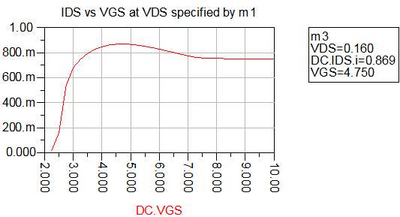
Note. This mis-prediction doesn't affect simulation of MRF300AN in it's normal operating mode as class AB amplifier. Typical peak current in this mode is about 12A that doesn't require VGS more than 4V.
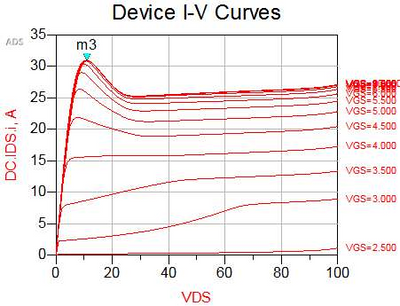
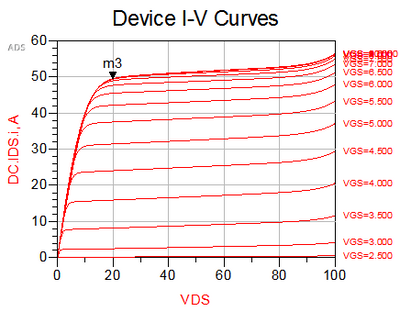
The last note. Self-heating effects are important when doing DC simulation. In practice, DC characterization can be performed in pulsed mode to remove the influence of self-heating. The same effect can be obtained in simulation if you set model parameter RTH=0. You can see the difference of IDS vs VDS curves from the previous chart.
Best Regards
Pavel
NXP TIC
- Mark as New
- Bookmark
- Subscribe
- Mute
- Subscribe to RSS Feed
- Permalink
- Report Inappropriate Content
Thank you for the comprehensive answer.
I have simulated the 13.56 MHz reference circuit and found the results to be similar to what is specified in the Datasheet.
A push-pull configuration seems to be a lot more effort to match correctly as I have never seen better efficiencies than 60% in my simulations as well as experimental setups.
Best regards
Frederik, DF5FS
LPP
- Mark as New
- Bookmark
- Subscribe
- Mute
- Subscribe to RSS Feed
- Permalink
- Report Inappropriate Content
1.
You can find some information about FET models in these publications.
https://core.ac.uk/download/pdf/17180215.pdf
http://epubs.surrey.ac.uk/805122/1/PID1256805-1.pdf
http://epubs.surrey.ac.uk/803447/1/6565_final.pdf
2.
The datasheet DC parameters can differ from those obtained by simulations on several reasons.
- datasheet specs provide typical values. The model parameters may be based on different device instances. Generally, most critical simulated parameters fit the specified min-max range.
- the model has been optimized to fit measured data within some characterization limits. The priority is given to fit measured RF performance. The values beyond the characterization limits are extrapolated.
- Apparently, MRF300AN model parameters has been characterized at VGS<4V. The model mis-predicts drain current at higher VGS value. You can see it on simulated IDS vs VGS plot. The drain current increases from VGS 0V to 4.5V. It decreases at VGS>5V and it doesn't reach maximum at VGS=10V. This is unexpected behavior - the drain current must increase vs gate voltage (excepting thermal self-heating effects).
Note. This mis-prediction doesn't affect simulation of MRF300AN in it's normal operating mode as class AB amplifier. Typical peak current in this mode is about 12A that doesn't require VGS more than 4V.
The last note. Self-heating effects are important when doing DC simulation. In practice, DC characterization can be performed in pulsed mode to remove the influence of self-heating. The same effect can be obtained in simulation if you set model parameter RTH=0. You can see the difference of IDS vs VDS curves from the previous chart.
Best Regards
Pavel
NXP TIC
