- Forums
- Product Forums
- General Purpose MicrocontrollersGeneral Purpose Microcontrollers
- i.MX Forumsi.MX Forums
- QorIQ Processing PlatformsQorIQ Processing Platforms
- Identification and SecurityIdentification and Security
- Power ManagementPower Management
- Wireless ConnectivityWireless Connectivity
- RFID / NFCRFID / NFC
- Advanced AnalogAdvanced Analog
- Neural Processing UnitsNeural Processing Units
- MCX Microcontrollers
- S32G
- S32K
- S32V
- MPC5xxx
- Other NXP Products
- S12 / MagniV Microcontrollers
- Powertrain and Electrification Analog Drivers
- Sensors
- Vybrid Processors
- Digital Signal Controllers
- 8-bit Microcontrollers
- ColdFire/68K Microcontrollers and Processors
- PowerQUICC Processors
- OSBDM and TBDML
- S32M
- S32Z/E
-
- Solution Forums
- Software Forums
- MCUXpresso Software and ToolsMCUXpresso Software and Tools
- CodeWarriorCodeWarrior
- MQX Software SolutionsMQX Software Solutions
- Model-Based Design Toolbox (MBDT)Model-Based Design Toolbox (MBDT)
- FreeMASTER
- eIQ Machine Learning Software
- Embedded Software and Tools Clinic
- S32 SDK
- S32 Design Studio
- GUI Guider
- Zephyr Project
- Voice Technology
- Application Software Packs
- Secure Provisioning SDK (SPSDK)
- Processor Expert Software
- Generative AI & LLMs
-
- Topics
- Mobile Robotics - Drones and RoversMobile Robotics - Drones and Rovers
- NXP Training ContentNXP Training Content
- University ProgramsUniversity Programs
- Rapid IoT
- NXP Designs
- SafeAssure-Community
- OSS Security & Maintenance
- Using Our Community
-
- Cloud Lab Forums
-
- Knowledge Bases
- ARM Microcontrollers
- i.MX Processors
- Identification and Security
- Model-Based Design Toolbox (MBDT)
- QorIQ Processing Platforms
- S32 Automotive Processing Platform
- Wireless Connectivity
- CodeWarrior
- MCUXpresso Suite of Software and Tools
- MQX Software Solutions
- RFID / NFC
- Advanced Analog
- Neural Processing Units
-
- NXP Tech Blogs
- Home
- :
- Translated Content
- :
- Multi Source Translation Content
- :
- 2144170_en-US
2144170_en-US
- Subscribe to RSS Feed
- Mark as New
- Mark as Read
- Bookmark
- Subscribe
- Printer Friendly Page
- Report Inappropriate Content
2144170_en-US
2144170_en-US
Hi, I have a question about the application schematic of TJA1043 (page 19):
The TJA1043's INH pin controls the enable pin of the 5V power supply chip that supplies power to the TJA1043's VCC pin, so when INH pulls down the enable pin of the 5V power supply chip, the 5V power supply chip can't supply power to the TJA1043's VCC pin, and there is no power supply to the TJA1043, so how can it output the INH signal to pull up the enable of the 5V power supply chip?
right
您给的资料中提到了While the microcontroller is completely un-powered (no VCC supply),
the TJA1043 keeps partly alive via its battery supply. It allows the transceiver to monitor
the bus for CAN messages。我理解这就是TJA1043可以在没有VCC的情况下继续监听总线报文的原因吧
Sleep mode VCC was already dead.
Take a closer look at AH1014 page45: 6.2.4 Sleep Mode
The VBAT is not powered on in the constant power application scenario, and according to the reference application schematic, the local wake pin is pulled up to the VBAT through a resistor, so the wake pin is always high, so is it not used to control the wake up.
If the TJA1043 is not supplied with power at VCC via the CAN bus, can it receive a wake-up message from the CAN bus.
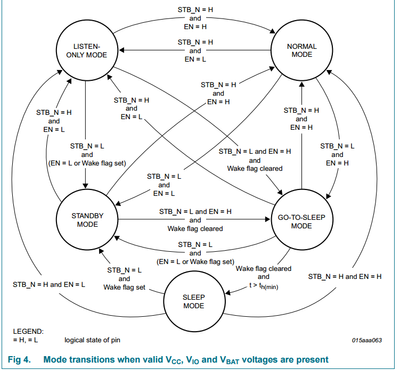
INH 是上拉到VBAT的,通过外部设置STB/EN来控制TJA1043的状态控制INH的H/L,他是一直受控的因为VBAT没断电,比方说上电VBAT以后 TJA1043工作在sleep的模式,STB/EN都是floating的无法唤醒他,那么可以通过本地wake pin 或者Remote wake-up (via the CAN bus)唤醒 让INH 拉高从而让TJA1043 工作:
Any wake-up request, setting the Pwon flag or a LOW-to-HIGH transition on STB_N will
clear UVNOM and the timers, allowing the voltage regulators to be reactivated (at least until
UVNOM is set again).