
- Forums
- Product Forums
- General Purpose MicrocontrollersGeneral Purpose Microcontrollers
- i.MX Forumsi.MX Forums
- QorIQ Processing PlatformsQorIQ Processing Platforms
- Identification and SecurityIdentification and Security
- Power ManagementPower Management
- Wireless ConnectivityWireless Connectivity
- RFID / NFCRFID / NFC
- Advanced AnalogAdvanced Analog
- Neural Processing UnitsNeural Processing Units
- MCX Microcontrollers
- S32G
- S32K
- S32V
- MPC5xxx
- Other NXP Products
- S12 / MagniV Microcontrollers
- Powertrain and Electrification Analog Drivers
- Sensors
- Vybrid Processors
- Digital Signal Controllers
- 8-bit Microcontrollers
- ColdFire/68K Microcontrollers and Processors
- PowerQUICC Processors
- OSBDM and TBDML
- S32M
- S32Z/E
-
- Solution Forums
- Software Forums
- MCUXpresso Software and ToolsMCUXpresso Software and Tools
- CodeWarriorCodeWarrior
- MQX Software SolutionsMQX Software Solutions
- Model-Based Design Toolbox (MBDT)Model-Based Design Toolbox (MBDT)
- FreeMASTER
- eIQ Machine Learning Software
- Embedded Software and Tools Clinic
- S32 SDK
- S32 Design Studio
- GUI Guider
- Zephyr Project
- Voice Technology
- Application Software Packs
- Secure Provisioning SDK (SPSDK)
- Processor Expert Software
- Generative AI & LLMs
-
- Topics
- Mobile Robotics - Drones and RoversMobile Robotics - Drones and Rovers
- NXP Training ContentNXP Training Content
- University ProgramsUniversity Programs
- Rapid IoT
- NXP Designs
- SafeAssure-Community
- OSS Security & Maintenance
- Using Our Community
-
- Cloud Lab Forums
-
- Knowledge Bases
- ARM Microcontrollers
- i.MX Processors
- Identification and Security
- Model-Based Design Toolbox (MBDT)
- QorIQ Processing Platforms
- S32 Automotive Processing Platform
- Wireless Connectivity
- CodeWarrior
- MCUXpresso Suite of Software and Tools
- MQX Software Solutions
- RFID / NFC
- Advanced Analog
- Neural Processing Units
-
- NXP Tech Blogs
- Home
- :
- General Purpose Microcontrollers
- :
- LPC Microcontrollers
- :
- LPC1547 secondary bootloader cannot jump to application
LPC1547 secondary bootloader cannot jump to application
- Subscribe to RSS Feed
- Mark Topic as New
- Mark Topic as Read
- Float this Topic for Current User
- Bookmark
- Subscribe
- Mute
- Printer Friendly Page
LPC1547 secondary bootloader cannot jump to application

- Mark as New
- Bookmark
- Subscribe
- Mute
- Subscribe to RSS Feed
- Permalink
- Report Inappropriate Content
Hi guys,
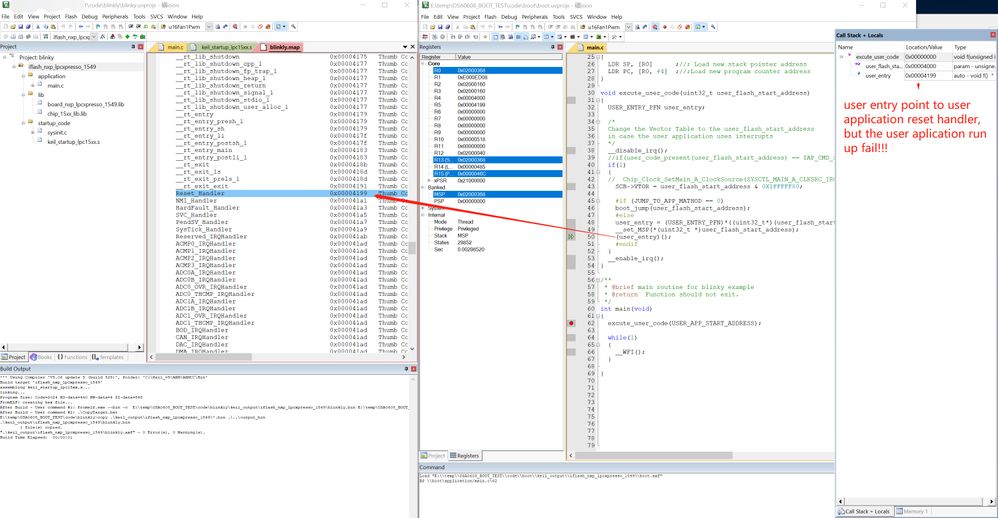
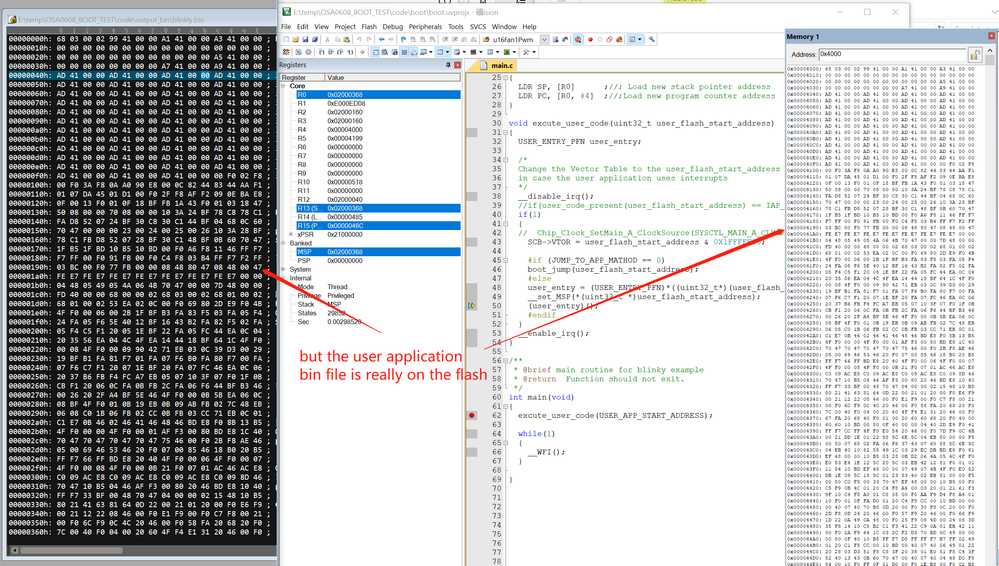
I want to write a secondary boot loader for the LPC1547, but it always fail to jump to application. Is anybody have ever write a secondary boot loader for LPC15xx? It will be very pleasure if any body can give me a help. Both boot loader and application project is very simple, and they can run up independently.
The boot loader is jump to application directly.
The application blink two LEDs only.
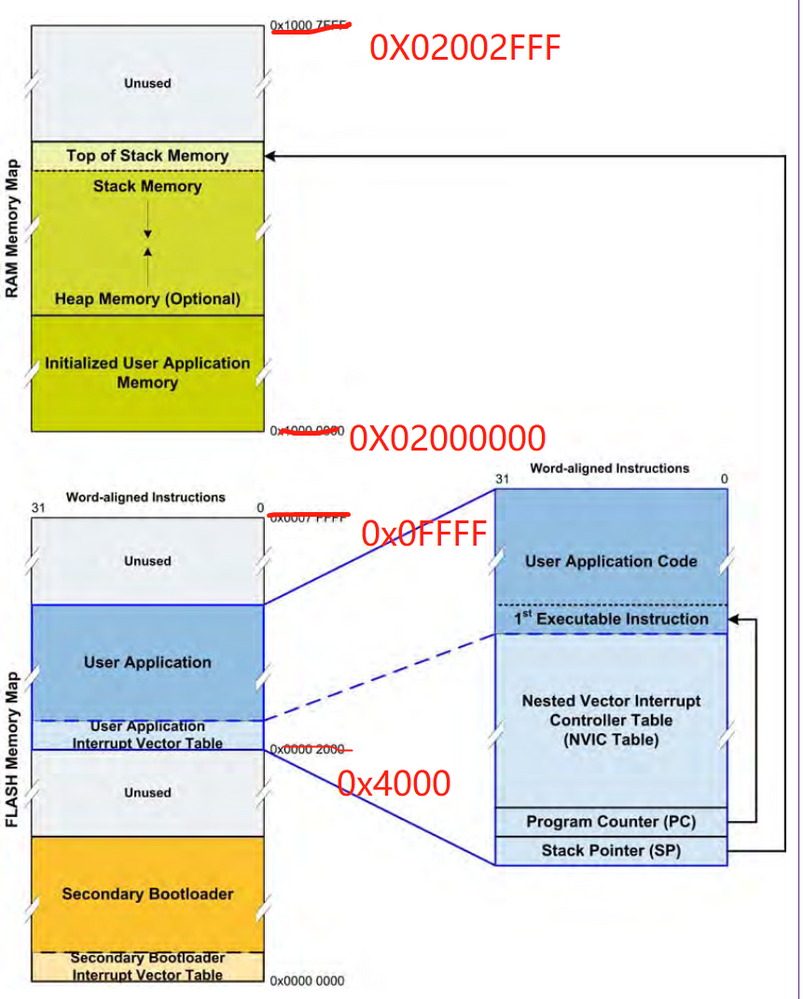
Boot loader and user application in flash:
- Mark as New
- Bookmark
- Subscribe
- Mute
- Subscribe to RSS Feed
- Permalink
- Report Inappropriate Content
Hanz,
I use a bunch of LPC1549 in projects, and my bootloader is used in all projects 
I have a function:
//----------------------------------------------------------------------------------
//
//----------------------------------------------------------------------------------
static __asm void BootJump(unsigned int firmwareStartAddress) {
LDR R1, [R0]
MSR MSP, R1 ; Load MSP with new stack pointer address
LDR SP, [R0] ;Load new stack pointer address
LDR PC, [R0, #4] ;Load new program counter address
}
Which I call like this:
#define FW_ENTRY_CM3 0x4000
if (*(unsigned int*)FW_ENTRY_CM3 != 0xFFFFFFFF) {
// Disable all interrupts
NVIC->ICER[0] = 0xFFFFFFFF;
NVIC->ICER[1] = 0x0000001F;
// Clear all pending interrupts
NVIC->ICPR[0] = 0xFFFFFFFF;
NVIC->ICPR[1] = 0x0000001F;
tsk_lock();
// IRQ vectors at BASE of firmware
SCB->VTOR = FW_ENTRY_CM3 & 0x1FFFFF80;
// Lets go..
BootJump(FW_ENTRY_CM3);
}
My main firmware is located at 0x4000. The call to tsk_lock() stops the RTOS (Keil RTX) from running (basically disables timertick for the task scheduling).
This works, the same is used on a bunch of different NXP Cortex processors...
The check
if (*(unsigned int*)FW_ENTRY_CM3 != 0xFFFFFFFF) {
simply checks if there is something in the Flash at 0x4000, if not (Flash is erased) it will not try and jump to it. You can add more check to this if you need, basically the jump works.
- Mark as New
- Bookmark
- Subscribe
- Mute
- Subscribe to RSS Feed
- Permalink
- Report Inappropriate Content
Hello,
I would like to know why is necessary to put 0x1FFFFF80?
SCB->VTOR = FW_ENTRY_CM3 & 0x1FFFFF80;I am trying this code, and the micro is still not running.
Thanks in advance.
- Mark as New
- Bookmark
- Subscribe
- Mute
- Subscribe to RSS Feed
- Permalink
- Report Inappropriate Content
Carsten,
Thank you very much! I was busy on other things these days. Your code looks better, I will try it later. ^_^
