
- Forums
- Product Forums
- General Purpose MicrocontrollersGeneral Purpose Microcontrollers
- i.MX Forumsi.MX Forums
- QorIQ Processing PlatformsQorIQ Processing Platforms
- Identification and SecurityIdentification and Security
- Power ManagementPower Management
- Wireless ConnectivityWireless Connectivity
- RFID / NFCRFID / NFC
- Advanced AnalogAdvanced Analog
- Neural Processing UnitsNeural Processing Units
- MCX Microcontrollers
- S32G
- S32K
- S32V
- MPC5xxx
- Other NXP Products
- S12 / MagniV Microcontrollers
- Powertrain and Electrification Analog Drivers
- Sensors
- Vybrid Processors
- Digital Signal Controllers
- 8-bit Microcontrollers
- ColdFire/68K Microcontrollers and Processors
- PowerQUICC Processors
- OSBDM and TBDML
- S32M
- S32Z/E
-
- Solution Forums
- Software Forums
- MCUXpresso Software and ToolsMCUXpresso Software and Tools
- CodeWarriorCodeWarrior
- MQX Software SolutionsMQX Software Solutions
- Model-Based Design Toolbox (MBDT)Model-Based Design Toolbox (MBDT)
- FreeMASTER
- eIQ Machine Learning Software
- Embedded Software and Tools Clinic
- S32 SDK
- S32 Design Studio
- GUI Guider
- Zephyr Project
- Voice Technology
- Application Software Packs
- Secure Provisioning SDK (SPSDK)
- Processor Expert Software
- Generative AI & LLMs
-
- Topics
- Mobile Robotics - Drones and RoversMobile Robotics - Drones and Rovers
- NXP Training ContentNXP Training Content
- University ProgramsUniversity Programs
- Rapid IoT
- NXP Designs
- SafeAssure-Community
- OSS Security & Maintenance
- Using Our Community
-
- Cloud Lab Forums
-
- Knowledge Bases
- ARM Microcontrollers
- i.MX Processors
- Identification and Security
- Model-Based Design Toolbox (MBDT)
- QorIQ Processing Platforms
- S32 Automotive Processing Platform
- Wireless Connectivity
- CodeWarrior
- MCUXpresso Suite of Software and Tools
- MQX Software Solutions
- RFID / NFC
- Advanced Analog
- Neural Processing Units
-
- NXP Tech Blogs
- Home
- :
- CodeWarrior
- :
- CodeWarrior开发工具
- :
- kit9z1j638evm problem
kit9z1j638evm problem
kit9z1j638evm problem

Hi,
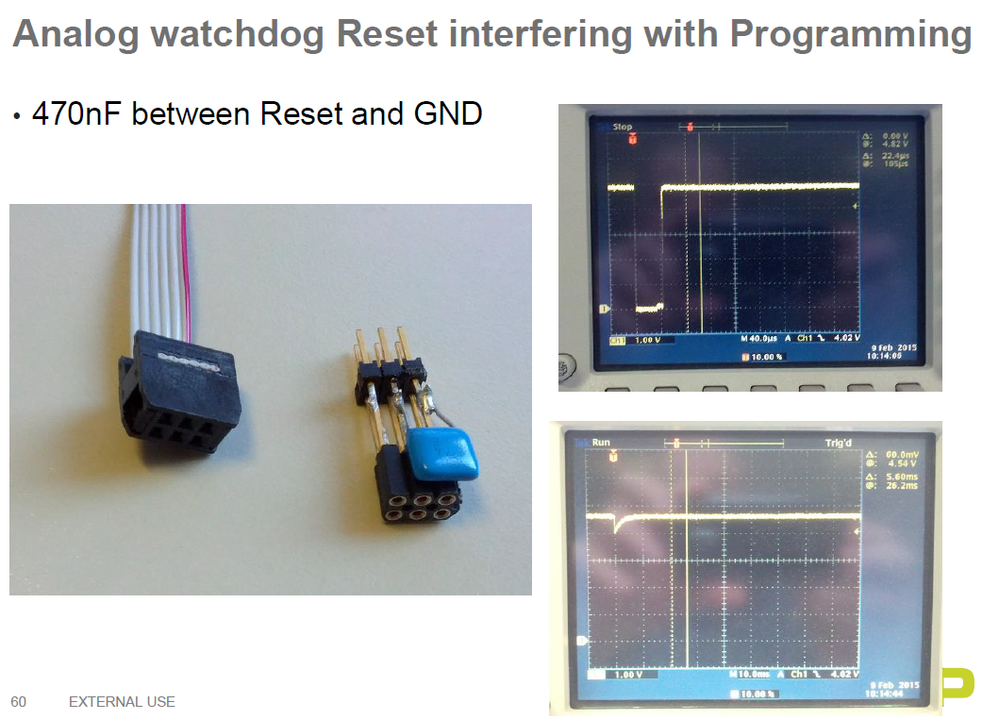
Its probably an issue with the RESET. The Analog Die Watchdog might reset the device every 250ms (if not previously) disabled.
there are two proposals:
- open the S1-1 to disconnect the RESET_A from RESET (for programming)
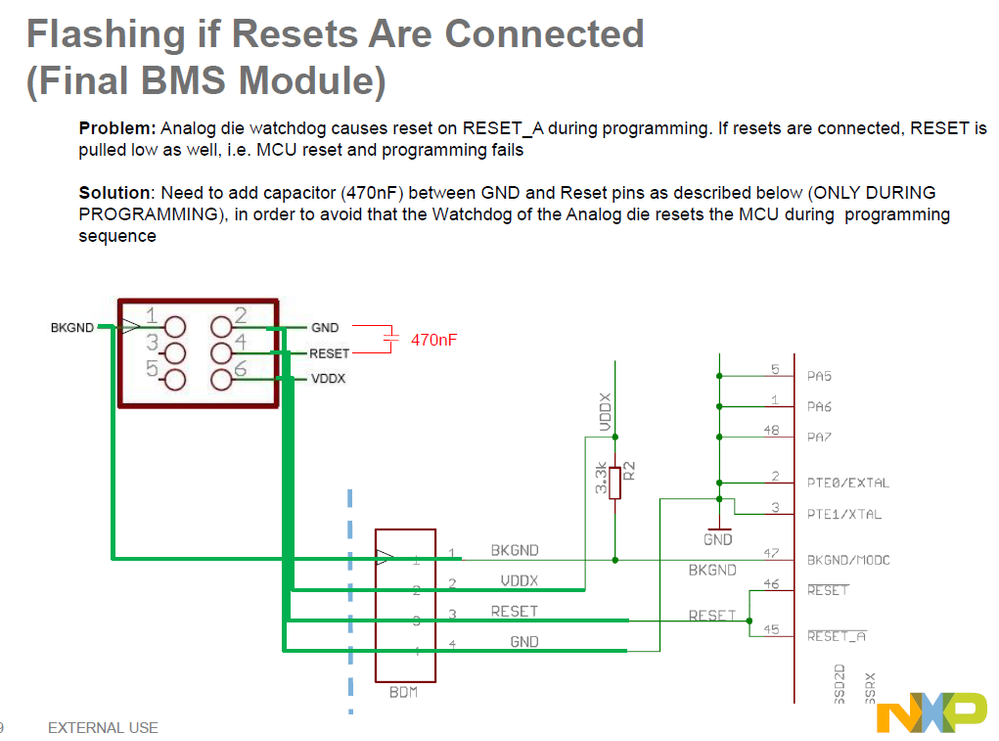
- or use a capacitor to "filter" the resets
Best regards,
Ladislav

Wow, thank you so very much for your amazingly detailed reply!
 dianabatrlova
Hi,
Do you use your own or example project?
Please, could you share the whole error message (I assume that is different than the first one)?
Have you tried to program MCU via OSBDM such as is described in Quick Start Guide (just connect the USB cable to J3 and PC)?
https://www.nxp.com/docs/en/quick-reference-guide/KT9Z1J638QSG.pdf
Thank you.
Best regards,
Diana
HI Diana,
Now,i use my board to measure voltage and current,but its value are increase all the time.Is there something wrong with my schematic or my program(KT9Z1_638_CAN_demo).
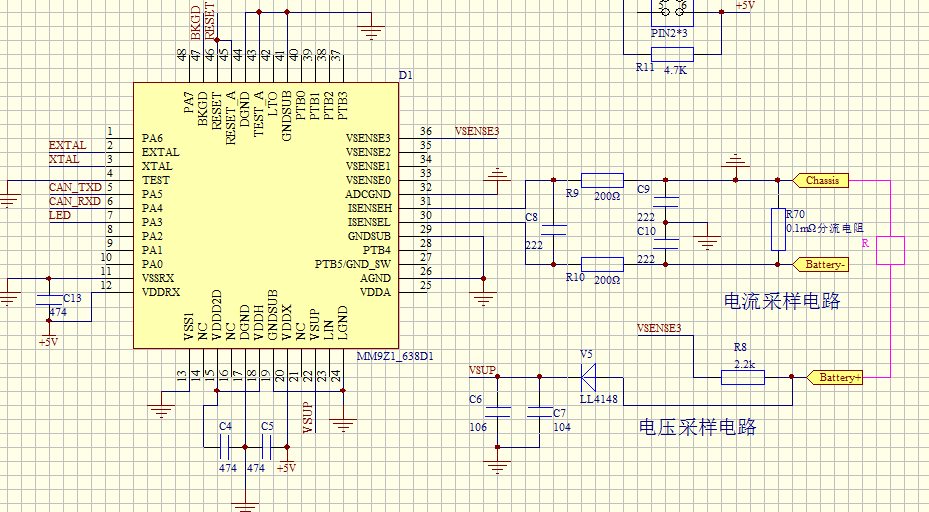
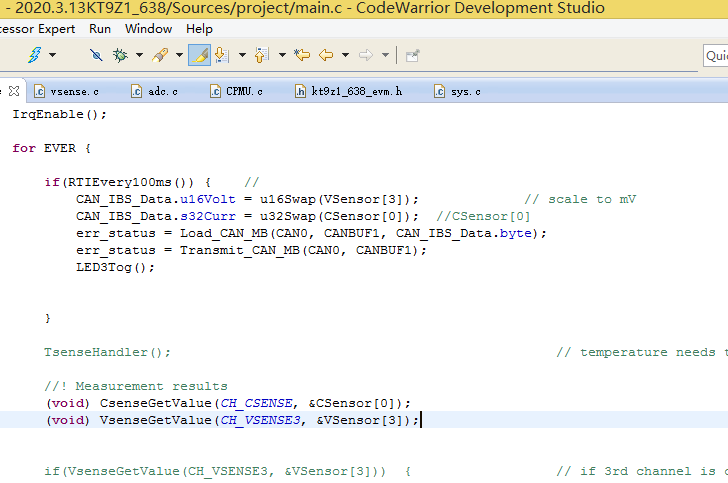


Thank you.
Best regards,
H YW
dianabatrlova
Hello,
The issue could be related to your SW. Could you share your main.c?
The VSensor[3] signal is NOT automatically VSENSE3 voltage.
If your code cannot be shared publicly you can create a support ticket:
Thank you.
Best regards,
Diana
// --------------------------------------------------------------------
// Copyright (c) 2015, NXP Semiconductors.
// All rights reserved.
//
// Redistribution and use in source and binary forms, with or without modification,
// are permitted provided that the following conditions are met:
//
// o Redistributions of source code must retain the above copyright notice, this list
// of conditions and the following disclaimer.
//
// o Redistributions in binary form must reproduce the above copyright notice, this
// list of conditions and the following disclaimer in the documentation and/or
// other materials provided with the distribution.
//
// o Neither the name of NXP Semiconductors nor the names of its
// contributors may be used to endorse or promote products derived from this
// software without specific prior written permission.
//
// THIS SOFTWARE IS PROVIDED BY THE COPYRIGHT HOLDERS AND CONTRIBUTORS "AS IS" AND
// ANY EXPRESS OR IMPLIED WARRANTIES, INCLUDING, BUT NOT LIMITED TO, THE IMPLIED
// WARRANTIES OF MERCHANTABILITY AND FITNESS FOR A PARTICULAR PURPOSE ARE
// DISCLAIMED. IN NO EVENT SHALL THE COPYRIGHT HOLDER OR CONTRIBUTORS BE LIABLE FOR
// ANY DIRECT, INDIRECT, INCIDENTAL, SPECIAL, EXEMPLARY, OR CONSEQUENTIAL DAMAGES
// (INCLUDING, BUT NOT LIMITED TO, PROCUREMENT OF SUBSTITUTE GOODS OR SERVICES;
// LOSS OF USE, DATA, OR PROFITS; OR BUSINESS INTERRUPTION) HOWEVER CAUSED AND ON
// ANY THEORY OF LIABILITY, WHETHER IN CONTRACT, STRICT LIABILITY, OR TORT
// (INCLUDING NEGLIGENCE OR OTHERWISE) ARISING IN ANY WAY OUT OF THE USE OF THIS
// SOFTWARE, EVEN IF ADVISED OF THE POSSIBILITY OF SUCH DAMAGE.
// --------------------------------------------------------------------
// Please find the software documentation: \docu\documentation.htm
// --------------------------------------------------------------------
#include "main.h"
#include "drv638.h" // driver for MM9Z1-638
#include "nvm.h" // nvm driver
#include <stdio.h> // sprintf
#include "kt9z1_638_evm.h"
#include "ntc.h"
#include "msCANdrv.h"
//---------------------------------------------------------------------
#define TSENSE_EXT CH_T_PTB0 //!< external T-sensor is connected to PTBx
extern TYPE_NTC_CONVERT NTCconvert; //!< lookup table for NTC
//---------------------------------------------------------------------
/*! \brief Structure for Clock configuration for CAN demo
- use external oscillator (4.000MHz) as reference clock (divide by 4)
- target VCO clock: 50.000MHz
- target core clock: 50.000MHz
- target bus clock : 25.000MHz
- target D2D clock : 25.000MHz
*/
TYPE_CPMU_CONF const ClockConf = {
ClockSrc_EXT,
VCO_RANGE,
SYNR(CLOCK_VCO, CLOCK_REF),
REFCLK_FREQ_1_2_MHZ_RANGE, // Ref is IRC = 1.000MHz
REFDIV(4), // Refdivider div = 4 (4MHz quarz)
// REFDIV(16), // Refdivider div = 16 (16MHz quarz)
POSTDIV(CLOCK_VCO, CLOCK_BUS),
PLL_FREQ_MOD_0_PERCENT,
PCRPRE(CLOCK_D2D), // PCR prescaler
D2DDIV(CLOCK_BUS, CLOCK_D2D)
};
// --------------------------------------------------------------------
//! \brief TSENSE list of channels to convert...
TYPE_TSENSE_LIST const tList[] = {
// ch , avg, latency
CH_TSENSE_ITS , 1, 6, //!< measure internal chip temperature
TSENSE_EXT , 1, 6 //!< measure external temperature sensor (NTC)
};
const u8 tListEntries = sizeof(tList)/sizeof(TYPE_TSENSE_LIST); //!< number of entries in the list above
static u16 tValues[sizeof(tList)/sizeof(TYPE_TSENSE_LIST)]; //!< RAM buffer for the TSENSE module
// --------------------------------------------------------------------
//! \brief VSENSE list of channels to convert...
TYPE_VSENSE_LIST const vList[] = {
// ch , avg , latency
CH_VSENSE2 , 1, 12,
CH_VSENSE1 , 1, 12,
CH_VSENSE0 , 1, 12,
CH_VSENSE3 , 1, 12
};
const u8 vListEntries = sizeof(vList)/sizeof(TYPE_VSENSE_LIST); //!< number of entries in the list above
static u16 vValues[sizeof(vList)/sizeof(TYPE_VSENSE_LIST)]; //!< RAM buffer for the VSENSE module
// --------------------------------------------------------------------
//! \brief CSENSE list of channels to convert...
TYPE_CSENSE_LIST const cList[] = {
// ch , avg , latency
CH_CSENSE , 1 , 0
};
const u8 cListEntries = sizeof(cList)/sizeof(TYPE_CSENSE_LIST); //!< number of entries in the list above
static s32 cValues[sizeof(cList)/sizeof(TYPE_CSENSE_LIST)]; //!< RAM buffer for the TSENSE module
// --------------------------------------------------------------------
// PTA0 is connected to MC33901 STB pin
#define STANDBYMODE (1) //!< CAN standby signal
#define NORMALMODE (0) //!< CAN standby signal
#define CAN_STDBY(v) {DDRA_DDRA0 = 1; PTA_PTA0 = (v);} //!< CAN standby signal
// --------------------------------------------------------------------
// --------------------------------------------------------------------
// --------------------------------------------------------------------
void main(void) {
u16 TSensor[tListEntries];
u16 VSensor[vListEntries];
s32 CSensor[cListEntries];
u16 temp = 0;
TYPE_CAN_IBS_Dummy CAN_IBS_Dummy;
TYPE_CAN_IBS_Data CAN_IBS_Data;
TYPE_CAN_IBS_CONTROL CAN_IBS_Control;
MSCAN_TYPE_ERROR_CODE err_status; // To store the return value of the driver APIs.
MSCAN_TYPE_STATUS mbStat;
u8 CAN_status[3]; // CAN_status to store channel status,byte 0 store CANCTL0, byte 1 store CANCTL1, byte 2 store CANRFLG
Bool WriteSystemCalibrationValues = FALSE; // do not change !!!
// LEDs
// LEDModeInit();
// LEDRxInit();
LED3Init();
SYS_Init();
CPMUInit(&ClockConf);
D2DInit((TYPE_D2DCLKDIV) ClockConf.D2dDiv);
XirqEnable(); // enable XIRQ -> isrD2DErr() "write-once"
if (B_PCR_CTL_OPM & 2) { // Check if Wake Up from Sleep mode (see page RM3.0 110 Intermediate Mode)
B_PCR_CTL = OPM_SET_NORMAL; // set normal mode
while (!(B_PCR_SRH_WLPMF )) DO_NOTHING; // Wait for Clock Domain Change //! \todo where is this described?
}else{
if(!B_PCR_SR_HWRF) {
PCRReset(); // generate a HWR reset to ensure analog die is in defined state! E.g. debugging might cause strange effects in case bits are set from before //
}
}
B_WD_CTL = WD_OFF;
PCRInit(ClockConf.PCRprescaler);
SYSStartupTrimming();
//! \brief Set a breakpoint to this line and change the variable WriteSystemCalibrationValues to TRUE in the debugger to write values \ref CalibWrite
if(WriteSystemCalibrationValues) { // hook to manually write system calibration values to eeprom during sw development
CalibWriteManual();
}
if(CalibRead()==FALSE) { // reads system calibration data from EEPROM (if avaliable). needs to be before ADCInit()
CalibDefault(); // otherwise use default values
}
ADCInit();
VsenseInit(&(vList[0]), &vListEntries, &(vValues[0]));
CsenseInit(&(cList[0]), &cListEntries, &(cValues[0]));
//TsenseInit(&(tList[0]), &tListEntries, &(tValues[0]));
//GPIOInit();
CAN_STDBY(NORMALMODE); //
// IBS data frame
CAN_IBS_Data.u8Len = 8;
CAN_IBS_Data.u16Volt = 0x00;//u16Swap(0x1234)
CAN_IBS_Data.s32Curr = 0x00; //u32Swap(0)
CAN_IBS_Data.u8CTemp = 0x00;
// IBS dummy frame
CAN_IBS_Dummy.u8Len = 2;
CAN_IBS_Dummy.u16Var = u16Swap(0x1234);
// IBS control frame
CAN_IBS_Control.u8Len = 2;
err_status = Init_CAN(CAN0, FAST); //CMPTX FAST //Initialization msCAN channel 0, FAST means the reset won't wait until current transmit completed
do{
err_status = Check_CAN_Status(CAN0, CAN_status);
}while ((CAN_status[0] & SYNCH) == 0); //Wait for msCAN channel 0 synchronized to CAN Bus
err_status = Config_CAN_MB (CAN0, CANBUF1, TXDF, CAN_MO1); //configure the msCAN channel 0, buffer 1 to be TXDF mode (transmit dataframe) -> message object 1,see details in "MSCANID.h"
err_status = Config_CAN_MB (CAN0, CANBUF2, TXDF, CAN_MO2); //configure the msCAN channel 0, buffer 2 to be TXDF mode (transmit dataframe) -> message object 2
err_status = Config_CAN_MB (CAN0, CANBUF3, RXDF, CAN_MO3); //configure the msCAN channel 0, buffer 3 to be RXDF mode (receive dataframe) -> message object 3
// LEDModeOn();
RTIInit();
RTIEnable();
IrqEnable();
for EVER {
if(RTIEvery100ms()) { //
CAN_IBS_Data.u16Volt = u16Swap(VSensor[3]); // scale to mV
CAN_IBS_Data.s32Curr = u32Swap(CSensor[0]); //CSensor[0]
err_status = Load_CAN_MB(CAN0, CANBUF1, CAN_IBS_Data.byte);
err_status = Transmit_CAN_MB(CAN0, CANBUF1);
LED3Tog();
temp++;
}
// TsenseHandler(); // temperature needs to be done polling (V,I interrupt driven)
//! Measurement results
(void) CsenseGetValue(CH_CSENSE, &CSensor[0]);
(void) VsenseGetValue(CH_VSENSE3, &VSensor[3]);
/* if(VsenseGetValue(CH_VSENSE3, &VSensor[3])) { // if 3rd channel is converted then first 3 are done
(void) TsenseGetValue(CH_TSENSE_ITS, &TSensor[0]); // check for new results ITS
(void) TsenseGetValue(CH_T_PTB0, &TSensor[1]); // check for new results PTB4
(void) VsenseGetValue(CH_VSENSE0, &VSensor[0]); // check for new results
(void) VsenseGetValue(CH_VSENSE1, &VSensor[1]); // check for new results
(void) VsenseGetValue(CH_VSENSE2, &VSensor[2]); // check for new results
}*/
// read message object .....读CAN数据
/* err_status = Check_CAN_MB_Status(CAN0, CANBUF3, &mbStat);
if(mbStat.Status == NEWDATA) { // Wait for the Receive ISR to finish and change the buffer status, NEWDATA indicates that the buffer has receive a new data
err_status = Read_CAN_MB_Data(CAN0, CANBUF3, CAN_IBS_Control.byte);//Copy the received data in msCAN channel 0 buffer 2 to data_rec;
CAN_IBS_Control.u16Var = u16Swap(CAN_IBS_Control.u16Var);
mbStat.Status = NODATA; // Clear buffer_status[0]
if(CAN_IBS_Control.u16Var&0x8000) { // Goto Sleep Request
// goto sleep
err_status = Sleep_CAN(CAN0, CMPTX); // request CAN channel 0 go to sleep with completing transmission scheduled
do {
err_status = Check_CAN_Status(CAN0,CAN_status); // read the channel 0 status
}while (!(CAN_status[1]&SLPAK)); // wait till SLPAK bit set
}
}*/
}
}
// ---------------------------------------------------------------------
/*! \brief Initialises GPIO PTBx pins
<b>Configuration used for the KT9Z1_638_CAN_Demo:</b>
| Pin | Enabled | Direction | Routing | used for |
|:----------:|:--------:|:---------:|:-------:|------------------------------------|
| PTB0 | - | - | | analog input |
| PTB1 | disabled | n.a. | | not used |
| PTB2 | disabled | n.a. | | not used |
| PTB3 | disabled | n.a. | | not used |
| PTB4 | enabled | input | PTWU | CAN PHY wake up input |
| PTB5/GNDSW | - | - | - | GND switch for TSENSE_EXT |
*/
void GPIOInit(void) {
B_GPIO_CTL = GPIO_CTL_PTB1_DISABLE;
B_GPIO_CTL = GPIO_CTL_PTB2_DISABLE;
B_GPIO_CTL = GPIO_CTL_PTB3_DISABLE;
B_GPIO_CTL = GPIO_CTL_PTB4_ENABLE; // PTB4 is used for CAN Wakeup
B_GPIO_IN4 = IN4_PTWU|IN4_NWUE; // enable WU in low power mode, negative edge
}
// --------------------------------------------------------------------
interrupt VectorNumber_Vcan0wkup void isrCANWakeup(void) {
CAN_Wakeup(CAN0);
}
// --------------------------------------------------------------------
interrupt VectorNumber_Vcan0err void isrCANErr(void) {
CAN_ERR(CAN0);
}
// --------------------------------------------------------------------
interrupt VectorNumber_Vcan0tx void isrCANTx(void) {
CAN_Transmit(CAN0);
}
// --------------------------------------------------------------------
interrupt VectorNumber_Vcan0rx void isrCANRx(void) {
CAN_Receive(CAN0);
}
dianabatrlova
Hello,
I'm very sorry for the delay. Have you solved your issue?
I'm discussing this with the expert on the MM9Z1_638
The SW seems ok.
- TsenseHandler should be active, such that the device can perform compensation (needs to know the ITS = chip temperature)
- Maybe you can enable the TsenseHandler and perform some measurements and send us that data?
Best regards,
Diana
