
- Forums
- Product Forums
- General Purpose MicrocontrollersGeneral Purpose Microcontrollers
- i.MX Forumsi.MX Forums
- QorIQ Processing PlatformsQorIQ Processing Platforms
- Identification and SecurityIdentification and Security
- Power ManagementPower Management
- Wireless ConnectivityWireless Connectivity
- RFID / NFCRFID / NFC
- Advanced AnalogAdvanced Analog
- Neural Processing UnitsNeural Processing Units
- MCX Microcontrollers
- S32G
- S32K
- S32V
- MPC5xxx
- Other NXP Products
- S12 / MagniV Microcontrollers
- Powertrain and Electrification Analog Drivers
- Sensors
- Vybrid Processors
- Digital Signal Controllers
- 8-bit Microcontrollers
- ColdFire/68K Microcontrollers and Processors
- PowerQUICC Processors
- OSBDM and TBDML
- S32M
- S32Z/E
-
- Solution Forums
- Software Forums
- MCUXpresso Software and ToolsMCUXpresso Software and Tools
- CodeWarriorCodeWarrior
- MQX Software SolutionsMQX Software Solutions
- Model-Based Design Toolbox (MBDT)Model-Based Design Toolbox (MBDT)
- FreeMASTER
- eIQ Machine Learning Software
- Embedded Software and Tools Clinic
- S32 SDK
- S32 Design Studio
- GUI Guider
- Zephyr Project
- Voice Technology
- Application Software Packs
- Secure Provisioning SDK (SPSDK)
- Processor Expert Software
- Generative AI & LLMs
-
- Topics
- Mobile Robotics - Drones and RoversMobile Robotics - Drones and Rovers
- NXP Training ContentNXP Training Content
- University ProgramsUniversity Programs
- Rapid IoT
- NXP Designs
- SafeAssure-Community
- OSS Security & Maintenance
- Using Our Community
-
- Cloud Lab Forums
-
- Knowledge Bases
- ARM Microcontrollers
- i.MX Processors
- Identification and Security
- Model-Based Design Toolbox (MBDT)
- QorIQ Processing Platforms
- S32 Automotive Processing Platform
- Wireless Connectivity
- CodeWarrior
- MCUXpresso Suite of Software and Tools
- MQX Software Solutions
- RFID / NFC
- Advanced Analog
- Neural Processing Units
-
- NXP Tech Blogs
- Home
- :
- i.MX处理器
- :
- i.MX RT Crossover MCUs Knowledge Base
- :
- LVGL Benchmark Performance Optimization
LVGL Benchmark Performance Optimization
LVGL Benchmark Performance Optimization
LVGL Benchmark Performance Optimization
1 Background
2 Development Setup
2.1 Software
2.2 Hardware
3 Performance Optimization
3.1 Baseline Performance
3.2 Optimization 1: Compiler Optimization
3.3 Optimization 2: External SDRAM
3.4 Optimization 3: VGLite Acceleration
3.5 Optimization Comparison
4 Conclusion
5 References
1. Background
LVGL (Light and Versatile Graphics Library) is a high-performance, low-resource embedded graphics library. Thanks to its robust open-source ecosystem and broad OS compatibility, it supports a wide range of hardware platforms—from low-power ARM Cortex-M microcontrollers (with clock speeds as low as 100 MHz) to high-performance MPUs running Linux—making it a preferred choice in embedded open-source solutions. Many silicon vendors now offer “out-of-the-box” support for LVGL.
NXP provides ready-to-use software and hardware examples for its mainstream platforms—including MCX, i.MX RT, and LPC series—and integrates LVGL examples into the MCUXpresso SDK. These examples include quantified benchmark metrics for various scenarios. However, due to differences in software/hardware configurations and specifications, actual performance may vary significantly and often requires scenario-specific tuning.
This document, based on practical experience with the i.MX RT1170 platform, aims to help NXP users quickly understand and apply appropriate optimization strategies to enhance LVGL application performance.


4. Conclusion
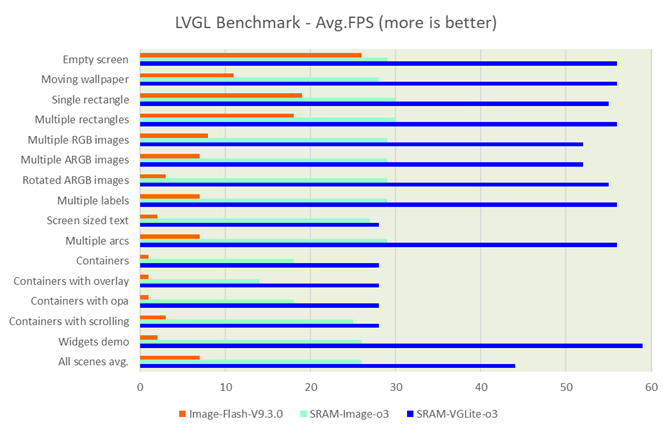
This document presents a step-by-step optimization of NXP’s official LVGL benchmark example, with quantified improvements in CPU usage, FPS, render time, and flush time. Taking the Widgets demo as an example:
- CPU usage dropped from 96% → 12%
- FPS increased from 2 → 59
These optimization techniques—not limited to LVGL—are broadly applicable to system-level performance tuning on i.MX RT platforms.
