
- Forums
- Product Forums
- General Purpose MicrocontrollersGeneral Purpose Microcontrollers
- i.MX Forumsi.MX Forums
- QorIQ Processing PlatformsQorIQ Processing Platforms
- Identification and SecurityIdentification and Security
- Power ManagementPower Management
- Wireless ConnectivityWireless Connectivity
- RFID / NFCRFID / NFC
- Advanced AnalogAdvanced Analog
- Neural Processing UnitsNeural Processing Units
- MCX Microcontrollers
- S32G
- S32K
- S32V
- MPC5xxx
- Other NXP Products
- S12 / MagniV Microcontrollers
- Powertrain and Electrification Analog Drivers
- Sensors
- Vybrid Processors
- Digital Signal Controllers
- 8-bit Microcontrollers
- ColdFire/68K Microcontrollers and Processors
- PowerQUICC Processors
- OSBDM and TBDML
- S32M
- S32Z/E
-
- Solution Forums
- Software Forums
- MCUXpresso Software and ToolsMCUXpresso Software and Tools
- CodeWarriorCodeWarrior
- MQX Software SolutionsMQX Software Solutions
- Model-Based Design Toolbox (MBDT)Model-Based Design Toolbox (MBDT)
- FreeMASTER
- eIQ Machine Learning Software
- Embedded Software and Tools Clinic
- S32 SDK
- S32 Design Studio
- GUI Guider
- Zephyr Project
- Voice Technology
- Application Software Packs
- Secure Provisioning SDK (SPSDK)
- Processor Expert Software
- Generative AI & LLMs
-
- Topics
- Mobile Robotics - Drones and RoversMobile Robotics - Drones and Rovers
- NXP Training ContentNXP Training Content
- University ProgramsUniversity Programs
- Rapid IoT
- NXP Designs
- SafeAssure-Community
- OSS Security & Maintenance
- Using Our Community
-
- Cloud Lab Forums
-
- Knowledge Bases
- ARM Microcontrollers
- i.MX Processors
- Identification and Security
- Model-Based Design Toolbox (MBDT)
- QorIQ Processing Platforms
- S32 Automotive Processing Platform
- Wireless Connectivity
- CodeWarrior
- MCUXpresso Suite of Software and Tools
- MQX Software Solutions
- RFID / NFC
- Advanced Analog
- Neural Processing Units
-
- NXP Tech Blogs
- Home
- :
- Product Forums
- :
- S32K
- :
- cmp
cmp
- Subscribe to RSS Feed
- Mark Topic as New
- Mark Topic as Read
- Float this Topic for Current User
- Bookmark
- Subscribe
- Mute
- Printer Friendly Page
cmp

- Mark as New
- Bookmark
- Subscribe
- Mute
- Subscribe to RSS Feed
- Permalink
- Report Inappropriate Content
Hi N,
I'm working on a project using the S32K358 and encountering challenges related to zero-crossing detection at 85kHz. I’m currently utilizing the LPCMP module in both of the following modes:
- CMP_IP_FUNCTIONALMODE_CONTINUOUS
- CMP_IP_FUNCTIONALMODE_SAMPLED_FILTERED_INT_CLK (with a delay of ~1µs)
Additionally, I’ve implemented the windowing functionality with the same sampled/filtered mode. As per the reference manual, windowing is particularly recommended for high-frequency zero-crossing detection, like in my case at 85kHz. However, this requires a window signal input via TRGMUX.
Current Setup:
- I’m using eMIOS to generate the window signal.
- However, the PWM from eMIOS is independently running and not synchronized with the input zero-crossing signal.
- This lack of synchronization between the PWM window and the zero-crossing signal is causing challenges in reliable detection.
I'm currently testing with a square wave input just to observe the behavior and delay in zero-crossing, but my final application involves a more dynamic signal.
Questions:
- How can I synchronize the window signal with the input zero-crossing?
The reference manual states that windowing should be synchronized with the signal for accurate detection at high frequencies like 85kHz. Is there a recommended method to achieve this synchronization, particularly between eMIOS PWM and the input signal? - Is there a way to introduce a controlled delay (or phase shift) in the zero-crossing signal?
I’m looking to possibly lag the signal to adjust the crossing point. Is there any way to achieve this via hardware settings or using internal delay features? - Can the LPCMP be configured to use different reference voltages for rising and falling edges?
Essentially, I want to differentiate the threshold for positive and negative transitions if possible.
Additional Context:
- Signal frequency: 85kHz
- Reference voltage: Approx. 2.7V, configured via DAC (value 126)
I’d appreciate any guidance or suggestions on how to implement a more deterministic and synchronized zero-crossing detection mechanism, possibly with edge-specific control and window alignment.
Thanks in advance!
@PetrS, I’d really appreciate your input on this if you have a moment.
- Mark as New
- Bookmark
- Subscribe
- Mute
- Subscribe to RSS Feed
- Permalink
- Report Inappropriate Content
 _Leo_
_Leo_
- Mark as New
- Bookmark
- Subscribe
- Mute
- Subscribe to RSS Feed
- Permalink
- Report Inappropriate Content
Sorry for the delay. We currently have a backlog of cases and we try to resolve them as soon as possible.
I see your other post:
Do you still need help in this one? Or do we focus in the aforementioned?
- Mark as New
- Bookmark
- Subscribe
- Mute
- Subscribe to RSS Feed
- Permalink
- Report Inappropriate Content
Yes, this is a different issue from the one I posted earlier. I would still like to resolve the question here, as I am specifically looking to get the LPCMP working for switching based on the current waveform. I kindly request your support on this matter.
_Leo_
- Mark as New
- Bookmark
- Subscribe
- Mute
- Subscribe to RSS Feed
- Permalink
- Report Inappropriate Content
Hi again,
It is easily to synchronize window signal with the input zero-crossing in motor control applications because PWM signals for actuation can use the same time base as PWM for window signal and thus it is known the zero-crossing event. But in your particular case, the dynamic signal is external.
Hardware workaround (offloading the CPU) which comes to my mind is the following:

You need to route your dynamic signal to two pins, one for CMP_0 and the other one for cmp1.
CMP_0 will perform Continuous mode to transform sine wave into an square wave. Then such signal is routed to LCU (though TRGMUX) to perform phase shift in order to serves as window signal of CMP_1 (again though TRGMUX). Finally CMP_1 should perform Windowed mode.
For the part in green from the diagram above you can refer to the attached example.
Such example generates a PWM signal in PTB16 (emios_0_ch_4_g) (in scope yellow signal). Receive the PWM signal in PTD15 (cmp0_in1) and replicates it in PTE3 (cmp0_out) (green signal). Then such signal is routed thought TRGMUX to PTA1 (trgmux_out0) (blue signal) and also it is routed to LCU in PTD3 (lcu0_out0) (purple signal), where PWM signal is phase shifted.
Connections required: PTB16 -> PTD15
S32DS 3.6 + RTD 5.0.0 (S32K3X4EVB-T172)
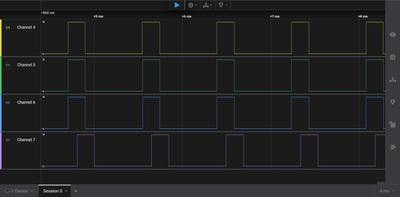
Regarding the different threshold for positive and negative transitions, it is not possible.
Hope it helps you.
Have a nice day!
