
- Forums
- Product Forums
- General Purpose MicrocontrollersGeneral Purpose Microcontrollers
- i.MX Forumsi.MX Forums
- QorIQ Processing PlatformsQorIQ Processing Platforms
- Identification and SecurityIdentification and Security
- Power ManagementPower Management
- Wireless ConnectivityWireless Connectivity
- RFID / NFCRFID / NFC
- Advanced AnalogAdvanced Analog
- Neural Processing UnitsNeural Processing Units
- MCX Microcontrollers
- S32G
- S32K
- S32V
- MPC5xxx
- Other NXP Products
- S12 / MagniV Microcontrollers
- Powertrain and Electrification Analog Drivers
- Sensors
- Vybrid Processors
- Digital Signal Controllers
- 8-bit Microcontrollers
- ColdFire/68K Microcontrollers and Processors
- PowerQUICC Processors
- OSBDM and TBDML
- S32M
- S32Z/E
-
- Solution Forums
- Software Forums
- MCUXpresso Software and ToolsMCUXpresso Software and Tools
- CodeWarriorCodeWarrior
- MQX Software SolutionsMQX Software Solutions
- Model-Based Design Toolbox (MBDT)Model-Based Design Toolbox (MBDT)
- FreeMASTER
- eIQ Machine Learning Software
- Embedded Software and Tools Clinic
- S32 SDK
- S32 Design Studio
- GUI Guider
- Zephyr Project
- Voice Technology
- Application Software Packs
- Secure Provisioning SDK (SPSDK)
- Processor Expert Software
- Generative AI & LLMs
-
- Topics
- Mobile Robotics - Drones and RoversMobile Robotics - Drones and Rovers
- NXP Training ContentNXP Training Content
- University ProgramsUniversity Programs
- Rapid IoT
- NXP Designs
- SafeAssure-Community
- OSS Security & Maintenance
- Using Our Community
-
- Cloud Lab Forums
-
- Knowledge Bases
- ARM Microcontrollers
- i.MX Processors
- Identification and Security
- Model-Based Design Toolbox (MBDT)
- QorIQ Processing Platforms
- S32 Automotive Processing Platform
- Wireless Connectivity
- CodeWarrior
- MCUXpresso Suite of Software and Tools
- MQX Software Solutions
- RFID / NFC
- Advanced Analog
- Neural Processing Units
-
- NXP Tech Blogs
- Home
- :
- Product Forums
- :
- S32K
- :
- Re: S32K3
S32K3
- Subscribe to RSS Feed
- Mark Topic as New
- Mark Topic as Read
- Float this Topic for Current User
- Bookmark
- Subscribe
- Mute
- Printer Friendly Page
S32K3

- Mark as New
- Bookmark
- Subscribe
- Mute
- Subscribe to RSS Feed
- Permalink
- Report Inappropriate Content
I want to use Jlink on S32K344, but the current board simulation is not normal, I want to know when it can be resolved?

 Senlent
- Mark as New
- Bookmark
- Subscribe
- Mute
- Subscribe to RSS Feed
- Permalink
- Report Inappropriate Content
For now, J-LINK does not support for S32K3 in S32 Design Studio, and I have confirmed with the AE team, the specific release time is unclear.
The latest Ozone provided by Segger's official website supports S32K3, and colleagues from AE have confirmed this.
BR!
Jim,
- Mark as New
- Bookmark
- Subscribe
- Mute
- Subscribe to RSS Feed
- Permalink
- Report Inappropriate Content
Hi,
Can you please confirm whether S32K312 supports the segger fully as of now? and if so, the support related to S32K312 [ With FreeRTOS ] - where we can find?
Thanks
Prakash V
- Mark as New
- Bookmark
- Subscribe
- Mute
- Subscribe to RSS Feed
- Permalink
- Report Inappropriate Content
- Mark as New
- Bookmark
- Subscribe
- Mute
- Subscribe to RSS Feed
- Permalink
- Report Inappropriate Content
I have tried to use Ozone for simulation, but there was still a hardware error at the beginning. Could you please help me ask what is the wrong setting or what is the problem? Thank you!
Senlent
- Mark as New
- Bookmark
- Subscribe
- Mute
- Subscribe to RSS Feed
- Permalink
- Report Inappropriate Content
Can you describe the problem you encountered clearly? For example, screenshots or debug Log information. I will help you record the current problem.
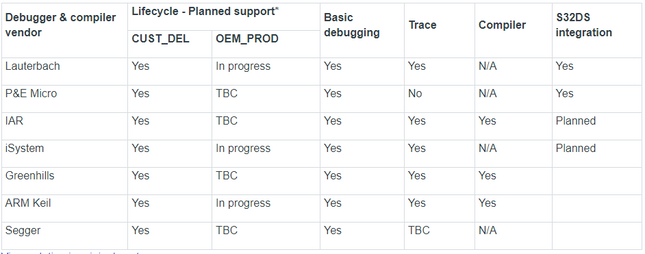
As I know so far, S32K3 does not fully support Segger. If there is an update, I will notify you in time.
update:05-18-2021
BR!
Jim,
-------------------------------------------------------------------------------
Note:
- If this post answers your question, please click the "Mark Correct" button. Thank you!
- We are following threads for 7 weeks after the last post, later replies are ignored
Please open a new thread and refer to the closed one, if you have a related question at a later point in time.
-------------------------------------------------------------------------------
- Mark as New
- Bookmark
- Subscribe
- Mute
- Subscribe to RSS Feed
- Permalink
- Report Inappropriate Content

 Senlent
- Mark as New
- Bookmark
- Subscribe
- Mute
- Subscribe to RSS Feed
- Permalink
- Report Inappropriate Content
According to the description of the debugger error exception message.
https://wiki.segger.com/Cortex-M_Fault#HardFault_Status_Register_.28HFSR.29
UsageFault Status Register (UFSR)
The UFSR is a 16-bit pseudo-register, part of the Configurable Fault Status Register (CFSR) at address 0xE000ED28. It can also be directly accessed with halfword access to 0xE000ED2A.
Bitfields:
[9] DIVBYZERO  - If 1, SDIV or UDIV instruction executed with divisor 0.
[8] UNALIGNED  - If 1, LDM, STM, LDRD, STRD on unaligned address executed, or single load or store executed when enabled to trap.
[3] NOCP       - If 1, access to unsupported (e.g. not available or not enabled) coprocessor.
[2] INVPC      - If 1, illegal or invalid EXC_RETURN value load to PC.
[1] INVSTATE   - If 1, execution in invalid state. E.g. Thumb bit not set in EPSR, or invalid IT state in EPSR.
[0] UNDEFINSTR - If 1, execution of undefined instruction.
UsageFault Examples
Undefined Instruction Execution
/*********************************************************************
*
*       _UndefInst()
*
*  Function description
*   Trigger a UsageFault or HardFault by executing an undefined instruction.
*
*  Additional Information
*    UsageFault is triggered on execution at the invalid address.
*    Related registers on hard fault:
*      HFSR = 0x40000000
*        FORCED = 1           - UsageFault escalated to HardFault
*      UFSR = 0x0001
*        UNDEFINSTR = 1       - Undefined instruction executed
*/
static int _UndefInst(void) {
  static const unsigned short _UDF[4] = {0xDEAD, 0xDEAD, 0xDEAD, 0xDEAD}; // 0xDEAD: UDF #<imm> (permanently undefined)
  int r;
  int (*pF)(void);

  pF = (int(*)(void))(((char*)&_UDF) + 1);
  //  4B05        ldr r3, =0x08001C18 <_UDF> <- Load address of "RAM Code" instructions
  //  3301        adds r3, #1                <- Make sure Thumb bit is set
  r = pF();
  //  4798        blx r3                     <- Call "RAM Code", will execute UDF instruction and raise exception
  //  9000        str r0, [sp]
  return r;
}
It seems that this is not a problem caused by the debugger, please check if the code has similar problems.
BR!
Jim,
- Mark as New
- Bookmark
- Subscribe
- Mute
- Subscribe to RSS Feed
- Permalink
- Report Inappropriate Content
I used the program of SDK package, which has the same problem, but these programs can run normally through PE. I hope you can help solve it. We basically used JLINK for debugging in the later stage. Thank you very much!
Senlent
- Mark as New
- Bookmark
- Subscribe
- Mute
- Subscribe to RSS Feed
- Permalink
- Report Inappropriate Content
I will report your questions to the AE team, and I will update you in time.
Thank you for your feedback.
BR!
Jim,
- Mark as New
- Bookmark
- Subscribe
- Mute
- Subscribe to RSS Feed
- Permalink
- Report Inappropriate Content
Ok, thank you very much!
Senlent
- Mark as New
- Bookmark
- Subscribe
- Mute
- Subscribe to RSS Feed
- Permalink
- Report Inappropriate Content
I communicated with members of the AE team that the routines in the IDE do not yet support J-LINK. It may be supported in the next version. If there is a new message, I will notify you via email.
BR!
Jim,
