
- Forums
- Product Forums
- General Purpose MicrocontrollersGeneral Purpose Microcontrollers
- i.MX Forumsi.MX Forums
- QorIQ Processing PlatformsQorIQ Processing Platforms
- Identification and SecurityIdentification and Security
- Power ManagementPower Management
- Wireless ConnectivityWireless Connectivity
- RFID / NFCRFID / NFC
- Advanced AnalogAdvanced Analog
- MCX Microcontrollers
- S32G
- S32K
- S32V
- MPC5xxx
- Other NXP Products
- S12 / MagniV Microcontrollers
- Powertrain and Electrification Analog Drivers
- Sensors
- Vybrid Processors
- Digital Signal Controllers
- 8-bit Microcontrollers
- ColdFire/68K Microcontrollers and Processors
- PowerQUICC Processors
- OSBDM and TBDML
- S32M
- S32Z/E
-
- Solution Forums
- Software Forums
- MCUXpresso Software and ToolsMCUXpresso Software and Tools
- CodeWarriorCodeWarrior
- MQX Software SolutionsMQX Software Solutions
- Model-Based Design Toolbox (MBDT)Model-Based Design Toolbox (MBDT)
- FreeMASTER
- eIQ Machine Learning Software
- Embedded Software and Tools Clinic
- S32 SDK
- S32 Design Studio
- GUI Guider
- Zephyr Project
- Voice Technology
- Application Software Packs
- Secure Provisioning SDK (SPSDK)
- Processor Expert Software
- Generative AI & LLMs
-
- Topics
- Mobile Robotics - Drones and RoversMobile Robotics - Drones and Rovers
- NXP Training ContentNXP Training Content
- University ProgramsUniversity Programs
- Rapid IoT
- NXP Designs
- SafeAssure-Community
- OSS Security & Maintenance
- Using Our Community
-
- Cloud Lab Forums
-
- Knowledge Bases
- ARM Microcontrollers
- i.MX Processors
- Identification and Security
- Model-Based Design Toolbox (MBDT)
- QorIQ Processing Platforms
- S32 Automotive Processing Platform
- Wireless Connectivity
- CodeWarrior
- MCUXpresso Suite of Software and Tools
- MQX Software Solutions
- RFID / NFC
- Advanced Analog
-
- NXP Tech Blogs
- Home
- :
- パワーマネージメント
- :
- パワーマネージメント
- :
- MC33771 measurement channel timing issue
MC33771 measurement channel timing issue
- RSS フィードを購読する
- トピックを新着としてマーク
- トピックを既読としてマーク
- このトピックを現在のユーザーにフロートします
- ブックマーク
- 購読
- ミュート
- 印刷用ページ

- 新着としてマーク
- ブックマーク
- 購読
- ミュート
- RSS フィードを購読する
- ハイライト
- 印刷
- 不適切なコンテンツを報告
Hi, I am working on MC33771BSP AFE and I am able to read measurement registers properly but the time taken from sending start of conversion bit to read current measurement register is 7ms , but as per datasheet it will take only 0.86 ms to read all measurement registers. Please any one support as I need to reduce the time for reading the measurement registers.

Thanks.
Paneri Shah.
解決済! 解決策の投稿を見る。
 jann_
jann_
- 新着としてマーク
- ブックマーク
- 購読
- ミュート
- RSS フィードを購読する
- ハイライト
- 印刷
- 不適切なコンテンツを報告
Hi Paneri,
I am the developer of the SW driver you shared screenshots from. A few notes and recommendations follows:
1. Time values in the BCC datasheet do not count any SW overhead. They asume time for transmission of SOC command (at the physical layer = SPI) + conversion + reading the values back. No time for pre- (and post-) processing of data at MCU is counted.
2. I suppose you are using S32K144 MCU with some code based on the examples provided with the SW driver. Therefore, the time mentioned in the datasheet is extended by packing the SPI frames, calculating/checking CRC and finally by not negligible time overhead of used S32K144 SPI SDK in your case.
3. If you would like to decreace the time for measuring the current to the possible minimum, I would recommend:
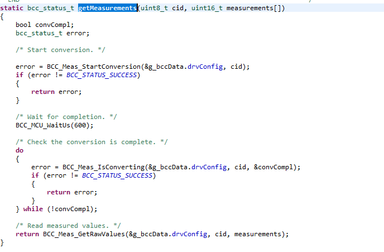
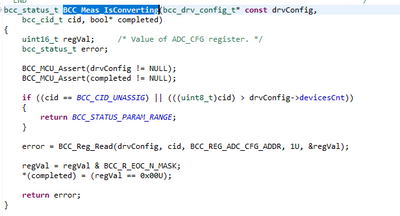
- Calling of BCC_Meas_IsConverting() in getMeasurements() is not needed if your BCC_MCU_WaitUs() is implemented accurately. This can be removed as one more read-request causes a time overhead.
- If you are interested only in the current measurement, read back only the MEAS_ISENSE1 and MEAS_ISENSE2 registers (instead of 30 registers by BCC_Meas_GetRawValues()). This will save really a lot of time.
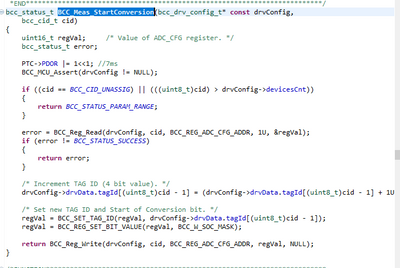
- Optimize pre-processing: Pre-create the content of sent SPI frames including CRCs - i.e. write your own optimized code and do not use the BCC SW driver to dynamically create the frames.
- Optimize SPI transfer: For the SPI transmission, do not use the SDK SPI driver in BCC_MCU_* functions but implement a so-called "pooling" approach for the LPSPI periphery to directly access the LPSPI periphery registers. When the periphery is well configured, only (+-) three register accesses are enough to start the SPI transmission including the movement of transmitted data to LPSPI FIFO.
The same with reading the data received from SPI MISO to LPSPI periphery.
Best regards,
Jan
 TomasVaverka
- 新着としてマーク
- ブックマーク
- 購読
- ミュート
- RSS フィードを購読する
- ハイライト
- 印刷
- 不適切なコンテンツを報告
Hi Paneri,
Are you polling the EOC_N bit or wait for the maximum conversion time (546us in 16-bit mode, with some margin typically 600us) before reading all the measured values?
Is your SPI communication running at 4Mbps? If yes, it should indeed take in total ~900us.
Best regards,
Tomas
- 新着としてマーク
- ブックマーク
- 購読
- ミュート
- RSS フィードを購読する
- ハイライト
- 印刷
- 不適切なコンテンツを報告
Hello Tomas,
I have a requirement to detect over current in 500us. Is there any way to do it?
- 新着としてマーク
- ブックマーク
- 購読
- ミュート
- RSS フィードを購読する
- ハイライト
- 印刷
- 不適切なコンテンツを報告
Hi Tomas, I have changed frequency to 4Mhz and ensure it using Hantek(please check image).
But still the time is not reduced after increasing frequency also. I have attached the code snippet below. Please take a look and support for reducing time of reading measurement registers.
jann_
- 新着としてマーク
- ブックマーク
- 購読
- ミュート
- RSS フィードを購読する
- ハイライト
- 印刷
- 不適切なコンテンツを報告
If I'm counting well:
When you would be reading only the current, you should save reading of 24 registers in terms of the t(CLST_SPI) datasheet value, i.e. 24 times 40-bit SPI frame @4MHz, i.e. more than 240us from the t(CLST_SPI) datasheet value.
Therefore, with a highly optimized SW, you could be theoretically able to read the current within 500 us with the BCC configured to 15-bit ADC (not 16-bit ADC)
Best regards,
Jan
jann_
- 新着としてマーク
- ブックマーク
- 購読
- ミュート
- RSS フィードを購読する
- ハイライト
- 印刷
- 不適切なコンテンツを報告
Hi Paneri,
I am the developer of the SW driver you shared screenshots from. A few notes and recommendations follows:
1. Time values in the BCC datasheet do not count any SW overhead. They asume time for transmission of SOC command (at the physical layer = SPI) + conversion + reading the values back. No time for pre- (and post-) processing of data at MCU is counted.
2. I suppose you are using S32K144 MCU with some code based on the examples provided with the SW driver. Therefore, the time mentioned in the datasheet is extended by packing the SPI frames, calculating/checking CRC and finally by not negligible time overhead of used S32K144 SPI SDK in your case.
3. If you would like to decreace the time for measuring the current to the possible minimum, I would recommend:
- Calling of BCC_Meas_IsConverting() in getMeasurements() is not needed if your BCC_MCU_WaitUs() is implemented accurately. This can be removed as one more read-request causes a time overhead.
- If you are interested only in the current measurement, read back only the MEAS_ISENSE1 and MEAS_ISENSE2 registers (instead of 30 registers by BCC_Meas_GetRawValues()). This will save really a lot of time.
- Optimize pre-processing: Pre-create the content of sent SPI frames including CRCs - i.e. write your own optimized code and do not use the BCC SW driver to dynamically create the frames.
- Optimize SPI transfer: For the SPI transmission, do not use the SDK SPI driver in BCC_MCU_* functions but implement a so-called "pooling" approach for the LPSPI periphery to directly access the LPSPI periphery registers. When the periphery is well configured, only (+-) three register accesses are enough to start the SPI transmission including the movement of transmitted data to LPSPI FIFO.
The same with reading the data received from SPI MISO to LPSPI periphery.
Best regards,
Jan
- 新着としてマーク
- ブックマーク
- 購読
- ミュート
- RSS フィードを購読する
- ハイライト
- 印刷
- 不適切なコンテンツを報告
Hi,
I am trying to optimize the BCC_S32k144_Monitoring_Diagnostics code by transmit and receive LPSPI data in polling method. I am able to write the data for the first time properly but while reading the data the RDF flag of status register is not getting set because of which I am not able to read any data and simply getting CRC error. I have attached the code snippets below. Please help to find where is the issue.


.png) jann_
jann_
- 新着としてマーク
- ブックマーク
- 購読
- ミュート
- RSS フィードを購読する
- ハイライト
- 印刷
- 不適切なコンテンツを報告
Hi paneri,
the issue of your code is that RDR and TDR are 32b FIFO registers (not 8bit!). I cannot test any code as have not the HW equipment at home, but my test implementation of BCC_MCU_TransferSpi was like:
/* Not sure about the byte order...!! */
LPSPI0->TDR = (transBuf[0] << 24U) | (transBuf[1] << 16U) | (transBuf[2] << 8U) | (transBuf[3]);
LPSPI0->TDR = (transBuf[4]);
/* Wait till transfer is done. (LPSPI0->FSR[TXCOUNT] is 0) */
/* Wait till 2 words are in RX FIFO (LPSPI0->FSR[RXCOUNT] is 2) */
/* Read that two 32b words from LPSPI0->RDR a parse individual bytes to recvBuf */
BR,
Jan
- 新着としてマーク
- ブックマーク
- 購読
- ミュート
- RSS フィードを購読する
- ハイライト
- 印刷
- 不適切なコンテンツを報告
Hi jann,
Thanks for the information, I will try to optimize the code based on your suggestions.
