
- Forums
- Product Forums
- General Purpose MicrocontrollersGeneral Purpose Microcontrollers
- i.MX Forumsi.MX Forums
- QorIQ Processing PlatformsQorIQ Processing Platforms
- Identification and SecurityIdentification and Security
- Power ManagementPower Management
- Wireless ConnectivityWireless Connectivity
- RFID / NFCRFID / NFC
- Advanced AnalogAdvanced Analog
- Neural Processing UnitsNeural Processing Units
- MCX Microcontrollers
- S32G
- S32K
- S32V
- MPC5xxx
- Other NXP Products
- S12 / MagniV Microcontrollers
- Powertrain and Electrification Analog Drivers
- Sensors
- Vybrid Processors
- Digital Signal Controllers
- 8-bit Microcontrollers
- ColdFire/68K Microcontrollers and Processors
- PowerQUICC Processors
- OSBDM and TBDML
- S32M
- S32Z/E
-
- Solution Forums
- Software Forums
- MCUXpresso Software and ToolsMCUXpresso Software and Tools
- CodeWarriorCodeWarrior
- MQX Software SolutionsMQX Software Solutions
- Model-Based Design Toolbox (MBDT)Model-Based Design Toolbox (MBDT)
- FreeMASTER
- eIQ Machine Learning Software
- Embedded Software and Tools Clinic
- S32 SDK
- S32 Design Studio
- GUI Guider
- Zephyr Project
- Voice Technology
- Application Software Packs
- Secure Provisioning SDK (SPSDK)
- Processor Expert Software
- Generative AI & LLMs
-
- Topics
- Mobile Robotics - Drones and RoversMobile Robotics - Drones and Rovers
- NXP Training ContentNXP Training Content
- University ProgramsUniversity Programs
- Rapid IoT
- NXP Designs
- SafeAssure-Community
- OSS Security & Maintenance
- Using Our Community
-
- Cloud Lab Forums
-
- Knowledge Bases
- ARM Microcontrollers
- i.MX Processors
- Identification and Security
- Model-Based Design Toolbox (MBDT)
- QorIQ Processing Platforms
- S32 Automotive Processing Platform
- Wireless Connectivity
- CodeWarrior
- MCUXpresso Suite of Software and Tools
- MQX Software Solutions
- RFID / NFC
- Advanced Analog
- Neural Processing Units
-
- NXP Tech Blogs
- Home
- :
- Product Forums
- :
- Other NXP Products
- :
- Re: NXP SJA1000 will issue overload frame? when RX FIFO is full.
NXP SJA1000 will issue overload frame? when RX FIFO is full.
- Subscribe to RSS Feed
- Mark Topic as New
- Mark Topic as Read
- Float this Topic for Current User
- Bookmark
- Subscribe
- Mute
- Printer Friendly Page

- Mark as New
- Bookmark
- Subscribe
- Mute
- Subscribe to RSS Feed
- Permalink
- Report Inappropriate Content
According to the CAN 2.0 B specs,there are two kinds of OVERLOAD conditions, which both lead to the transmission of an OVERLOAD FLAG: 1. The internal conditions of a receiver, which requires a delay of the next DATA FRAME or REMOTE FRAME. 2. Detection of a ’dominant’ bit at the first and second bit of INTERMISSION. About the item 1 condition, will NXP SJA 1000 implement item 1 condition? If yes, cloud you describe more detail.
Solved! Go to Solution.

 JozefKozon
- Mark as New
- Bookmark
- Subscribe
- Mute
- Subscribe to RSS Feed
- Permalink
- Report Inappropriate Content
Hi SamLee1805,
please see below an answer from the application engineer I have just received.
DESCRIPTION
An application expert, at the time involved in the design of the SJA1000, came with the following extensive reply:
The so-called “Overload Frame” feature of CAN is from the very first days of CAN in the 1990th and was required for the very first CAN implementations just having a simple Receiver Buffer, which was needed to be read by the host on very short notice before the next frame comes in. At that time, Bosch invented the Overload Frame feature to allow a node pushing-out the next frame on the bus without any penalty of Error Counting in other nodes in the system. Actually, this feature was needed at that time due to the super slow first devices with very poor receive buffer construction.
This Overload Frame feature was never really wanted by any customer and as such, newer devices implemented more powerful receive buffer constructions with according Acceptance Filtering. These devices do not send any Overload Frame, even if the buffer internally would overflow. With other words: The SJA1000 does not actively send any Overload Frame, even if the buffer is full. In case of an overflow in the FIFO, the application loses frames. Nevertheless, every CAN compliant implementation has to tolerate overload frames from other nodes and has to behave accordingly and extend the time between frames. To my knowledge, there are no products in the market, which intentionally drive overload frames since no OEM would like to have such things in a system. Overload Frames would make the CAN bus less predictable with respect to available band width. So, nobody would send such frames today.
With Best Regards,
Jozef
JozefKozon
- Mark as New
- Bookmark
- Subscribe
- Mute
- Subscribe to RSS Feed
- Permalink
- Report Inappropriate Content
Hi SamLee1805,
for consequences of the overload conditions please see below.

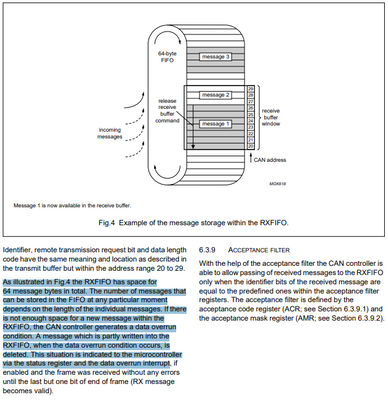
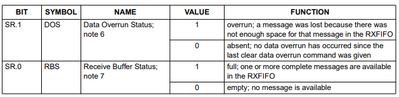

With Best Regards,
Jozef
- Mark as New
- Bookmark
- Subscribe
- Mute
- Subscribe to RSS Feed
- Permalink
- Report Inappropriate Content
Hi, Sir,
Excuse me, I know the overrun condition, but I want to ask a condition:
Before the overrun condition was happened or else RX abnormal condition, will the overload frame be issued on the CAN bus by this controller?
JozefKozon
- Mark as New
- Bookmark
- Subscribe
- Mute
- Subscribe to RSS Feed
- Permalink
- Report Inappropriate Content
Hi SamLee1805,
I have contacted an application engineer with the question and he just sent me an answer. Please see below and a application note attached.
DESCRIPTION
Pls check Table 6 of SJA1000 App hint.
https://www.nxp.com.cn/docs/en/application-note/AN97076.pdf
With Best Regards,
Jozef
- Mark as New
- Bookmark
- Subscribe
- Mute
- Subscribe to RSS Feed
- Permalink
- Report Inappropriate Content
I can't find the answer about this question,could you tell me which item of the table 6 to meet my question?
JozefKozon
- Mark as New
- Bookmark
- Subscribe
- Mute
- Subscribe to RSS Feed
- Permalink
- Report Inappropriate Content
Hi SamLee1805,
I apologize for not having an answer yet. So far I haven't received a reply from the application engineer. Today I have added more engineers in the loop. Hopefully they will answer me soon.
Thank you for your patience.
With Best Regards,
Jozef
JozefKozon
- Mark as New
- Bookmark
- Subscribe
- Mute
- Subscribe to RSS Feed
- Permalink
- Report Inappropriate Content
Hi SamLee1805,
please see below an answer from the application engineer I have just received.
DESCRIPTION
An application expert, at the time involved in the design of the SJA1000, came with the following extensive reply:
The so-called “Overload Frame” feature of CAN is from the very first days of CAN in the 1990th and was required for the very first CAN implementations just having a simple Receiver Buffer, which was needed to be read by the host on very short notice before the next frame comes in. At that time, Bosch invented the Overload Frame feature to allow a node pushing-out the next frame on the bus without any penalty of Error Counting in other nodes in the system. Actually, this feature was needed at that time due to the super slow first devices with very poor receive buffer construction.
This Overload Frame feature was never really wanted by any customer and as such, newer devices implemented more powerful receive buffer constructions with according Acceptance Filtering. These devices do not send any Overload Frame, even if the buffer internally would overflow. With other words: The SJA1000 does not actively send any Overload Frame, even if the buffer is full. In case of an overflow in the FIFO, the application loses frames. Nevertheless, every CAN compliant implementation has to tolerate overload frames from other nodes and has to behave accordingly and extend the time between frames. To my knowledge, there are no products in the market, which intentionally drive overload frames since no OEM would like to have such things in a system. Overload Frames would make the CAN bus less predictable with respect to available band width. So, nobody would send such frames today.
With Best Regards,
Jozef
