
- Forums
- Product Forums
- General Purpose MicrocontrollersGeneral Purpose Microcontrollers
- i.MX Forumsi.MX Forums
- QorIQ Processing PlatformsQorIQ Processing Platforms
- Identification and SecurityIdentification and Security
- Power ManagementPower Management
- Wireless ConnectivityWireless Connectivity
- RFID / NFCRFID / NFC
- Advanced AnalogAdvanced Analog
- Neural Processing UnitsNeural Processing Units
- MCX Microcontrollers
- S32G
- S32K
- S32V
- MPC5xxx
- Other NXP Products
- S12 / MagniV Microcontrollers
- Powertrain and Electrification Analog Drivers
- Sensors
- Vybrid Processors
- Digital Signal Controllers
- 8-bit Microcontrollers
- ColdFire/68K Microcontrollers and Processors
- PowerQUICC Processors
- OSBDM and TBDML
- S32M
- S32Z/E
-
- Solution Forums
- Software Forums
- MCUXpresso Software and ToolsMCUXpresso Software and Tools
- CodeWarriorCodeWarrior
- MQX Software SolutionsMQX Software Solutions
- Model-Based Design Toolbox (MBDT)Model-Based Design Toolbox (MBDT)
- FreeMASTER
- eIQ Machine Learning Software
- Embedded Software and Tools Clinic
- S32 SDK
- S32 Design Studio
- GUI Guider
- Zephyr Project
- Voice Technology
- Application Software Packs
- Secure Provisioning SDK (SPSDK)
- Processor Expert Software
- Generative AI & LLMs
-
- Topics
- Mobile Robotics - Drones and RoversMobile Robotics - Drones and Rovers
- NXP Training ContentNXP Training Content
- University ProgramsUniversity Programs
- Rapid IoT
- NXP Designs
- SafeAssure-Community
- OSS Security & Maintenance
- Using Our Community
-
- Cloud Lab Forums
-
- Knowledge Bases
- ARM Microcontrollers
- i.MX Processors
- Identification and Security
- Model-Based Design Toolbox (MBDT)
- QorIQ Processing Platforms
- S32 Automotive Processing Platform
- Wireless Connectivity
- CodeWarrior
- MCUXpresso Suite of Software and Tools
- MQX Software Solutions
- RFID / NFC
- Advanced Analog
- Neural Processing Units
-
- NXP Tech Blogs
- Home
- :
- i.MX Forums
- :
- i.MX Processors
- :
- i.MX6: how to use RTS/CTS properly using UART (DTE/DCE)
i.MX6: how to use RTS/CTS properly using UART (DTE/DCE)
- Subscribe to RSS Feed
- Mark Topic as New
- Mark Topic as Read
- Float this Topic for Current User
- Bookmark
- Subscribe
- Mute
- Printer Friendly Page

- Mark as New
- Bookmark
- Subscribe
- Mute
- Subscribe to RSS Feed
- Permalink
- Report Inappropriate Content
I have read a lot of posts in this community and on the internet
and the datasheet but I'm still confused about the RTS/CTS management with i.MX6.
Looks line any board is supporting these signals properly nor anybody really cares about them,
so I wonder if someone out there has experienced and solved this problem.
https://community.freescale.com/docs/DOC-97509
I need to reproduce the behaviour I have connecting two PCs with a
Loopback handshaking null modem cable
https://en.wikipedia.org/wiki/Null_modem#Loopback_handshaking
If I use 2 PCs I see RTS low during the transmission of data on TX
Using an i.MX6 UART3 (/dev/ttymxc2) configured in the Device Tree as follows
I get this 2 different behaviours depending on the "fsl,dte-mode" only.
TX and RTS are normally low
If I set "fsl,dte-mode" I see RTS going high during a period of time similar to the trasmission of data
but there is no data exiting out on TX
If I comment (unset) "fsl,dte-mode" I see data exiting out on TX
but RTS is always low not moving and not handshaking data.
Would be possible to use RTS/CTS like a PC does?
I tested this with linux kernel 3.14.28 and 4.1.15 without success.
pinctrl_uart3_mh: uart3grp-mh {
fsl,pins = <
MX6QDL_PAD_EIM_D25__UART3_RX_DATA 0x1b0b1
MX6QDL_PAD_EIM_D24__UART3_TX_DATA 0x1b0b1
MX6QDL_PAD_EIM_D23__UART3_CTS_B 0x1b0b1
MX6QDL_PAD_EIM_D31__UART3_RTS_B 0x1b0b1
>;
};
&uart3 { // /dev/ttymxc2
pinctrl-names = "default";
pinctrl-0 = <&pinctrl_uart3_mh>;
fsl,uart-has-rtscts;
fsl,dte-mode;
status = "okay";
};
Any hint would be greatly appreciated.
TIA
Solved! Go to Solution.
- Mark as New
- Bookmark
- Subscribe
- Mute
- Subscribe to RSS Feed
- Permalink
- Report Inappropriate Content
At last I understood the behaviour and solved the problem.
This post explains everything perfectly: https://community.freescale.com/docs/DOC-97509
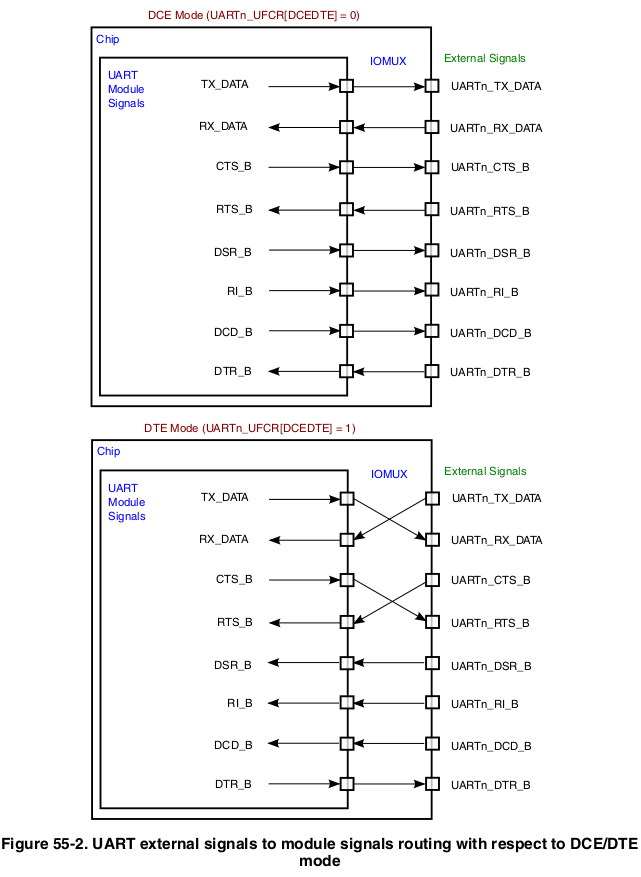
Be careful: dte-mode swaps RTS/CTS and TX/RX pins

- Mark as New
- Bookmark
- Subscribe
- Mute
- Subscribe to RSS Feed
- Permalink
- Report Inappropriate Content
Anyone really solved this issue with the above device tree along above device tree? I see its solved but looks like there is no solution provided.
- Mark as New
- Bookmark
- Subscribe
- Mute
- Subscribe to RSS Feed
- Permalink
- Report Inappropriate Content
Hi there. There is no possibility to swap RX<=>TX without swapping CTS<=>RTS.
You can swap RX <=> TX if you don't use CTS and RTS easily.
If you use TX/RX and CTS/RTS - and want to то swap only one of them => you must do it in hardware.
- Mark as New
- Bookmark
- Subscribe
- Mute
- Subscribe to RSS Feed
- Permalink
- Report Inappropriate Content
Hi
Thanks for responding.
We had a mistake in our board, RX &TX, CTS & RTS are connected 1 to 1 directly to the device from iMX8, and below is the existing Hardware connection done on our board. It's impossible to do the hardware reworked to swap these signals. Instead, I would like to swap inside the IO Port and IOMUX.
| Existing UART Connections Between iMX8 & BT Device | ||||
| UART IP port, Internal | IO Direction | iMX8 PIN OUT | Device Side Signals & Pins Connected | |
| RTS_B | I | UART_RTS_B | UART_RTS | |
| CTS_B | O | UART_CTS_B | UART_CTS | |
| RXD | I | UART_RXD | UART_RXD | |
| TXD | O | UART_TXD | UART_TXD | |
I have updated the device tree with the like below and I am trying to use UART3 in DTE mode. New UART Swap within the iMX8 and BT Device connection | ||||
| DTE Mode (DCEDTE=1) | ||||
| UART IP port, Internal | IO Direction | iMX8 PIN OUT | Device Side Signals & Pins Connected | |
| RTS_B | I | UART_CTS_B | UART_RTS | |
| CTS_B | O | UART_RTS_B | UART_CTS | |
| RXD | I | UART_TXD | UART_RXD | |
| TXD | O | UART_RXD | UART_TXD |
Can someone explain, WIll this New IOMUX swap work with the device connected?
How do we set UARTxUFCR[DTEDCE] bit? Is it the same as "fsl,dte-mode"set"?
I also followed this link to read about Swapping in the IOMUX and the possible solution I could See. but I couldn't see any transaction on the TX/RX signals?
Can someone provide me the link to this solution, As this is saying solved?
Thanks,
Peri
- Mark as New
- Bookmark
- Subscribe
- Mute
- Subscribe to RSS Feed
- Permalink
- Report Inappropriate Content
Hi.
1. I am not sure that IMX8 has the same problem with uart as imx6.
2. You can try next: not use CTS/RTS from uart. Use them as GPIO and set high level to enable transmit from other side. Some of devices perfectly work on speeds up to 115200.
- Mark as New
- Bookmark
- Subscribe
- Mute
- Subscribe to RSS Feed
- Permalink
- Report Inappropriate Content
Thanks a lot!
I read several threads about this problem (replacing RTS/CTS in the documentation from NXP regarding the standard description of these lines) - many developers made such a mistake (I made one too). And this solution (declaring them GPIO and setting static levels) really works (tested on IMX8).
It would be nice if NXP included this solution in the documentation.
Best regards,
- Mark as New
- Bookmark
- Subscribe
- Mute
- Subscribe to RSS Feed
- Permalink
- Report Inappropriate Content
Hi there. I have digged around of the topic.
I would like to finish this topic with one clear though: There is no possibility to swap RX<=>TX without swapping CTS<=>RTS.
@igorpadykov Is it right?

 igorpadykov
- Mark as New
- Bookmark
- Subscribe
- Mute
- Subscribe to RSS Feed
- Permalink
- Report Inappropriate Content
right
Best regards
igor
- Mark as New
- Bookmark
- Subscribe
- Mute
- Subscribe to RSS Feed
- Permalink
- Report Inappropriate Content
At last I understood the behaviour and solved the problem.
This post explains everything perfectly: https://community.freescale.com/docs/DOC-97509
Be careful: dte-mode swaps RTS/CTS and TX/RX pins
- Mark as New
- Bookmark
- Subscribe
- Mute
- Subscribe to RSS Feed
- Permalink
- Report Inappropriate Content
In addition I'm attaching the excerpt from NXP documentation
Marco Cavallini | KOAN sas | Bergamo - Italia
embedded software engineering
https://KoanSoftware.com

- Mark as New
- Bookmark
- Subscribe
- Mute
- Subscribe to RSS Feed
- Permalink
- Report Inappropriate Content
It took several iterations on both the i.MX6 side and the other, but eventually we did get CTS/RTS working on our 6Q custom board. We're using the default DCE mode for the UART. We set the "fsl,uart-has-rtscts" property on the uart in the device tree for the driver to make use of the pins, and use the "stty -F /dev/ttymxc<n> crtscts" command to turn it on.
- Mark as New
- Bookmark
- Subscribe
- Mute
- Subscribe to RSS Feed
- Permalink
- Report Inappropriate Content
Thank you madisox,
During my tests I use minicom, so the Hardware Flow Control is activated like you did with "stty -F /dev/ttymxc<n> crtscts" command.
I can't use the default DCE mode for the UART because I need that the RTS signal operated like with PC, so normally high and gets low when I want to TX.
The huge problem here is that if I enable dte-mode in the DeviceTree I don't have any data out on the TX line (even though I connect RTS to CTS to enable transmission), and I wonder if this is a silicon bug or a lack in the imx.c driver.
Any further help would be greatly appreciated.
TIA

- Mark as New
- Bookmark
- Subscribe
- Mute
- Subscribe to RSS Feed
- Permalink
- Report Inappropriate Content
Thanks Macro Cavallini
 weidong_sun
- Mark as New
- Bookmark
- Subscribe
- Mute
- Subscribe to RSS Feed
- Permalink
- Report Inappropriate Content
Hello Marco
Yes, we are often confused about these 2 concepts on UART port. Let me give you my explanation to you :
DCE side: provide clock to other side(DTE). In the mode, CTS is OUTPUT, RTS is INPUT.
DTE side: working with clock from DCT. In the mode, CTS is INPUT, RTS is OUTPUT.
Gernerally speaking, before you connect one device to the other, you only need to confirm CTS & RTS directions of UART for 2 devices. For example, connecting UART of I.MX6 to that of PC.
PC( usually, DTE device): PC_UART_CTS ----INPUT; PC_UART_RTS---OUTPUT.
I.MX6(using DCE mode); MX6_UART_CTS---OUTPUT; MX6_UART_RTS--INPUT.
Connect 2 devices together:
PC_UART_CTS-------MX6_UART_CTS
PC_UART_RTS-------MX6_UART_RTS
But if you set I.MX6 UART DTE mode, it means:
I.MX6(using DTE mode); MX6_UART_CTS---INPUT; MX6_UART_RTS--OUTPUT.
conections will be changed:
PC_UART_CTS-------MX6_UART_RTS
PC_UART_RTS-------MX6_UART_CTS
You only need to ensure signal directions are correct !
Hope above explanation can help you !
Regards,
Weidong
- Mark as New
- Bookmark
- Subscribe
- Mute
- Subscribe to RSS Feed
- Permalink
- Report Inappropriate Content
Hi Weidong,
thank you for answering.
I tried doing the way you told me, but I can't see any change.
I measured the signals TX,RX,RTS,CTS with a scope directly on the CPU pin (TTL) before the TTL-RS232 converter (I removed it)
The signals operate in the same manner and I didn't notice any swap on their behaviour.
The result of my test is that if I enable dte-mode in the DeviceTree I don't have any data out on the TX line
This is what I see transmitting a single char using minicom with a PC
When I use the iMX6 based board (/dev/ttymxc2) the RTS line is the same (high) but TX is always low and no data exit out.
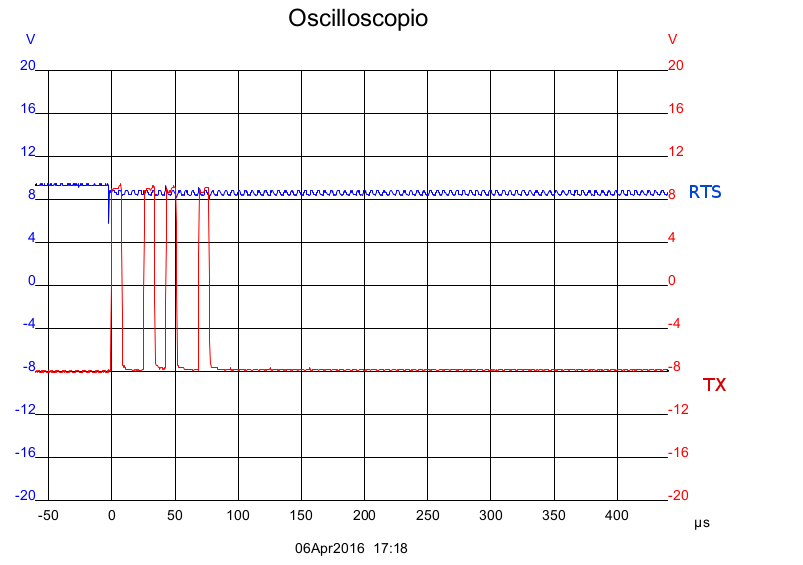
I tried these settings
// DCE mode : standard
MX6QDL_PAD_EIM_D25__UART3_RX_DATA 0x1b0b1
MX6QDL_PAD_EIM_D24__UART3_TX_DATA 0x1b0b1
MX6QDL_PAD_EIM_D23__UART3_CTS_B 0x1b0b1
MX6QDL_PAD_EIM_D31__UART3_RTS_B 0x1b0b1
// DTE mode : requires fsl,dte-mode; (RTS/CTS inverted)
MX6QDL_PAD_EIM_D25__UART3_RX_DATA 0x1b0b1
MX6QDL_PAD_EIM_D24__UART3_TX_DATA 0x1b0b1
MX6QDL_PAD_EIM_D23__UART3_RTS_B 0x1b0b1
MX6QDL_PAD_EIM_D31__UART3_CTS_B 0x1b0b1
// DTE mode : requires fsl,dte-mode; (all inverted)
MX6QDL_PAD_EIM_D25__UART3_TX_DATA 0x1b0b1
MX6QDL_PAD_EIM_D24__UART3_RX_DATA 0x1b0b1
MX6QDL_PAD_EIM_D23__UART3_RTS_B 0x1b0b1
MX6QDL_PAD_EIM_D31__UART3_CTS_B 0x1b0b1
I'm even more confused.
