
- Forums
- Product Forums
- General Purpose MicrocontrollersGeneral Purpose Microcontrollers
- i.MX Forumsi.MX Forums
- QorIQ Processing PlatformsQorIQ Processing Platforms
- Identification and SecurityIdentification and Security
- Power ManagementPower Management
- Wireless ConnectivityWireless Connectivity
- RFID / NFCRFID / NFC
- Advanced AnalogAdvanced Analog
- Neural Processing UnitsNeural Processing Units
- MCX Microcontrollers
- S32G
- S32K
- S32V
- MPC5xxx
- Other NXP Products
- S12 / MagniV Microcontrollers
- Powertrain and Electrification Analog Drivers
- Sensors
- Vybrid Processors
- Digital Signal Controllers
- 8-bit Microcontrollers
- ColdFire/68K Microcontrollers and Processors
- PowerQUICC Processors
- OSBDM and TBDML
- S32M
- S32Z/E
-
- Solution Forums
- Software Forums
- MCUXpresso Software and ToolsMCUXpresso Software and Tools
- CodeWarriorCodeWarrior
- MQX Software SolutionsMQX Software Solutions
- Model-Based Design Toolbox (MBDT)Model-Based Design Toolbox (MBDT)
- FreeMASTER
- eIQ Machine Learning Software
- Embedded Software and Tools Clinic
- S32 SDK
- S32 Design Studio
- GUI Guider
- Zephyr Project
- Voice Technology
- Application Software Packs
- Secure Provisioning SDK (SPSDK)
- Processor Expert Software
- Generative AI & LLMs
-
- Topics
- Mobile Robotics - Drones and RoversMobile Robotics - Drones and Rovers
- NXP Training ContentNXP Training Content
- University ProgramsUniversity Programs
- Rapid IoT
- NXP Designs
- SafeAssure-Community
- OSS Security & Maintenance
- Using Our Community
-
- Cloud Lab Forums
-
- Knowledge Bases
- ARM Microcontrollers
- i.MX Processors
- Identification and Security
- Model-Based Design Toolbox (MBDT)
- QorIQ Processing Platforms
- S32 Automotive Processing Platform
- Wireless Connectivity
- CodeWarrior
- MCUXpresso Suite of Software and Tools
- MQX Software Solutions
- RFID / NFC
- Advanced Analog
- Neural Processing Units
-
- NXP Tech Blogs
- Home
- :
- MCUXpresso Software and Tools
- :
- Kinetis Software Development Kit
- :
- How to use CDC VCOM example with printf?
How to use CDC VCOM example with printf?
- Subscribe to RSS Feed
- Mark Topic as New
- Mark Topic as Read
- Float this Topic for Current User
- Bookmark
- Subscribe
- Mute
- Printer Friendly Page

- Mark as New
- Bookmark
- Subscribe
- Mute
- Subscribe to RSS Feed
- Permalink
- Report Inappropriate Content
Hi,
Using KDS3.2, SDK 2.0. I would like to implement a virtual com port in our project. I have the dev_cdc_vcom_lite_bm_frdmk22f example project working fine. I see where and how it reads the received characters and writes them back. I cant see it anywhere obvious but is there an example project or easy way of redirecting some sort of formatted input and output to the virtual com port. Currently standard IO is redirected to the debug UART which I am also using. So... I would like to be able to use formatted output for multiple UARTs. Actually I have three I need to send to!
This would make a good advancement on the example demo project...
Any help would be appreciated
Regards
Ashley
Solved! Go to Solution.

 jorge_a_vazquez
- Mark as New
- Bookmark
- Subscribe
- Mute
- Subscribe to RSS Feed
- Permalink
- Report Inappropriate Content
Hi Ashley Duncan
If you are still interested of this, I have changed the SDK 2.0 dev_cdc_vcom_bm_frdmk22f example, You have to add some code that is not implemented in sdk:
Debug console is configured to be used with UART, so you need to change its default configuration to use USB. in fsl_debug_console.c I added USB library:
#include "usb_device_config.h"
#include "usb.h"
#include "usb_device.h"
#include "usb_device_class.h"
#include "usb_device_descriptor.h"
#include "virtual_com.h"
If you check in this file you will find a DebugConsoleOperationFunctions structure that define functions for debug console, so inside here I define a USB_Send and a USB_Receive:
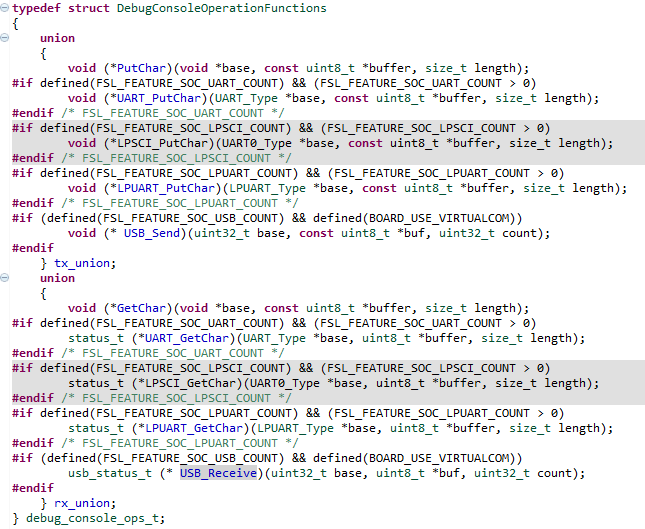
DbgConsole_Init function is called to set the function pointers to the function that will handler the read and write function, inside this function you can find a switch case that use for example DEBUG_CONSOLE_DEVICE_TYPE_UART or DEBUG_CONSOLE_DEVICE_TYPE_LPSCI. This macros are defined in fsl_common.h, here you can also find a DEBUG_CONSOLE_DEVICE_TYPE_USBCDC, so I used this to add the case branch.
case DEBUG_CONSOLE_DEVICE_TYPE_USBCDC:
{
//VirtualCom_Init();
s_debugConsole.base = s_cdcVcom.deviceHandle;
s_debugConsole.ops.tx_union.USB_Send = VirtualCom_SendDataBlocking;
s_debugConsole.ops.rx_union.USB_Receive = VirtualCom_ReceiveDataBlocking;
}
break;As you can see, I comment the VirtualCom_Init, this is because I going to initiate this in the application. So, my USB_Send and USB_Receive points to two function that will send through USB and they are user defined in other part of the code (I going to defined in the main file), so I need to defined as extern.
extern usb_cdc_vcom_struct_t s_cdcVcom;
extern void VirtualCom_SendDataBlocking (uint32_t base, const uint8_t *buf, uint32_t count);
extern usb_status_t VirtualCom_ReceiveDataBlocking (uint32_t base, uint8_t *buf, uint32_t count);There is also a DbgConsole_Deinit function, in this case you can also add the case for USB deinit.
This is all that you need to do to point some functions to USB application, now in virtual_com.c file I define my function as:
void VirtualCom_SendDataBlocking (uint32_t base, const uint8_t *buf, uint32_t count) {
usb_status_t error = kStatus_USB_Success;
if ((buf == NULL) || (base == NULL))
{
error = kStatus_USB_InvalidParameter;
}
else
{
if ((1 != s_cdcVcom.attach) && (1 != s_cdcVcom.startTransactions))
{
error=kStatus_USB_ControllerNotFound;
}
else
{
memcpy(s_currSendBuf, buf, count > DATA_BUFF_SIZE ? DATA_BUFF_SIZE : count);
if (USB_DeviceCdcAcmSend(s_cdcVcom.cdcAcmHandle, USB_CDC_VCOM_BULK_IN_ENDPOINT, s_currSendBuf, count > DATA_BUFF_SIZE ? DATA_BUFF_SIZE : count) != kStatus_USB_Success)
{
/* Failure to send Data Handling code here */
} else {
/* Wait until transmission are done */
while (!g_sendFinished) {};
g_sendFinished = false;
}
}
}
}
usb_status_t VirtualCom_ReceiveDataBlocking (uint32_t base, uint8_t *buf, uint32_t count) {
usb_status_t error = kStatus_USB_Success;
if ((buf == NULL) || (base == NULL)) {
error = kStatus_USB_InvalidParameter;
} else {
/* validate that count is not greater than bulk max size */
if (USB_DeviceCdcAcmRecv(s_cdcVcom.cdcAcmHandle, USB_CDC_VCOM_BULK_OUT_ENDPOINT,
s_currRecvBuf, g_UsbDeviceCdcVcomDicEndpoints[0].maxPacketSize) != kStatus_USB_Success)
{
error = kStatus_USB_TransferFailed;
/* Failure to received Data Handling code here */
} else {
while (!g_receiveDone) {};
memcpy(buf, s_currRecvBuf, g_UsbDeviceCdcVcomDicEndpoints[0].maxPacketSize != count ? g_UsbDeviceCdcVcomDicEndpoints[0].maxPacketSize : count);
g_receiveDone = false;
}
}
return error;
}As you can see here, I use two global variable, g_sendFinished and g_receiveDone (they are initialized as false). In usb libraries there is a function that handle CDC specific requests, here you can find a kUSB_DeviceCdcEventSendResponse and a kUSB_DeviceCdcEventRecvResponse. This functions are implemented to work with the example code of a loopback, I will modify them with my own receive and send event:
case kUSB_DeviceCdcEventSendResponse:
/*More code.......*/
#if Original
USB_DeviceCdcAcmRecv(handle, USB_CDC_VCOM_BULK_OUT_ENDPOINT, s_currRecvBuf,g_UsbDeviceCdcVcomDicEndpoints[0].maxPacketSize);
#elif My_app_debug
g_sendFinished = true;
#endif
/*More code.......*/
case kUSB_DeviceCdcEventRecvResponse:
{
if ((1 == s_cdcVcom.attach) && (1 == s_cdcVcom.startTransactions))
{
s_recvSize = epCbParam->length;
#if My_app_debug
g_receiveDone = true;
#endif
/*More code.......*/So, my two functions will be blocked until this events occurs (using my global variables).
And this is all that you have to do to defined your send and recieve functions, now in main() you find a BOARD_InitDebugConsole(); and inside you see that they used the DbgConsole_Init that we have previously modify, so I changed as:
void BOARD_InitDebugConsole(void)
{
uint32_t uartClkSrcFreq = BOARD_DEBUG_UART_CLK_FREQ;
// DbgConsole_Init(BOARD_DEBUG_UART_BASEADDR, BOARD_DEBUG_UART_BAUDRATE, BOARD_DEBUG_UART_TYPE, uartClkSrcFreq);
DbgConsole_Init(BOARD_DEBUG_USBCDC_INSTANCE, BOARD_DEBUG_USBCDC_BAUD, DEBUG_CONSOLE_DEVICE_TYPE_USBCDC,0);
}(you going to need to define BOARD_DEBUG_USBCDC_INSTANCE and BOARD_DEBUG_USBCDC_BAUD)
Now as this function used s_cdcVcom.deviceHandle I need VirtualCom_Init() to be called first, so in main
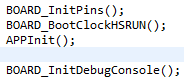
APPInit will call it.
I implemented a basic PRINTF("Hello\n\r"); to prof my program:

Hope this could help you, I have attached my code as reference (you need to locate it in the same path of the example code because it use USB and SDK linked paths).
Best Regards
Jorge Alcala
jorge_a_vazquez
- Mark as New
- Bookmark
- Subscribe
- Mute
- Subscribe to RSS Feed
- Permalink
- Report Inappropriate Content
Hi Ashley Duncan
If you are still interested of this, I have changed the SDK 2.0 dev_cdc_vcom_bm_frdmk22f example, You have to add some code that is not implemented in sdk:
Debug console is configured to be used with UART, so you need to change its default configuration to use USB. in fsl_debug_console.c I added USB library:
#include "usb_device_config.h"
#include "usb.h"
#include "usb_device.h"
#include "usb_device_class.h"
#include "usb_device_descriptor.h"
#include "virtual_com.h"
If you check in this file you will find a DebugConsoleOperationFunctions structure that define functions for debug console, so inside here I define a USB_Send and a USB_Receive:
DbgConsole_Init function is called to set the function pointers to the function that will handler the read and write function, inside this function you can find a switch case that use for example DEBUG_CONSOLE_DEVICE_TYPE_UART or DEBUG_CONSOLE_DEVICE_TYPE_LPSCI. This macros are defined in fsl_common.h, here you can also find a DEBUG_CONSOLE_DEVICE_TYPE_USBCDC, so I used this to add the case branch.
case DEBUG_CONSOLE_DEVICE_TYPE_USBCDC:
{
//VirtualCom_Init();
s_debugConsole.base = s_cdcVcom.deviceHandle;
s_debugConsole.ops.tx_union.USB_Send = VirtualCom_SendDataBlocking;
s_debugConsole.ops.rx_union.USB_Receive = VirtualCom_ReceiveDataBlocking;
}
break;As you can see, I comment the VirtualCom_Init, this is because I going to initiate this in the application. So, my USB_Send and USB_Receive points to two function that will send through USB and they are user defined in other part of the code (I going to defined in the main file), so I need to defined as extern.
extern usb_cdc_vcom_struct_t s_cdcVcom;
extern void VirtualCom_SendDataBlocking (uint32_t base, const uint8_t *buf, uint32_t count);
extern usb_status_t VirtualCom_ReceiveDataBlocking (uint32_t base, uint8_t *buf, uint32_t count);There is also a DbgConsole_Deinit function, in this case you can also add the case for USB deinit.
This is all that you need to do to point some functions to USB application, now in virtual_com.c file I define my function as:
void VirtualCom_SendDataBlocking (uint32_t base, const uint8_t *buf, uint32_t count) {
usb_status_t error = kStatus_USB_Success;
if ((buf == NULL) || (base == NULL))
{
error = kStatus_USB_InvalidParameter;
}
else
{
if ((1 != s_cdcVcom.attach) && (1 != s_cdcVcom.startTransactions))
{
error=kStatus_USB_ControllerNotFound;
}
else
{
memcpy(s_currSendBuf, buf, count > DATA_BUFF_SIZE ? DATA_BUFF_SIZE : count);
if (USB_DeviceCdcAcmSend(s_cdcVcom.cdcAcmHandle, USB_CDC_VCOM_BULK_IN_ENDPOINT, s_currSendBuf, count > DATA_BUFF_SIZE ? DATA_BUFF_SIZE : count) != kStatus_USB_Success)
{
/* Failure to send Data Handling code here */
} else {
/* Wait until transmission are done */
while (!g_sendFinished) {};
g_sendFinished = false;
}
}
}
}
usb_status_t VirtualCom_ReceiveDataBlocking (uint32_t base, uint8_t *buf, uint32_t count) {
usb_status_t error = kStatus_USB_Success;
if ((buf == NULL) || (base == NULL)) {
error = kStatus_USB_InvalidParameter;
} else {
/* validate that count is not greater than bulk max size */
if (USB_DeviceCdcAcmRecv(s_cdcVcom.cdcAcmHandle, USB_CDC_VCOM_BULK_OUT_ENDPOINT,
s_currRecvBuf, g_UsbDeviceCdcVcomDicEndpoints[0].maxPacketSize) != kStatus_USB_Success)
{
error = kStatus_USB_TransferFailed;
/* Failure to received Data Handling code here */
} else {
while (!g_receiveDone) {};
memcpy(buf, s_currRecvBuf, g_UsbDeviceCdcVcomDicEndpoints[0].maxPacketSize != count ? g_UsbDeviceCdcVcomDicEndpoints[0].maxPacketSize : count);
g_receiveDone = false;
}
}
return error;
}As you can see here, I use two global variable, g_sendFinished and g_receiveDone (they are initialized as false). In usb libraries there is a function that handle CDC specific requests, here you can find a kUSB_DeviceCdcEventSendResponse and a kUSB_DeviceCdcEventRecvResponse. This functions are implemented to work with the example code of a loopback, I will modify them with my own receive and send event:
case kUSB_DeviceCdcEventSendResponse:
/*More code.......*/
#if Original
USB_DeviceCdcAcmRecv(handle, USB_CDC_VCOM_BULK_OUT_ENDPOINT, s_currRecvBuf,g_UsbDeviceCdcVcomDicEndpoints[0].maxPacketSize);
#elif My_app_debug
g_sendFinished = true;
#endif
/*More code.......*/
case kUSB_DeviceCdcEventRecvResponse:
{
if ((1 == s_cdcVcom.attach) && (1 == s_cdcVcom.startTransactions))
{
s_recvSize = epCbParam->length;
#if My_app_debug
g_receiveDone = true;
#endif
/*More code.......*/So, my two functions will be blocked until this events occurs (using my global variables).
And this is all that you have to do to defined your send and recieve functions, now in main() you find a BOARD_InitDebugConsole(); and inside you see that they used the DbgConsole_Init that we have previously modify, so I changed as:
void BOARD_InitDebugConsole(void)
{
uint32_t uartClkSrcFreq = BOARD_DEBUG_UART_CLK_FREQ;
// DbgConsole_Init(BOARD_DEBUG_UART_BASEADDR, BOARD_DEBUG_UART_BAUDRATE, BOARD_DEBUG_UART_TYPE, uartClkSrcFreq);
DbgConsole_Init(BOARD_DEBUG_USBCDC_INSTANCE, BOARD_DEBUG_USBCDC_BAUD, DEBUG_CONSOLE_DEVICE_TYPE_USBCDC,0);
}(you going to need to define BOARD_DEBUG_USBCDC_INSTANCE and BOARD_DEBUG_USBCDC_BAUD)
Now as this function used s_cdcVcom.deviceHandle I need VirtualCom_Init() to be called first, so in main
APPInit will call it.
I implemented a basic PRINTF("Hello\n\r"); to prof my program:
Hope this could help you, I have attached my code as reference (you need to locate it in the same path of the example code because it use USB and SDK linked paths).
Best Regards
Jorge Alcala
- Mark as New
- Bookmark
- Subscribe
- Mute
- Subscribe to RSS Feed
- Permalink
- Report Inappropriate Content
To add to this... I wondered if I could uses fprintf and have handles to my various ports in the and _write function. But, I get a hard fault if I try call fprintf. Calling printf works fine and calls the _write function. However, there does seem to be some sort of built in internal buffering in the debug printf implementation as the _write function is not hit until you try resume execution!
