
- Forums
- Product Forums
- General Purpose MicrocontrollersGeneral Purpose Microcontrollers
- i.MX Forumsi.MX Forums
- QorIQ Processing PlatformsQorIQ Processing Platforms
- Identification and SecurityIdentification and Security
- Power ManagementPower Management
- Wireless ConnectivityWireless Connectivity
- RFID / NFCRFID / NFC
- Advanced AnalogAdvanced Analog
- Neural Processing UnitsNeural Processing Units
- MCX Microcontrollers
- S32G
- S32K
- S32V
- MPC5xxx
- Other NXP Products
- S12 / MagniV Microcontrollers
- Powertrain and Electrification Analog Drivers
- Sensors
- Vybrid Processors
- Digital Signal Controllers
- 8-bit Microcontrollers
- ColdFire/68K Microcontrollers and Processors
- PowerQUICC Processors
- OSBDM and TBDML
- S32M
- S32Z/E
-
- Solution Forums
- Software Forums
- MCUXpresso Software and ToolsMCUXpresso Software and Tools
- CodeWarriorCodeWarrior
- MQX Software SolutionsMQX Software Solutions
- Model-Based Design Toolbox (MBDT)Model-Based Design Toolbox (MBDT)
- FreeMASTER
- eIQ Machine Learning Software
- Embedded Software and Tools Clinic
- S32 SDK
- S32 Design Studio
- GUI Guider
- Zephyr Project
- Voice Technology
- Application Software Packs
- Secure Provisioning SDK (SPSDK)
- Processor Expert Software
- Generative AI & LLMs
-
- Topics
- Mobile Robotics - Drones and RoversMobile Robotics - Drones and Rovers
- NXP Training ContentNXP Training Content
- University ProgramsUniversity Programs
- Rapid IoT
- NXP Designs
- SafeAssure-Community
- OSS Security & Maintenance
- Using Our Community
-
- Cloud Lab Forums
-
- Knowledge Bases
- ARM Microcontrollers
- i.MX Processors
- Identification and Security
- Model-Based Design Toolbox (MBDT)
- QorIQ Processing Platforms
- S32 Automotive Processing Platform
- Wireless Connectivity
- CodeWarrior
- MCUXpresso Suite of Software and Tools
- MQX Software Solutions
- RFID / NFC
- Advanced Analog
- Neural Processing Units
-
- NXP Tech Blogs
- Home
- :
- QorIQプロセッシングプラットフォーム
- :
- QorIQナレッジベース
- :
- IPSec demo on T1040RDB
IPSec demo on T1040RDB
- RSS フィードを購読する
- 新着としてマーク
- 既読としてマーク
- ブックマーク
- 購読
- 印刷用ページ
- 不適切なコンテンツを報告
IPSec demo on T1040RDB
IPSec demo on T1040RDB
IPSec Performance Reproducibility Procedure on T1040RDB platform
1. Enable ASF in Linux Kernel
Step 1: Launch the kernel menu using the command: bitbake -c menuconfig virtual/kernel
Step 2: Enable ASF under Device Driver -> Networking device support -> Application Specific Fastpath
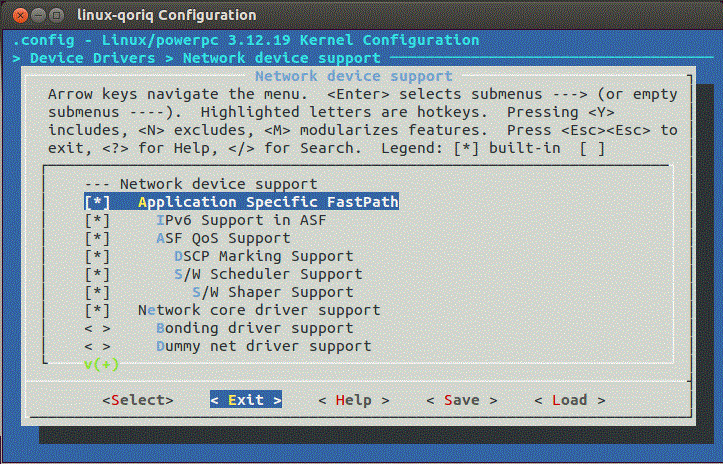
Step 3: Build the final binaries that needs to be loaded on T1040RDB using the command : bitbake fsl-image-core
NOTE: The ASF modules are compiled as dynamically loadable modules and placed in the ROOTFS under the path /usr/driver/asf/min and /usr/driver/asf/full
2. Steps to boot the board with 2 cores: (optional)
=> cpu 2 disable
=> cpu 3 disable
=> boot
Board configuration after Linux is up
A. Enable ip_forwarding and Linux performance parameters
- echo 1 > /proc/sys/net/ipv4/ip_forward
- echo 9000 > /proc/sys/net/netfilter/nf_conntrack_udp_timeout
- echo 9000 >/proc/sys/net/netfilter/nf_conntrack_udp_timeout_stream
B. Insmod ASF ko’s
- cd /usr/driver/asf/min
- insmod asf.ko
- insmod asfctrl.ko
- insmod asfipsec.ko
- insmod asfctrl_ipsec.ko
C. Run fmc command :
- cd /usr/driver/asf/scripts/fmc/
- fmc -s Soft_FragParser.xml -p asf-fman-perf-policy.xml -c asf-cfg-perf-2041.xml -a
D. Assign interface IP addresses and routes according to setup.
- Left DUT:
- ifconfig fm1-gb0 172.18.18.10 netmask 255.255.0.0 up
- ifconfig fm1-gb3 200.200.200.10/24 up
- ifconfig fm1-gb1 172.20.20.10 netmask 255.255.0.0 up
- ifconfig fm1-gb4 20.20.20.10/24 up
- route add -net 192.168.1.0/24 gw 172.18.18.2
- route add default gw 200.200.200.20
- route add -net 172.168.1.0/24 gw 172.20.20.2
- route add -net 172.168.2.0/24 gw 20.20.20.20
- arp -s 172.18.18.2 00:00:00:00:00:01 (optional)
- arp -s 172.20.20.2 00:00:00:00:00:02 (optional)
- Right DUT:
- ifconfig fm1-gb0 172.19.19.10 netmask 255.255.0.0 up
- ifconfig fm1-gb3 200.200.200.20/24 up
- ifconfig fm1-gb1 172.21.21.10 netmask 255.255.0.0 up
- ifconfig fm1-gb4 20.20.20.20/24 up
- route add -net 192.168.2.0/24 gw 172.19.19.2
- route add default gw 200.200.200.10
- route add -net 172.168.2.0/24 gw 172.21.21.2
- route add -net 172.168.1.0/24 gw 20.20.20.10
- arp -s 172.19.19.2 00:00:00:00:00:02 (optional)
- arp -s 172.21.21.2 00:00:00:00:00:04 (optional)
E. Configure IPSec policies and SAs (attached below that needs to be downloaded to the box via tftp or sftp)
- Left DUT:
- ./left_tun-4port-v1.txt
- Right DUT:
- ./right_tun-4port-v1.txt
F. Switch settings
- killall -9 l2sw_bin
- l2sw_bin
Using UIO: /dev/uio0
Mapped register memory @ 0xb7b3f000
Chipid: 099530e9
fsl_dpa ethernet.17 fm1-gb0: Err FD status = 0x00040000
fsl_dpa ethernet.18 fm1-gb1: Err FD status = 0x00040000
l2switch>
l2switch>mac add 00:00:00:00:00:01 3 [MAC 00:00...00:01 is reachable on port 3]
m2switch>mac add 00:00:00:00:00:03 7
l2switch>mac add 00:04:9f:03:30:f6 8 [MAC of fm1-gb0]
l2switch>mac add 00:04:9f:03:30:f7 9 [MAC of fm1-gb1]
l2switch>mac dump [Displays MACDB of switch (static & Dynamic)]
Type VID MAC Address Ports
------ --- ----------------- -----
Static 1 00:00:00:00:00:01 3
Static 1 00:00:00:00:00:03 7
Static 1 00:04:9f:03:30:f6 8
Static 1 00:04:9f:03:30:f7 9
Static entries: 4
Dynamic entries: 0
l2switch> l2switch>^Z [Press ctrl+z to stop the process]
[1]+ Stopped(SIGTSTP) l2sw_bin
root@t1040rdb:/mnt/sridhar/asf-bins/qos/bin/full#
- killall -9 l2sw_bin
G. Configure IXIA/STC to generate the traffic with 128 flows.
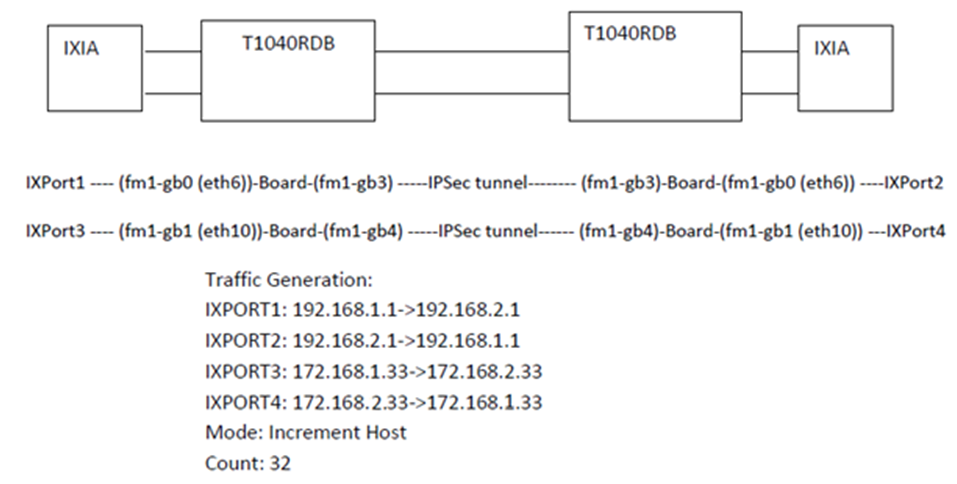
H. Start the traffic from both end and verify all the flows are offloaded and packet is going through IPSec ASF.
Note: Except switch settings everything is similar to previous performance releases by IDC.
I. The ASF flow can be observed using the following command
- cat /proc/asf/flow_debug
Script files
PFA in attachment