
- Forums
- Product Forums
- General Purpose MicrocontrollersGeneral Purpose Microcontrollers
- i.MX Forumsi.MX Forums
- QorIQ Processing PlatformsQorIQ Processing Platforms
- Identification and SecurityIdentification and Security
- Power ManagementPower Management
- Wireless ConnectivityWireless Connectivity
- RFID / NFCRFID / NFC
- Advanced AnalogAdvanced Analog
- Neural Processing UnitsNeural Processing Units
- MCX Microcontrollers
- S32G
- S32K
- S32V
- MPC5xxx
- Other NXP Products
- S12 / MagniV Microcontrollers
- Powertrain and Electrification Analog Drivers
- Sensors
- Vybrid Processors
- Digital Signal Controllers
- 8-bit Microcontrollers
- ColdFire/68K Microcontrollers and Processors
- PowerQUICC Processors
- OSBDM and TBDML
- S32M
- S32Z/E
-
- Solution Forums
- Software Forums
- MCUXpresso Software and ToolsMCUXpresso Software and Tools
- CodeWarriorCodeWarrior
- MQX Software SolutionsMQX Software Solutions
- Model-Based Design Toolbox (MBDT)Model-Based Design Toolbox (MBDT)
- FreeMASTER
- eIQ Machine Learning Software
- Embedded Software and Tools Clinic
- S32 SDK
- S32 Design Studio
- GUI Guider
- Zephyr Project
- Voice Technology
- Application Software Packs
- Secure Provisioning SDK (SPSDK)
- Processor Expert Software
- Generative AI & LLMs
-
- Topics
- Mobile Robotics - Drones and RoversMobile Robotics - Drones and Rovers
- NXP Training ContentNXP Training Content
- University ProgramsUniversity Programs
- Rapid IoT
- NXP Designs
- SafeAssure-Community
- OSS Security & Maintenance
- Using Our Community
-
- Cloud Lab Forums
-
- Knowledge Bases
- ARM Microcontrollers
- i.MX Processors
- Identification and Security
- Model-Based Design Toolbox (MBDT)
- QorIQ Processing Platforms
- S32 Automotive Processing Platform
- Wireless Connectivity
- CodeWarrior
- MCUXpresso Suite of Software and Tools
- MQX Software Solutions
- RFID / NFC
- Advanced Analog
- Neural Processing Units
-
- NXP Tech Blogs
- Home
- :
- i.MX Forums
- :
- i.MX Processors
- :
- iMX8M-Mini 4GB LPDDR4 RAM
iMX8M-Mini 4GB LPDDR4 RAM
- Subscribe to RSS Feed
- Mark Topic as New
- Mark Topic as Read
- Float this Topic for Current User
- Bookmark
- Subscribe
- Mute
- Printer Friendly Page
iMX8M-Mini 4GB LPDDR4 RAM

- Mark as New
- Bookmark
- Subscribe
- Mute
- Subscribe to RSS Feed
- Permalink
- Report Inappropriate Content
Hi, Is there a single chip LPDDR4 4GByte RAM chip that is compatible with the iMX8M-Mini processor?
- Mark as New
- Bookmark
- Subscribe
- Mute
- Subscribe to RSS Feed
- Permalink
- Report Inappropriate Content
Hi, Thanks for the info. I'm trying to decide which memory to use to design the iMX8M-Mini with 4GBytes RAM. I can only find x32 4GB parts that are QDP(quad die package) which the iMX8M-Mini doesn't support. The largest DDP (dual die package) LPDDR4 i can find is 2GB. What RAM configuration would you suggest i use to get 4GB RAM please?

- Mark as New
- Bookmark
- Subscribe
- Mute
- Subscribe to RSS Feed
- Permalink
- Report Inappropriate Content
Did you checked MT53D1024M32xxx? It has the same datasheet with DDR4 used in the reference design. I guess i.mx8 mini has control pins for 4 GByte DDR4 which are shown as NC(not connected) in 2 GB DDR4 schematic page and connected.
- Mark as New
- Bookmark
- Subscribe
- Mute
- Subscribe to RSS Feed
- Permalink
- Report Inappropriate Content
Hi, The iMX8M-Mini doesn't support QDP (Quad-Die, Dual-Channel, Dual-Rank Package) and the only 4GByte parts including the one you have mentioned are QDP. In that same datasheet the 2Gbyte part is DDP (Dual-Die, Dual-Channel, Single-Rank Package). I think we are going to go with a single chip 2Gbyte part design and hope a DDP 4Gbyte part is available in the future. Thanks for your input.
- Mark as New
- Bookmark
- Subscribe
- Mute
- Subscribe to RSS Feed
- Permalink
- Report Inappropriate Content
Hi Graeme,
Why do you think i.MX8M Mini doesn't support QDP ? We have successfully deployed Micron MT53D1024M32D4DT-053 on our i.MX8M Mini board.
Felix.
- Mark as New
- Bookmark
- Subscribe
- Mute
- Subscribe to RSS Feed
- Permalink
- Report Inappropriate Content
Hi Felix,
What changes have you made to support the Micron MT53D1024M32D4DT-053 on our i.MX8M please let me know. I am trying to integrate the exact same part in out custom board design.
- Mark as New
- Bookmark
- Subscribe
- Mute
- Subscribe to RSS Feed
- Permalink
- Report Inappropriate Content
Hi Felix,
What changes have you made to support the Micron MT53D1024M32D4DT-053 on our i.MX8M please let me know. I am trying to integrate the exact same part in out custom board design.
- Mark as New
- Bookmark
- Subscribe
- Mute
- Subscribe to RSS Feed
- Permalink
- Report Inappropriate Content
Hi Felix,
I am currently working on imx8mm with 4GB as well. How did you get 4GB works? what changes you made ?
I am using the latest kernel and uboot version, and I enabled CONFIG_IMX8M_4G_LPDDR4 in uboot and changed #define PHYS_SDRAM_SIZE to 0xC0000000 to make it work on 3GB. But if I change to 4GB, it won't boot up and shows "Error found for upper 32 bits".
Any idea for that?
Regards,
Jacob
- Mark as New
- Bookmark
- Subscribe
- Mute
- Subscribe to RSS Feed
- Permalink
- Report Inappropriate Content
Hi Graeme,
Please send datasheet of MT53D1024M32D4DT-053. I need to integrate it with imx8m quad processor.
- Mark as New
- Bookmark
- Subscribe
- Mute
- Subscribe to RSS Feed
- Permalink
- Report Inappropriate Content
Hi Felix,
I've just found this is an old email from one of our distributors, maybe he was wrong?
Please note that
MT53D1024M32D4DT-053 WT:D – 200ball VFBGA FBGA – DID Z11M
SDRAM 32Gb LPDDR4 1GX32 1.1V .- 1866 MHz – QDP
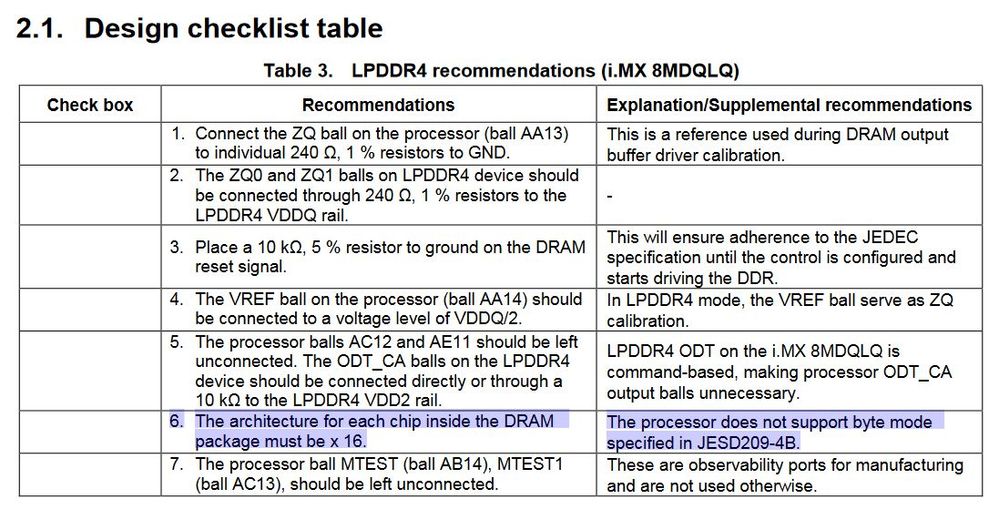
Is not supported because i.MX 8M Mini does not support byte mode which is required for quad die package (QDP) dual channel dual rank
Supported (JESD209-4B ) is dual die dual channel single rank (=32bit) and single die single channel single rank (=16bit) with x16mode
- Mark as New
- Bookmark
- Subscribe
- Mute
- Subscribe to RSS Feed
- Permalink
- Report Inappropriate Content
I wonder why you think that byte-mode would be a requirement on QDP LPDDR4?
Generally all LPDDR4, including the QDP ones, are running 16 bit wide per channel as a standard.
Operating the LPDDR4 components in byte-mode is just an optional way that the LPDDR4 memories allow, but the i.MX8 does not support it anyhow!
Thus I think you mixed something up.... there is no byte-mode-requirement for the i.MX8. In contrary, byte mode can not be used with i.MX8.
i.MX8 supports maximum 2 Chip Selects (=ranks), 2 Channels, 2 CKE.
Note: There are seperate pins for each channel's Chip-Select and CKE --> CS0_a, CS0_b, CS1_a, CS1_b and same for CKE. So some people might misunderstand this as 4 CS and 4 CKE
- Mark as New
- Bookmark
- Subscribe
- Mute
- Subscribe to RSS Feed
- Permalink
- Report Inappropriate Content
Hi Thorsten,
Thank you for the information, I will pass this on to our designer.
- Mark as New
- Bookmark
- Subscribe
- Mute
- Subscribe to RSS Feed
- Permalink
- Report Inappropriate Content
One more thing:
From a cost-perspective, DDR3L and DDR4 components are a lot cheaper "per Gigabit of Memory" than LPDDR4. Given todays market prices, LPDDR4 is almost twice as expensive than DDR3L or DDR4 for the same amount of memory.
But DDR3L and DDR4 components are only available in a x8 or x16 configuration, requiring to use multiple components to fill the bus-width of a rank. If you use a 32 bit wide bus, you would need to connect four pieces of x8 or two pieces of x16 components to each rank (with LPDDR4 you could just have one chip and you're done!).
Note: The i.MX8 supports maximum two ranks.
Both DDR4 and LPDDR4 are technologies which are limited to the worlds largest DRAM manufacturers. These big manufacturers require customers taking hundreds of millions of parts from them to fill their fab. Surely 99% or maybe more of the output of DDR4 and LPDDR4 goes into PC's, laptops, smartphones and tablets.
But now think about the following:
In latest a year all these applications will have changed to DDR5 and LPDDR5. The demand for DDR4 and LPDDR4 then might drop to only 1% of industrial customers. What do you think will the biggest manufacturers do? Will they continue making DDR4 and LPDDR4 ? I have doubts!
In the past, with all former memory technologies, smaller "fabless" DRAM makers jumped on the technology and produced compatible alternative parts. But the bad news is: This door is almost closed as the production of high-capacity DDR4 and LPDDR4 components requires production-technologies of 20nm or smaller, which cost BILLIONS of dollars. Only the largest memory-firms can afford that. Eventually the one or another fabless company will simply buy the parts from the big companies and marks them with their own part number, but once the large manufacturer goes EOL, the product from the smaller company will die as well, as it is the same chip.
You might only see some lower-density DDR4 and LPDDR4 from other fabless manufacturers which offer longevity. I know that Intelligent Memory has designed some DDR4 and LPDDR4 "with on-chip ECC error-correction" (which increases system-availability and reliability a lot!), but I do not yet see any other companies with plans for such parts.
While DDR3L technology sounds "outdated" to some people, it will be the technology that can securely survive long-term, simple because there are lots of manufacturers offering such parts and the demand for DDR3L does not depend on mass-market applications like computers, phones or tables.
Regards,
Thorsten Wronski
Memphis Electronic AG
We Know Memory
- Mark as New
- Bookmark
- Subscribe
- Mute
- Subscribe to RSS Feed
- Permalink
- Report Inappropriate Content
Thanks Thorsten,
Very interesting information, it has given us a lot to think about.
- Mark as New
- Bookmark
- Subscribe
- Mute
- Subscribe to RSS Feed
- Permalink
- Report Inappropriate Content
Hi Felix,
It came from one of the datasheets.
I've not been working on the iMX8M-mini for a few weeks but thanks for the info.

 Rita_Wang
- Mark as New
- Bookmark
- Subscribe
- Mute
- Subscribe to RSS Feed
- Permalink
- Report Inappropriate Content
The i.MX 8M Mini supports x32/16 bit DRAM interfaces. LPDDR4 is essentially dual channeled; using single channel means half of memory is lost. About the LDDR4 configure you can see the script here:
