
- Forums
- Product Forums
- General Purpose MicrocontrollersGeneral Purpose Microcontrollers
- i.MX Forumsi.MX Forums
- QorIQ Processing PlatformsQorIQ Processing Platforms
- Identification and SecurityIdentification and Security
- Power ManagementPower Management
- Wireless ConnectivityWireless Connectivity
- RFID / NFCRFID / NFC
- Advanced AnalogAdvanced Analog
- Neural Processing UnitsNeural Processing Units
- MCX Microcontrollers
- S32G
- S32K
- S32V
- MPC5xxx
- Other NXP Products
- S12 / MagniV Microcontrollers
- Powertrain and Electrification Analog Drivers
- Sensors
- Vybrid Processors
- Digital Signal Controllers
- 8-bit Microcontrollers
- ColdFire/68K Microcontrollers and Processors
- PowerQUICC Processors
- OSBDM and TBDML
- S32M
- S32Z/E
-
- Solution Forums
- Software Forums
- MCUXpresso Software and ToolsMCUXpresso Software and Tools
- CodeWarriorCodeWarrior
- MQX Software SolutionsMQX Software Solutions
- Model-Based Design Toolbox (MBDT)Model-Based Design Toolbox (MBDT)
- FreeMASTER
- eIQ Machine Learning Software
- Embedded Software and Tools Clinic
- S32 SDK
- S32 Design Studio
- GUI Guider
- Zephyr Project
- Voice Technology
- Application Software Packs
- Secure Provisioning SDK (SPSDK)
- Processor Expert Software
- Generative AI & LLMs
-
- Topics
- Mobile Robotics - Drones and RoversMobile Robotics - Drones and Rovers
- NXP Training ContentNXP Training Content
- University ProgramsUniversity Programs
- Rapid IoT
- NXP Designs
- SafeAssure-Community
- OSS Security & Maintenance
- Using Our Community
-
- Cloud Lab Forums
-
- Knowledge Bases
- ARM Microcontrollers
- i.MX Processors
- Identification and Security
- Model-Based Design Toolbox (MBDT)
- QorIQ Processing Platforms
- S32 Automotive Processing Platform
- Wireless Connectivity
- CodeWarrior
- MCUXpresso Suite of Software and Tools
- MQX Software Solutions
- RFID / NFC
- Advanced Analog
- Neural Processing Units
-
- NXP Tech Blogs
- Home
- :
- 製品フォーラム
- :
- Vybrid プロセッサ
- :
- Re: Re: Vf6xx and Contact image sensor
Vf6xx - Contact image sensor - VideoADC
- RSS フィードを購読する
- トピックを新着としてマーク
- トピックを既読としてマーク
- このトピックを現在のユーザーにフロートします
- ブックマーク
- 購読
- ミュート
- 印刷用ページ

- 新着としてマーク
- ブックマーク
- 購読
- ミュート
- RSS フィードを購読する
- ハイライト
- 印刷
- 不適切なコンテンツを報告
Hello everyone,
I'm an owner of a tower kit TWR-VF65GS10 and I want to buy a little camera with analog output for testing the camera interface.
I want to test Contact Image sensor (CIS) interface with the vybrid. Depending on what I've understood I should also need an ADC to convert my analog output from the camera to a digitial signal that goes to the VIU parallel interface of the Vybrid.
In the Vybrid documentations there is not a lot of informations about the VideoADC integrated in the Vybrid. It can takes up to 4 analog inputs composites. Does it provides also the synchronization ? Or do I need something else ?
If someone have some more information about the VideoADC ..
In the case I use an external ADC of this type : http://www.wolfsonmicro.com/documents/uploads/data_sheets/en/WM8214.pdf
Do you know if the vybrid can provide the control unit (SEN SCK SDI on the Wolfson ADC) and the MCLK,VSMP and RSMP ?
Does anyone have already test a camera application with the vydrid vf6xx or the imx6 ? (I think it's not so different)
Thank you
Ahmed
解決済! 解決策の投稿を見る。
- 新着としてマーク
- ブックマーク
- 購読
- ミュート
- RSS フィードを購読する
- ハイライト
- 印刷
- 不適切なコンテンツを報告
Thanks for your help, Stéphane!
It looks like a good option covering the gap between our Tower and Automotive platforms.
It appears we, Freescale, have more "board partners” than I thought!
Regards, Naoum Gitnik.

- 新着としてマーク
- ブックマーク
- 購読
- ミュート
- RSS フィードを購読する
- ハイライト
- 印刷
- 不適切なコンテンツを報告
Hello,
Thank you for your post, however please consider moving it to the right community place (e.g. Vybrid Processors ) to get it visible for active members.
For details please see general advice Where to post a Discussion?
Thank you for using Freescale Community.
- 新着としてマーク
- ブックマーク
- 購読
- ミュート
- RSS フィードを購読する
- ハイライト
- 印刷
- 不適切なコンテンツを報告
Done thank you, if someone have suggestions..
- 新着としてマーク
- ブックマーク
- 購読
- ミュート
- RSS フィードを購読する
- ハイライト
- 印刷
- 不適切なコンテンツを報告
Dear Ahmed,
If you are asking about experience with i.MX6 as well, then as per Wlodek, it should be on the i.MX6 community, too - here you most likely will only have replies from those using Vybrid.
So, you are planning to connect and analog video signal to the Vybrid VideoADC input(s); there are several requirements to be met:
- The analog video signal format should be supported by Vybrid. The regular NTSC or PAL composite video format (i.e. with “built-in” synchronization pulses) is one of the options (refer to Reference Manual for more details).
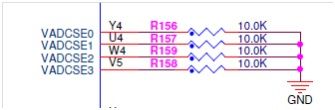
- The Vybrid VideoADC inputs should be available on the board in your possession; take into account that all the Tower board revisions currently available have all 4 of them wired to Ground, and I am afraid there is no easy way to use them.
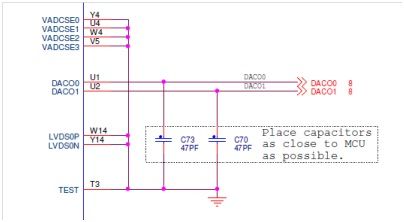
But wait, there is a solution for that! - A new Tower board revision will be “offered to the public” within several weeks, on which these 4 pins will have pull-down resistors instead, i.e. will be accessible!
There already exists, though, another platform, Vybrid Automotive board, and it does have 4 RCA connectors tied to the Vybrid VideoADC inputs via an impedance matching (+ optional attenuation) circuit:
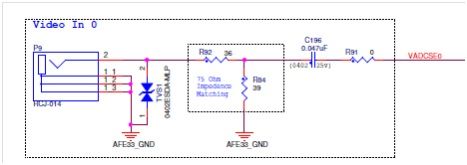
But this board is larger, more complex hence much more expensive than the Tower one…
Unfortunately, I cannot comment on the case when an external Video ADC of any kind used and what signals Vybrid can provide for it.
Sincerely, Naoum Gitnik.
- 新着としてマーク
- ブックマーク
- 購読
- ミュート
- RSS フィードを購読する
- ハイライト
- 印刷
- 不適切なコンテンツを報告
Hi Naoum,
I want to integrate a analog camera, using VADC-input, too.
Your information and the sample code helped me to get a first picture on my display (not in sync and no color, but ...) , but there are a lot of questions.
1. Do I need to use a external voltage divider as seen in schematic of the Auto-EVB (36 and 39Ohm) ?
2. My camera uses NTSC but it is not using the standard resolution of . It has a resolution of 720 hor. x 480 ver. (2 x 240 (interlaced)). Is this supported ?
3. Your example-code uses a lot of register of the AFE-IP which are not described in the reference manual. Do I need to use this registers, or can I just ignore them ?
4. How do I have to set all the clamping-registers ? Where do I have so set the virtual ground of the analog signal ? To the lowest voltage provided by the camera ?
5. Is there an application note about the video subsystem ?
6. Howto set EXT_CONFIG, especially the signals vsync_pol, hsync_pol, ... which are not describes for the VDEC-output ?
7. At the moment I only have a custom board where the connection to the camera is not optimal. I have a noise-level from about 0x90 (VDEC-register NOISE). Is that ok ? How can I reduce this noise level ?
The reference manual and datasheet of the vybrid has only poor information about the video subsystem !
Regards
Sebastian
- 新着としてマーク
- ブックマーク
- 購読
- ミュート
- RSS フィードを購読する
- ハイライト
- 印刷
- 不適切なコンテンツを報告
Hello Sebastian,
Please, find my answers below.
1. Do I need to use an external voltage divider as seen in schematic of the Auto-EVB (36 and 39 Ohm)?
· I would recommend keeping this divider for the development stage but with changed values - 0 and 75 Ohms; if it works well with your specific camera type, you will be able to get rid of the 0-Ohms ones on the production stage.
2. My camera uses NTSC but it is not using the standard resolution of. It has a resolution of 720 hor. x 480 ver. (2 x 240 (interlaced)). Is this supported?
· It is a widescreen video option; like you, I could not find any mention of it in the Reference Manual, so the answer is "No” for now (see the discussion continuation digging deeper); if I learn something new from the Vybrid IC design team, I will let you know. Most likely, you will have to switch your camera to the standard aspect ratio.
3. Your example-code uses a lot of register of the AFE-IP which are not described in the reference manual. Do I need to use this registers, or can I just ignore them?
· The point with the composite video interface is that, compared to the other ones, it much less popular; so, with limited support resources, we focused on the more popular ones on the account of this one. Due to that, I am afraid we cannot order more than what you already have (the code we used to validate this part of the chip). I would recommend to not deviate much from this code while experimenting with it.
4. How do I have to set all the clamping-registers?
· Again, I am afraid you will have to copy our settings or try yourself. Also, try looking in the materials for other Freescale processors.
Where do I have so set the virtual ground of the analog signal? To the lowest voltage provided by the camera?
· To what is defined as GND for the camera, with the video signal positive to it (actually, as the composite video standard requires).
5. Is there an application note about the video subsystem?
· Not for Vybrid; try looking for other Freescale processors.
6. How to set EXT_CONFIG, especially the signals vsync_pol, hsync_pol, ... which are not described for the VDEC-output?
· Again, I am afraid you will have to copy our settings or try yourself. Also, try looking in the materials for other Freescale processors.
7. At the moment I only have a custom board where the connection to the camera is not optimal. I have a noise-level from about 0x90 (VDEC-register NOISE). Is that ok? How can I reduce this noise level?
· What kind of real problems is this noise level causing? - Picture, color, etc.? To improve the signal-to-noise ratio, try:
ü Disabling any other signals running in parallel to the video traces and inducing noise onto them,
ü Lowering/removing input video signal attenuation,
ü Providing clean signal and GND paths between the camera and Vybrid with direct wire connections between the 2 devices, in parallel to the existing ones, maybe even replacing them with direct wire connections, possibly shielded.
The reference manual and datasheet of the Vybrid has only poor information about the video subsystem.
· As I already mentioned above, with all due respect, the amount of attention a specific interface gets depends on its popularity among the users.
Regards, Naoum Gitnik.
- 新着としてマーク
- ブックマーク
- 購読
- ミュート
- RSS フィードを購読する
- ハイライト
- 印刷
- 不適切なコンテンツを報告
Hello Naoum,
Thanks for your answer.
In this case, we cannot use the analog video inputs and we need to use additional external hardware (using the digital video input capabilities) or another controller.
Regards
Sebastian Waldraff
- 新着としてマーク
- ブックマーク
- 購読
- ミュート
- RSS フィードを購読する
- ハイライト
- 印刷
- 不適切なコンテンツを報告
Dear Sebastian ,
I discussed the widescreen video option with my applications colleagues:
1. They confirmed that it is not mentioned in the documentation,
Came with an assumption that there is still a "question of whether the VDEC supports this mode or not; if standard NTSC, then would imagine so; synch pulses are embedded into the signal, so line sizes, etc. should all be auto detected/set”, and I am going to verify it with the video block designer, but it will take time. Meanwhile, do you have a platform with analog video inputs to play with (i.e. other than TWR-VF65GS10 which does not have)? As far as I know, there are boards produced by our partners featuring them.
Regards, Naoum Gitnik.
- 新着としてマーク
- ブックマーク
- 購読
- ミュート
- RSS フィードを購読する
- ハイライト
- 印刷
- 不適切なコンテンツを報告
Dear Naoum,
We have our own custom board, which we designed for a project without camera-support. For a new project, where we need camera-support, we use this board and add manually a RCA-connector to VADCSE0 (including the capacitor and a 75ohm resistor to ground). So the routing from the RCA to the input-pin is not very good and IMHO this is the reason for the high signal noise.
WideScreen-Option: I have set the line-width in VIU3, which sometimes posts a error "line to long" or "line to short" when doing a data transfer. But most of the time the transfer works without error. So it seams that
widescreen is supported, and the errors are a result of the poor signal quality.
You mentioned to look at the materials from other freescale-controllers. Do you know one, which has nearly the same IP-Cores (AFE and VDEC)? Or is it possible to get data from the IP-Core manufacturers ?
Thanks for your support.
Regards
Sebastian
- 新着としてマーク
- ブックマーク
- 購読
- ミュート
- RSS フィードを購読する
- ハイライト
- 印刷
- 不適切なコンテンツを報告
Dear Sebastian,
Thanks for the situation clarification and new data. I was discussing the widescreen video option with my applications colleagues further and deeper while your new data came (just in time).
1.
Regarding the fact that your video connection is a later addition with compromised quality - using a coaxial cable from the connector to the Vybrid chip will definitely help. As you are suspecting, it might help you get rid of the "line length" error, by making the sync pulses more easily recognizable by the VIU block.
BTW, not sure if it is applicable here, but, based on my analog TV experience, sometimes synch issues might be caused by a signal being too strong (i.e. the synch pulses in the composite signal are partially chopped off due to the input dynamic range).
2.
Regarding "I have set the line-width in VIU3" - may you be more specific, please? - Are you talking about the "Input Video Pixel and Line Count (VIU3_INVSZ)" register? If so, what value(s) are you using there, please? - It might be beneficial if we provided some additional explanation or examples in our documentation to make it clearer.
BTW, details of managing such errors can be found in the "Error Case" section (see "Line too long error" and "Line too short error").
Thanks a lot for opening this thread, Sebastian!
Until we improve the analog VIU portion Reference Manual, this discussion data will be helping the other Community members with their designs!
Regards, Naoum Gitnik.
- 新着としてマーク
- ブックマーク
- 購読
- ミュート
- RSS フィードを購読する
- ハイライト
- 印刷
- 不適切なコンテンツを報告
Dear Naoum,
At the moment we dont work at that problem. We're going to make a new pcb which integrates the analog inputs and the necessary cuircuit.
If there are new results and/or questions regarding this issue, I'm going to post it here.
Regards Sebastian
- 新着としてマーク
- ブックマーク
- 購読
- ミュート
- RSS フィードを購読する
- ハイライト
- 印刷
- 不適切なコンテンツを報告
Thank you very much for your answers
Best regards,
Ahmed.

- 新着としてマーク
- ブックマーク
- 購読
- ミュート
- RSS フィードを購読する
- ハイライト
- 印刷
- 不適切なコンテンツを報告
Hi:
I suggest a commercial kit
http://devicesolutions.net/vybrid.aspx
This board implements 2 x RCA Video input in the development kit.
Stéphane
- 新着としてマーク
- ブックマーク
- 購読
- ミュート
- RSS フィードを購読する
- ハイライト
- 印刷
- 不適切なコンテンツを報告
Thanks for your help, Stéphane!
It looks like a good option covering the gap between our Tower and Automotive platforms.
It appears we, Freescale, have more "board partners” than I thought!
Regards, Naoum Gitnik.
