
- Forums
- Product Forums
- General Purpose MicrocontrollersGeneral Purpose Microcontrollers
- i.MX Forumsi.MX Forums
- QorIQ Processing PlatformsQorIQ Processing Platforms
- Identification and SecurityIdentification and Security
- Power ManagementPower Management
- Wireless ConnectivityWireless Connectivity
- RFID / NFCRFID / NFC
- Advanced AnalogAdvanced Analog
- Neural Processing UnitsNeural Processing Units
- MCX Microcontrollers
- S32G
- S32K
- S32V
- MPC5xxx
- Other NXP Products
- S12 / MagniV Microcontrollers
- Powertrain and Electrification Analog Drivers
- Sensors
- Vybrid Processors
- Digital Signal Controllers
- 8-bit Microcontrollers
- ColdFire/68K Microcontrollers and Processors
- PowerQUICC Processors
- OSBDM and TBDML
- S32M
- S32Z/E
-
- Solution Forums
- Software Forums
- MCUXpresso Software and ToolsMCUXpresso Software and Tools
- CodeWarriorCodeWarrior
- MQX Software SolutionsMQX Software Solutions
- Model-Based Design Toolbox (MBDT)Model-Based Design Toolbox (MBDT)
- FreeMASTER
- eIQ Machine Learning Software
- Embedded Software and Tools Clinic
- S32 SDK
- S32 Design Studio
- GUI Guider
- Zephyr Project
- Voice Technology
- Application Software Packs
- Secure Provisioning SDK (SPSDK)
- Processor Expert Software
- Generative AI & LLMs
-
- Topics
- Mobile Robotics - Drones and RoversMobile Robotics - Drones and Rovers
- NXP Training ContentNXP Training Content
- University ProgramsUniversity Programs
- Rapid IoT
- NXP Designs
- SafeAssure-Community
- OSS Security & Maintenance
- Using Our Community
-
- Cloud Lab Forums
-
- Knowledge Bases
- ARM Microcontrollers
- i.MX Processors
- Identification and Security
- Model-Based Design Toolbox (MBDT)
- QorIQ Processing Platforms
- S32 Automotive Processing Platform
- Wireless Connectivity
- CodeWarrior
- MCUXpresso Suite of Software and Tools
- MQX Software Solutions
- RFID / NFC
- Advanced Analog
- Neural Processing Units
-
- NXP Tech Blogs

 danielmartynek
Hello Sherif,
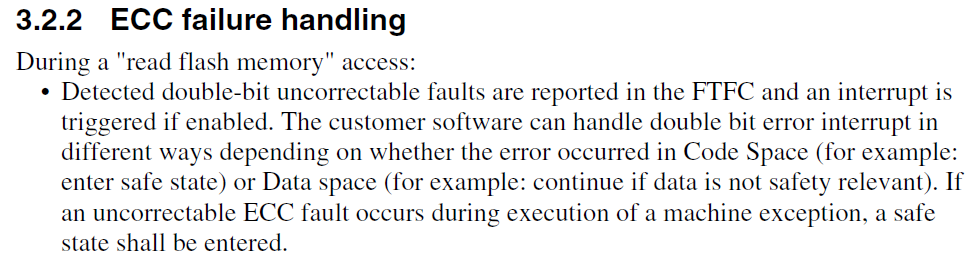
Yes, it can be done by two subsequent writes (program phrase command) with different data at one flash address (phrase). Normally, the phrase must be erased before the second write. The ECC error then depends on the resulting phrase value and ECC checksum value. Then, if you read the address, ECC error will be reported.
Regards,
Daniel
Hi Daniel,
I followed your advice and yet I observe FTFC_FERSTAT remains 0 after the read to location.
The function below writes 8 bytes to location 0X0D2660 (0XAA,0X55,,,) which is 64bit aligned and then it erases it and writes 0x14,0x13,0x12......
then I read the location 0x0d2660 and look at the register I mentioned above and it still is 0x00
This function flsh_ecc run out of RAM from 0x1FFE0000 which is at top of the ram also the debugger shows me the 1st phrase is written and then erased and rewritten with a new phrase.
then I read the location:
myvar = *((unsigned long long*)0xd2660);
the only thing which is notable is :the code hangs up up and won't run anymore.
void flsh_ecc(void)
{
//while((FTFC->FSTAT & FTFC_FSTAT_CCIF_MASK) != FTFC_FSTAT_CCIF_MASK); /* Wait until any ongoing flash operation is completed */
#pragma asm
;ldr r1, =0x40020000 (0x1fff027c <run_ocs_volt_once..C.3A.5CFramework_ZERV_v00.2E02.5CApplications.5CZERV_Framework.5CAppl.5Cobj.5CINF_CDD.>)
movw r1,0x0000
movt r1,0x4002
movs r0, #128 ; 0x80
strb r0, [r1, #0]
L1:
ldrb r0, [r1, #0]
lsls r0, r0, #24
bpl L1
#pragma endasm
//FTFC->FSTAT = FTFC_FSTAT_ACCERR_MASK | FTFC_FSTAT_FPVIOL_MASK;
FTFC->FCCOB[3] = 0x07;//a_cmd; //Program Phrase command (0x07)
FTFC->FCCOB[2] = 0x0d;//v_AddrVec[0]; //Flash address [23:16]
FTFC->FCCOB[1] =0x26; //v_AddrVec[1]; //Flash address [15:08]
FTFC->FCCOB[0] =0x60; //v_AddrVec[2]; //Flash address [7:0]
// if (a_pageBuffer != NULL) {
FTFC->FCCOB[7] =0x55; //a_pageBuffer[0]; //data
FTFC->FCCOB[6] = 0xaa;//a_pageBuffer[1];
FTFC->FCCOB[5] = 0x55;//a_pageBuffer[2];
FTFC->FCCOB[4] =0xaa; //a_pageBuffer[3];
FTFC->FCCOB[11] =0x55; //a_pageBuffer[4];
FTFC->FCCOB[10] =0xaa; //a_pageBuffer[5];
FTFC->FCCOB[9] =0x55; //a_pageBuffer[6];
FTFC->FCCOB[8] =0xaa; //a_pageBuffer[7];
// }
FTFC->FSTAT = FTFC_FSTAT_CCIF_MASK; //launch command
//while((FTFC->FSTAT & FTFC_FSTAT_CCIF_MASK) != FTFC_FSTAT_CCIF_MASK);
#pragma asm
;ldr r1, =0x40020000 (0x1fff027c <run_ocs_volt_once..C.3A.5CFramework_ZERV_v00.2E02.5CApplications.5CZERV_Framework.5CAppl.5Cobj.5CINF_CDD.>)
movw r1,0x0000
movt r1,0x4002
movs r0, #128 ; 0x80
strb r0, [r1, #0]
L2:
ldrb r0, [r1, #0]
lsls r0, r0, #24
bpl L2
#pragma endasm
FTFC->FCCOB[3] = 0x09;//a_cmd; //Program Phrase command (0x07)
FTFC->FCCOB[2] = 0x0d;//v_AddrVec[0]; //Flash address [23:16]
FTFC->FCCOB[1] =0x26; //v_AddrVec[1]; //Flash address [15:08]
FTFC->FCCOB[0] =0x60; //v_AddrVec[2]; //Flash address [7:0]
FTFC->FSTAT = FTFC_FSTAT_CCIF_MASK; //launch command
#pragma asm
;ldr r1, =0x40020000 (0x1fff027c <run_ocs_volt_once..C.3A.5CFramework_ZERV_v00.2E02.5CApplications.5CZERV_Framework.5CAppl.5Cobj.5CINF_CDD.>)
movw r1,0x0000
movt r1,0x4002
movs r0, #128 ; 0x80
strb r0, [r1, #0]
L3:
ldrb r0, [r1, #0]
lsls r0, r0, #24
bpl L3
#pragma endasm
FTFC->FCCOB[3] = 0x07;//a_cmd; //Program Phrase command (0x07)
FTFC->FCCOB[2] = 0x0d;//v_AddrVec[0]; //Flash address [23:16]
FTFC->FCCOB[1] =0x26; //v_AddrVec[1]; //Flash address [15:08]
FTFC->FCCOB[0] =0x60; //v_AddrVec[2]; //Flash address [7:0]
// if (a_pageBuffer != NULL) {
FTFC->FCCOB[7] =0x10; //a_pageBuffer[0]; //data
FTFC->FCCOB[6] = 0x12;//a_pageBuffer[1];
FTFC->FCCOB[5] = 0x13;//a_pageBuffer[2];
FTFC->FCCOB[4] =0x14; //a_pageBuffer[3];
FTFC->FCCOB[11] =0x15; //a_pageBuffer[4];
FTFC->FCCOB[10] =0x16; //a_pageBuffer[5];
FTFC->FCCOB[9] =0x17; //a_pageBuffer[6];
FTFC->FCCOB[8] =0x18; //a_pageBuffer[7];
//INT_SYS_EnableIRQGlobal();
FTFC->FSTAT = FTFC_FSTAT_CCIF_MASK; //launch command
#pragma asm
;ldr r1, =0x40020000 (0x1fff027c <run_ocs_volt_once..C.3A.5CFramework_ZERV_v00.2E02.5CApplications.5CZERV_Framework.5CAppl.5Cobj.5CINF_CDD.>)
movw r1,0x0000
movt r1,0x4002
movs r0, #128 ; 0x80
strb r0, [r1, #0]
L4:
ldrb r0, [r1, #0]
lsls r0, r0, #24
bpl L4
#pragma endasm
}
Just wondering beside the register FTFC-FEPRT is it some else th check.
BR,
kOOROSH
Hi Daniel,
I guess it hits the Memory fault exception when It hangs up.
There is no reset causing mechanism for this exception handler. I did not write the code for it. it is all in assembly and good luck deciphering it.
Thanks,
