
- Forums
- Product Forums
- General Purpose MicrocontrollersGeneral Purpose Microcontrollers
- i.MX Forumsi.MX Forums
- QorIQ Processing PlatformsQorIQ Processing Platforms
- Identification and SecurityIdentification and Security
- Power ManagementPower Management
- Wireless ConnectivityWireless Connectivity
- RFID / NFCRFID / NFC
- Advanced AnalogAdvanced Analog
- Neural Processing UnitsNeural Processing Units
- MCX Microcontrollers
- S32G
- S32K
- S32V
- MPC5xxx
- Other NXP Products
- S12 / MagniV Microcontrollers
- Powertrain and Electrification Analog Drivers
- Sensors
- Vybrid Processors
- Digital Signal Controllers
- 8-bit Microcontrollers
- ColdFire/68K Microcontrollers and Processors
- PowerQUICC Processors
- OSBDM and TBDML
- S32M
- S32Z/E
-
- Solution Forums
- Software Forums
- MCUXpresso Software and ToolsMCUXpresso Software and Tools
- CodeWarriorCodeWarrior
- MQX Software SolutionsMQX Software Solutions
- Model-Based Design Toolbox (MBDT)Model-Based Design Toolbox (MBDT)
- FreeMASTER
- eIQ Machine Learning Software
- Embedded Software and Tools Clinic
- S32 SDK
- S32 Design Studio
- GUI Guider
- Zephyr Project
- Voice Technology
- Application Software Packs
- Secure Provisioning SDK (SPSDK)
- Processor Expert Software
- Generative AI & LLMs
-
- Topics
- Mobile Robotics - Drones and RoversMobile Robotics - Drones and Rovers
- NXP Training ContentNXP Training Content
- University ProgramsUniversity Programs
- Rapid IoT
- NXP Designs
- SafeAssure-Community
- OSS Security & Maintenance
- Using Our Community
-
- Cloud Lab Forums
-
- Knowledge Bases
- ARM Microcontrollers
- i.MX Processors
- Identification and Security
- Model-Based Design Toolbox (MBDT)
- QorIQ Processing Platforms
- S32 Automotive Processing Platform
- Wireless Connectivity
- CodeWarrior
- MCUXpresso Suite of Software and Tools
- MQX Software Solutions
- RFID / NFC
- Advanced Analog
- Neural Processing Units
-
- NXP Tech Blogs
- Home
- :
- Product Forums
- :
- S32K
- :
- LPI2C Slave Callback
LPI2C Slave Callback
- Subscribe to RSS Feed
- Mark Topic as New
- Mark Topic as Read
- Float this Topic for Current User
- Bookmark
- Subscribe
- Mute
- Printer Friendly Page

- Mark as New
- Bookmark
- Subscribe
- Mute
- Subscribe to RSS Feed
- Permalink
- Report Inappropriate Content
Hello All, I want to understated the LPI2C Slave Callback
void lpi2c0_SlaveCallback0(i2c_slave_event_t slaveEvent,void *userData);
what is meant by userData? in the code example it used as the instance
I want to do :
1- the master will send the frame ID and after that based on this ID the slave will send frame that related to the ID and I want to use the lpi2c0_SlaveCallback0 function but I don't know how to use it
so if anyone could help me in this part?
Solved! Go to Solution.

 PetrS
PetrS
- Mark as New
- Bookmark
- Subscribe
- Mute
- Subscribe to RSS Feed
- Permalink
- Report Inappropriate Content
Hi,
If slaveListening item is set, the slave interrupt is enabled at initialization time and the slave always listens to the line for a master addressing it. Any events are reported to the application through the callback function provided at initialization time.
So Master always starts with sending device address with R/W bit. Upon receving this, callback is called with I2C_SLAVE_EVENT_RX_REQ or I2C_SLAVE_EVENT_TX_REQ events depending R/W bit received. You can use LPI2C_DRV_SlaveSetRxBuffer() or LPI2C_DRV_SlaveSetTxBuffer() to provide the appropriate buffers for transmit or receive with given number of bytes to be transfered. As shown in the demo example.
If master still sending or requesting more bytes you got I2C_SLAVE_EVENT_RX_FULL or I2C_SLAVE_EVENT_TX_EMPTY events and above functions can be called again.
For stop or repeated start condition detected an I2C_SLAVE_EVENT_STOP event is called.
So the usage depends on used protocol, I think. Obviously if master request data from specified slave address/register it looks like below
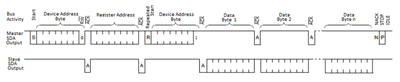
Master sends device address with R/W =0 followed by address/register to be read then repeat start is send. Using driver you got I2C_SLAVE_EVENT_RX_REQ, you define receive buffer. After next byte received you should get I2C_SLAVE_EVENT_STOP event and first byte in receive buffer should be address, in your case ID probably. As master then sends again device address with R/W = 1, you got I2C_SLAVE_EVENT_TX_REQ event an you can specify the TX buffer to be sent.
BR, Petr
PetrS
- Mark as New
- Bookmark
- Subscribe
- Mute
- Subscribe to RSS Feed
- Permalink
- Report Inappropriate Content
Hi,
If slaveListening item is set, the slave interrupt is enabled at initialization time and the slave always listens to the line for a master addressing it. Any events are reported to the application through the callback function provided at initialization time.
So Master always starts with sending device address with R/W bit. Upon receving this, callback is called with I2C_SLAVE_EVENT_RX_REQ or I2C_SLAVE_EVENT_TX_REQ events depending R/W bit received. You can use LPI2C_DRV_SlaveSetRxBuffer() or LPI2C_DRV_SlaveSetTxBuffer() to provide the appropriate buffers for transmit or receive with given number of bytes to be transfered. As shown in the demo example.
If master still sending or requesting more bytes you got I2C_SLAVE_EVENT_RX_FULL or I2C_SLAVE_EVENT_TX_EMPTY events and above functions can be called again.
For stop or repeated start condition detected an I2C_SLAVE_EVENT_STOP event is called.
So the usage depends on used protocol, I think. Obviously if master request data from specified slave address/register it looks like below
Master sends device address with R/W =0 followed by address/register to be read then repeat start is send. Using driver you got I2C_SLAVE_EVENT_RX_REQ, you define receive buffer. After next byte received you should get I2C_SLAVE_EVENT_STOP event and first byte in receive buffer should be address, in your case ID probably. As master then sends again device address with R/W = 1, you got I2C_SLAVE_EVENT_TX_REQ event an you can specify the TX buffer to be sent.
BR, Petr
- Mark as New
- Bookmark
- Subscribe
- Mute
- Subscribe to RSS Feed
- Permalink
- Report Inappropriate Content
Hi
I am facing an issue with the example code for the lpi2c_flexio_that the slave doesnot not receive the data even thought i am using the defaults configurations for the example code ,i think the slave callback function is not been called.
- Mark as New
- Bookmark
- Subscribe
- Mute
- Subscribe to RSS Feed
- Permalink
- Report Inappropriate Content
thanks for your replay
I use the callback function on the slave side in case of the master send Frame ID the salve receive it and push this id to the upper layer to take the data related to this id to send it to the master after send read request but the correct data send to the master in the next request not in the same read request so I need when the master send the frame id the slave take this id and send the data in the same request
I will attach the code of the slave and of the master
could you help me to solve this issue ?
