
- Forums
- Product Forums
- General Purpose MicrocontrollersGeneral Purpose Microcontrollers
- i.MX Forumsi.MX Forums
- QorIQ Processing PlatformsQorIQ Processing Platforms
- Identification and SecurityIdentification and Security
- Power ManagementPower Management
- Wireless ConnectivityWireless Connectivity
- RFID / NFCRFID / NFC
- Advanced AnalogAdvanced Analog
- Neural Processing UnitsNeural Processing Units
- MCX Microcontrollers
- S32G
- S32K
- S32V
- MPC5xxx
- Other NXP Products
- S12 / MagniV Microcontrollers
- Powertrain and Electrification Analog Drivers
- Sensors
- Vybrid Processors
- Digital Signal Controllers
- 8-bit Microcontrollers
- ColdFire/68K Microcontrollers and Processors
- PowerQUICC Processors
- OSBDM and TBDML
- S32M
- S32Z/E
-
- Solution Forums
- Software Forums
- MCUXpresso Software and ToolsMCUXpresso Software and Tools
- CodeWarriorCodeWarrior
- MQX Software SolutionsMQX Software Solutions
- Model-Based Design Toolbox (MBDT)Model-Based Design Toolbox (MBDT)
- FreeMASTER
- eIQ Machine Learning Software
- Embedded Software and Tools Clinic
- S32 SDK
- S32 Design Studio
- GUI Guider
- Zephyr Project
- Voice Technology
- Application Software Packs
- Secure Provisioning SDK (SPSDK)
- Processor Expert Software
- Generative AI & LLMs
-
- Topics
- Mobile Robotics - Drones and RoversMobile Robotics - Drones and Rovers
- NXP Training ContentNXP Training Content
- University ProgramsUniversity Programs
- Rapid IoT
- NXP Designs
- SafeAssure-Community
- OSS Security & Maintenance
- Using Our Community
-
- Cloud Lab Forums
-
- Knowledge Bases
- ARM Microcontrollers
- i.MX Processors
- Identification and Security
- Model-Based Design Toolbox (MBDT)
- QorIQ Processing Platforms
- S32 Automotive Processing Platform
- Wireless Connectivity
- CodeWarrior
- MCUXpresso Suite of Software and Tools
- MQX Software Solutions
- RFID / NFC
- Advanced Analog
- Neural Processing Units
-
- NXP Tech Blogs
- Home
- :
- ソフトウェア・フォーラム
- :
- S32 デザインスタジオ
- :
- 回复: the difference between library with FP (softfp) and library with FP (hard) in s32k144
the difference between library with FP (softfp) and library with FP (hard) in s32k144
- RSS フィードを購読する
- トピックを新着としてマーク
- トピックを既読としてマーク
- このトピックを現在のユーザーにフロートします
- ブックマーク
- 購読
- ミュート
- 印刷用ページ

- 新着としてマーク
- ブックマーク
- 購読
- ミュート
- RSS フィードを購読する
- ハイライト
- 印刷
- 不適切なコンテンツを報告
hello
I tested library with FP (softfp) and FP instructions(hard) using the attached example.

I found that there is no difference in performance between these two floating-point operations. However, from this document(S32K14x系列MCU使用Tips之硬件FPU特性介绍和使用详解 ), it can be seen that hard uses fpu registers, which should have a more significant improvement in floating-point performance.

Now, I don't quite understand how to use hardware floating-point operations in S32K44
thanks
解決済! 解決策の投稿を見る。

 Mehul_Patel_NXP
- 新着としてマーク
- ブックマーク
- 購読
- ミュート
- RSS フィードを購読する
- ハイライト
- 印刷
- 不適切なコンテンツを報告
Hi, @zhangchun ,
I understand looking at the screenshot that you got the no performance improvement.
But I feel it may be that because the test case you are trying for performance evaluation is not enough to test, if possible please can you try with more complex floating point operation and more iteration, and check what the result comes. Do also check the disassembly to see what is happening underneath.
Thank you. Kind regards.
- Mehul Patel
Mehul_Patel_NXP
- 新着としてマーク
- ブックマーク
- 購読
- ミュート
- RSS フィードを購読する
- ハイライト
- 印刷
- 不適切なコンテンツを報告
Hi, @zhangchun
Hard FP (floating point) will use the FP instructions of the device whereas soft FP will defer to software emulation of FP operations. That is, FP operations are performed by making a library call and the floating point operations are performed using integer instructions.
- The only difference between softfp and hard is the manner in which floating point values are passed and received from functions. (softfp ABI vs. hard ABI).
- Both softfp and hard will generate floating point instructions, but since you do not pass the float values to functions, you will see no difference.
- So, to truly see a difference between a software float operation and a hardware float operation, use the 'soft' option.
- To understand more about it please check this page: https://gcc.gnu.org/onlinedocs/gcc/ARM-Options.html
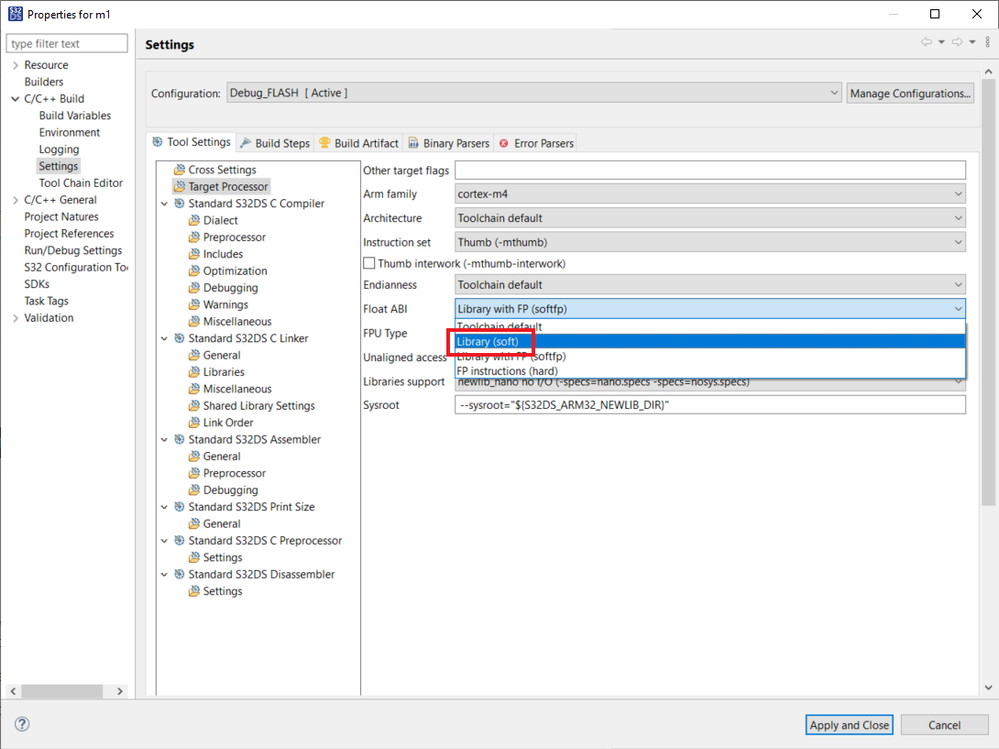
Now, another thing, you can check generate the disassembly file and understand the difference for different float ABI options - soft, hard, and library with FP.
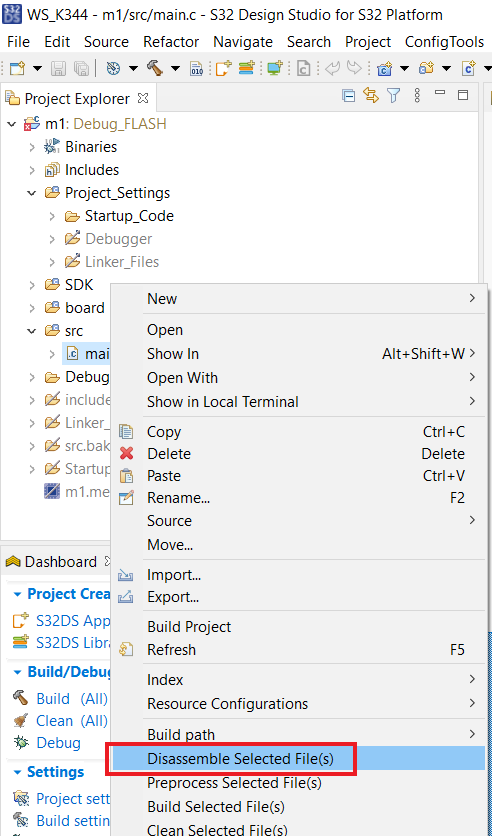
Additionally, sometime compiler might optimization also play role, and if the operation is not resource intensive compiler might decide to do differently than you are expecting. You can also check different test case operation to ty out.
You can change the optimization settings and check accordingly if it improves the performance or not:
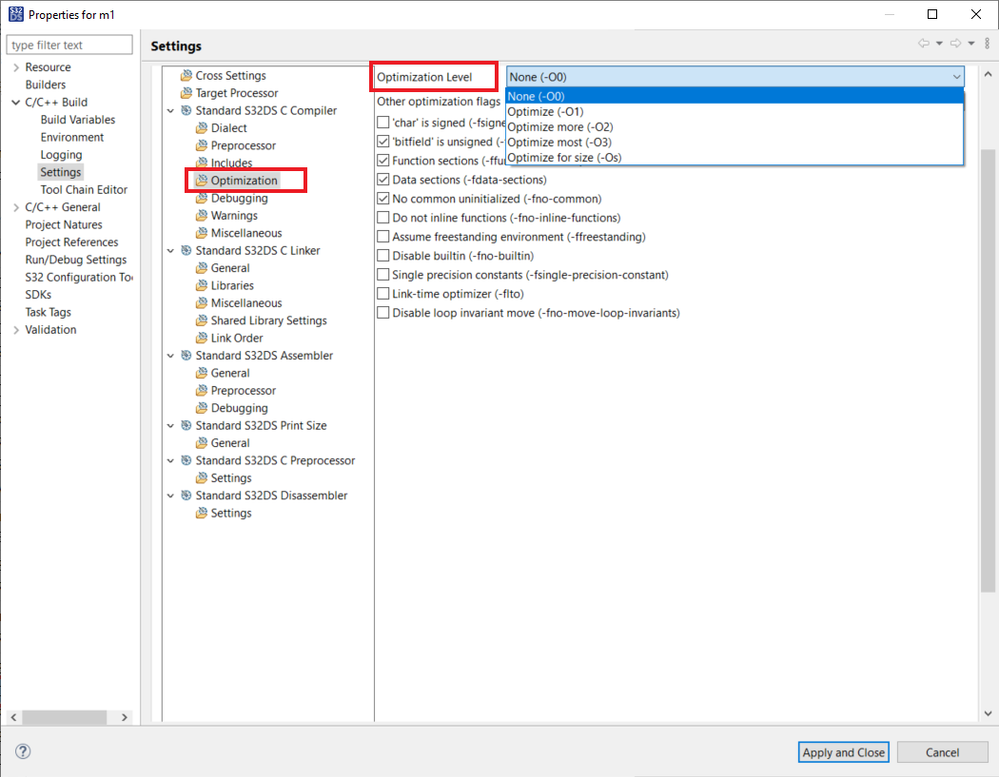
Please, can you check and tryout, let us know if you are able to get performance improvement accordingly.
Thank you, Best regards,
- Mehul Patel
- 新着としてマーク
- ブックマーク
- 購読
- ミュート
- RSS フィードを購読する
- ハイライト
- 印刷
- 不適切なコンテンツを報告
Dear Mehul_Patel_NXP
I know that Library (soft) will take more time than Library with FP (softfp) or FP instructions (hard). However, FP instructions (hard) use FPU hardware registers, which should take less time than library with FP (softfp), but in reality they do not differ.
Based on your suggestion, I performed the operation by calling the function, and the result obtained was the same

My purpose in doing this was to use FP instructions (hard) to improve code execution efficiency, but the result did not achieve my expected goal. During this process, it was found that there was no difference between library with FP (softfp) and FP instructions (hard).
Currently, it has been determined to use FP instructions (hard) by reviewing the assembly and compilation parameters

Thank you for your response.
- 新着としてマーク
- ブックマーク
- 購読
- ミュート
- RSS フィードを購読する
- ハイライト
- 印刷
- 不適切なコンテンツを報告
Mehul_Patel_NXP
- 新着としてマーク
- ブックマーク
- 購読
- ミュート
- RSS フィードを購読する
- ハイライト
- 印刷
- 不適切なコンテンツを報告
Hi, @zhangchun ,
I understand looking at the screenshot that you got the no performance improvement.
But I feel it may be that because the test case you are trying for performance evaluation is not enough to test, if possible please can you try with more complex floating point operation and more iteration, and check what the result comes. Do also check the disassembly to see what is happening underneath.
Thank you. Kind regards.
- Mehul Patel
- 新着としてマーク
- ブックマーク
- 購読
- ミュート
- RSS フィードを購読する
- ハイライト
- 印刷
- 不適切なコンテンツを報告
Dear Mehul_Patel_NXP
I have a few more questions
- Is it necessary to call the math library in cmsis to use the fpu register when using FP (hard) in s32k144? If needed, please tell me how to proceed
- I am currently trying to use the AMMCLib, but the performance has not improved either(The AMMCLib is designed to improve performance, and in my opinion, floating-point operations are used the FP hard))

Thanks
