
- Forums
- Product Forums
- General Purpose MicrocontrollersGeneral Purpose Microcontrollers
- i.MX Forumsi.MX Forums
- QorIQ Processing PlatformsQorIQ Processing Platforms
- Identification and SecurityIdentification and Security
- Power ManagementPower Management
- Wireless ConnectivityWireless Connectivity
- RFID / NFCRFID / NFC
- Advanced AnalogAdvanced Analog
- Neural Processing UnitsNeural Processing Units
- MCX Microcontrollers
- S32G
- S32K
- S32V
- MPC5xxx
- Other NXP Products
- S12 / MagniV Microcontrollers
- Powertrain and Electrification Analog Drivers
- Sensors
- Vybrid Processors
- Digital Signal Controllers
- 8-bit Microcontrollers
- ColdFire/68K Microcontrollers and Processors
- PowerQUICC Processors
- OSBDM and TBDML
- S32M
- S32Z/E
-
- Solution Forums
- Software Forums
- MCUXpresso Software and ToolsMCUXpresso Software and Tools
- CodeWarriorCodeWarrior
- MQX Software SolutionsMQX Software Solutions
- Model-Based Design Toolbox (MBDT)Model-Based Design Toolbox (MBDT)
- FreeMASTER
- eIQ Machine Learning Software
- Embedded Software and Tools Clinic
- S32 SDK
- S32 Design Studio
- GUI Guider
- Zephyr Project
- Voice Technology
- Application Software Packs
- Secure Provisioning SDK (SPSDK)
- Processor Expert Software
- Generative AI & LLMs
-
- Topics
- Mobile Robotics - Drones and RoversMobile Robotics - Drones and Rovers
- NXP Training ContentNXP Training Content
- University ProgramsUniversity Programs
- Rapid IoT
- NXP Designs
- SafeAssure-Community
- OSS Security & Maintenance
- Using Our Community
-
- Cloud Lab Forums
-
- Knowledge Bases
- ARM Microcontrollers
- i.MX Processors
- Identification and Security
- Model-Based Design Toolbox (MBDT)
- QorIQ Processing Platforms
- S32 Automotive Processing Platform
- Wireless Connectivity
- CodeWarrior
- MCUXpresso Suite of Software and Tools
- MQX Software Solutions
- RFID / NFC
- Advanced Analog
- Neural Processing Units
-
- NXP Tech Blogs
- Home
- :
- RFID / NFC
- :
- NFC
- :
- Re: PN7462 Current Measurement (Dev kit, DoorAccessFw)
PN7462 Current Measurement (Dev kit, DoorAccessFw)
- RSS フィードを購読する
- トピックを新着としてマーク
- トピックを既読としてマーク
- このトピックを現在のユーザーにフロートします
- ブックマーク
- 購読
- ミュート
- 印刷用ページ

- 新着としてマーク
- ブックマーク
- 購読
- ミュート
- RSS フィードを購読する
- ハイライト
- 印刷
- 不適切なコンテンツを報告
Hi
We are currently evaluating/prototyping PN7462 for a battery powered application and a key requirement is to be able to achieve very low power consumption when only polling for cards (target is 30uA range when polling for cards which we believe is theoretically achieveable).
Firmware Configuration
We are using DoorAccess example firmware on PNE7462C evaluation board. Using default settings of the firmware which indicate that LPCD is enabled, the only change we have made is:
1. Defined PHFL_ENABLE_STANDBY to enable Standby mode
Hardware Modifications
Following changes have been made to the board to get rid of anything otehr than PN7462 driving current from the supply:
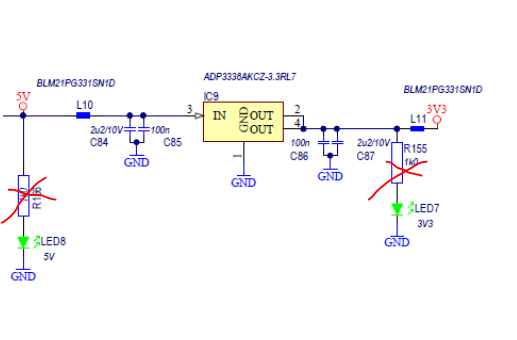
1. There are 3 leds on the supply lines of 3.3v, 5v, VBUS - these have been disconnected by removing corresponding resistors as shown below:

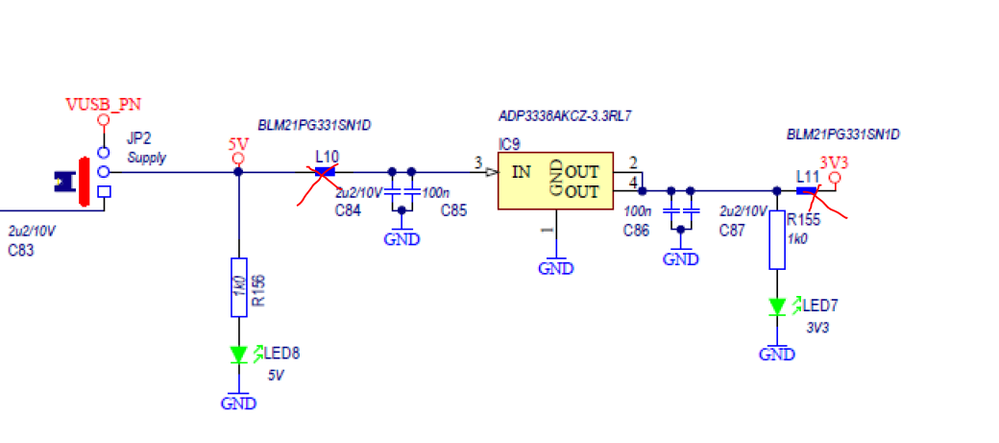
2. Also, L10 and L11 have been removed to disconnect the on board LDO and to be able to supply 5v and 3.3v externally and measure the current draws if needed:
Hardware Setup
1. Board is powered by providing external 5v to pin 2 of JP2 (JP2 can be seen in above image). Current drawn from this external 5v is measureed
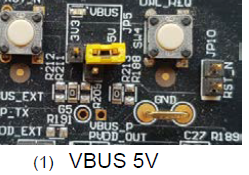
2. VBUS is set to 5v by linking 5v and VBUS pins of JP5 through as shown below:
3. 3.3v is only provided when PN7462 firmware is programmed and is removed otherwise. This means all the current draw during testing is through the 5v supply
The firmware configuration used is the "Release" one, PN7462 is programmed and run without the debugger.
Issue/Observation
With the above setup, the average current draw seems to be about 365uA which of course is too high.
Please note that the average current through JP1 is about 37uA (Peak ~200mA). This is the current going into TVDD_IN for the RF transmitter which seems to be within specs.
The rest of about 325uA is the problem. Please could you let us know what needs to be done to bring this current down? We were hoping there would be a ready made example demonstrating low power consumption and it would be possible to test that on the devleopment kit.
Thanks
解決済! 解決策の投稿を見る。
- 新着としてマーク
- ブックマーク
- 購読
- ミュート
- RSS フィードを購読する
- ハイライト
- 印刷
- 不適切なコンテンツを報告
While we await for the support, we have done some further investigation and here are details to share:
Hardware Changes
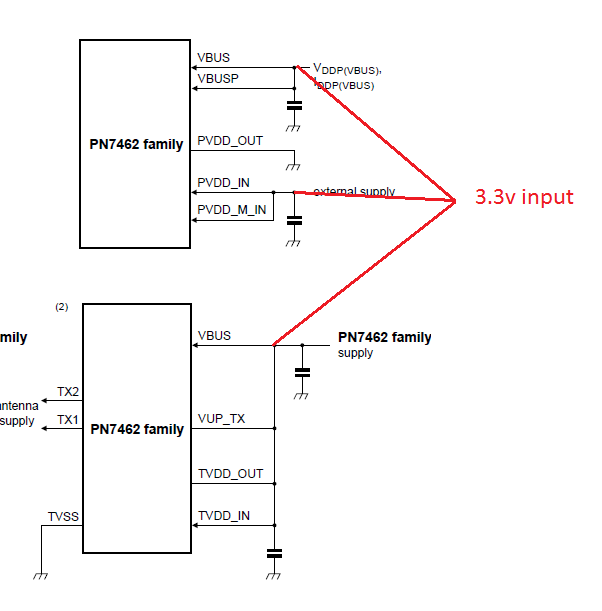
Continuing the setup as mentioned in the earlier post, we modified the PN7462C board to power it from 3.3v (instead of 5v) as per the instructions in the user manual. Basically, ended with the following power supply configuration:
Firmware Changes
This requried following macro to be defined in the DoorAccess example firmware:
#define PHFL_ENABLE_TVDD_3V_MON
Results
With these changes, we are seeing the following values for current draws @ 3.3v:
1. PVDD_IN, PVDD_M_IN combined: 108uA continuous
2. VUP_TX, TVDD_IN, TVDD_OUT combined: 25uA average
3. VBUS, VBUS_P combined: 123uA continuous
4. Total measured current: 250uA - 260uA average
Any help to resolve the current consumption issue willbe highly appreciated. This is a decisive factor whether or not to go for NXP NFC solution.
Thanks
- 新着としてマーク
- ブックマーク
- 購読
- ミュート
- RSS フィードを購読する
- ハイライト
- 印刷
- 不適切なコンテンツを報告
While we await for the support, we have done some further investigation and here are details to share:
Hardware Changes
Continuing the setup as mentioned in the earlier post, we modified the PN7462C board to power it from 3.3v (instead of 5v) as per the instructions in the user manual. Basically, ended with the following power supply configuration:
Firmware Changes
This requried following macro to be defined in the DoorAccess example firmware:
#define PHFL_ENABLE_TVDD_3V_MON
Results
With these changes, we are seeing the following values for current draws @ 3.3v:
1. PVDD_IN, PVDD_M_IN combined: 108uA continuous
2. VUP_TX, TVDD_IN, TVDD_OUT combined: 25uA average
3. VBUS, VBUS_P combined: 123uA continuous
4. Total measured current: 250uA - 260uA average
Any help to resolve the current consumption issue willbe highly appreciated. This is a decisive factor whether or not to go for NXP NFC solution.
Thanks

 vicentegomez
- 新着としてマーク
- ブックマーク
- 購読
- ミュート
- RSS フィードを購読する
- ハイライト
- 印刷
- 不適切なコンテンツを報告
Hi
you can check the following thread
PN7462AU -Hard Power Down Mode
Also please check the following application note
https://www.nxp.com/docs/en/application-note/AN11785.pdf
Have a good day
take care
- 新着としてマーク
- ブックマーク
- 購読
- ミュート
- RSS フィードを購読する
- ハイライト
- 印刷
- 不適切なコンテンツを報告
Hi
Thanks for the response.
I took alot of time & effort to present with logical details and explanation of the setup and the issues. You can imagine that in a week since I posted the query, I already have gone through every single post related to PN7462 on the forum.
My question was very specific about the ability to measure current on the development board. Provision of Gerber files and schematic PDF of the development board would have been the first and most important step to resolve this. Anyways I have sorted that out and would be happy to anyone else looking for the answers.
The issue now is the apparent inability of PN7462 LPCD to wake up the processor on card detection. Please help with that query https://community.nxp.com/message/1326059?commentID=1326059&et=watches.email.thread#comment-1326059 if you are able to.
Thanks
