
- Forums
- Product Forums
- General Purpose MicrocontrollersGeneral Purpose Microcontrollers
- i.MX Forumsi.MX Forums
- QorIQ Processing PlatformsQorIQ Processing Platforms
- Identification and SecurityIdentification and Security
- Power ManagementPower Management
- Wireless ConnectivityWireless Connectivity
- RFID / NFCRFID / NFC
- Advanced AnalogAdvanced Analog
- Neural Processing UnitsNeural Processing Units
- MCX Microcontrollers
- S32G
- S32K
- S32V
- MPC5xxx
- Other NXP Products
- S12 / MagniV Microcontrollers
- Powertrain and Electrification Analog Drivers
- Sensors
- Vybrid Processors
- Digital Signal Controllers
- 8-bit Microcontrollers
- ColdFire/68K Microcontrollers and Processors
- PowerQUICC Processors
- OSBDM and TBDML
- S32M
- S32Z/E
-
- Solution Forums
- Software Forums
- MCUXpresso Software and ToolsMCUXpresso Software and Tools
- CodeWarriorCodeWarrior
- MQX Software SolutionsMQX Software Solutions
- Model-Based Design Toolbox (MBDT)Model-Based Design Toolbox (MBDT)
- FreeMASTER
- eIQ Machine Learning Software
- Embedded Software and Tools Clinic
- S32 SDK
- S32 Design Studio
- GUI Guider
- Zephyr Project
- Voice Technology
- Application Software Packs
- Secure Provisioning SDK (SPSDK)
- Processor Expert Software
- Generative AI & LLMs
-
- Topics
- Mobile Robotics - Drones and RoversMobile Robotics - Drones and Rovers
- NXP Training ContentNXP Training Content
- University ProgramsUniversity Programs
- Rapid IoT
- NXP Designs
- SafeAssure-Community
- OSS Security & Maintenance
- Using Our Community
-
- Cloud Lab Forums
-
- Knowledge Bases
- ARM Microcontrollers
- i.MX Processors
- Identification and Security
- Model-Based Design Toolbox (MBDT)
- QorIQ Processing Platforms
- S32 Automotive Processing Platform
- Wireless Connectivity
- CodeWarrior
- MCUXpresso Suite of Software and Tools
- MQX Software Solutions
- RFID / NFC
- Advanced Analog
- Neural Processing Units
-
- NXP Tech Blogs
- Home
- :
- RFID / NFC
- :
- NFC
- :
- Re: NHS3152 - PCB verification pre-order.
NHS3152 - PCB verification pre-order.

I want to have a PCB manufactured and assembled with NHS3152 connected to antenna, as a prototype to attach my sensor.
Since i used an ECAD (EAGLE FUSION360 - Electronics) to design the chip and the antenna, I want to make sure that there aren't any obvious mistakes that can be easily caught.
ANTENNA
From Solved: Re: Open AN11276- Class_4 - Class_4.brd file with ... - NXP Community I understood that i can i) attach an antenna directly without a capacitor.
I designed an antenna that ii) is close to that of NHS3152DEMOBOARD (since measuring the NHS3152 DemoPCB with Reference Gerber Viewer, by the developer of the Gerber Format (ucamco.com) isn't incredibly accurate.)
Here are the dimensions of my antenna design:
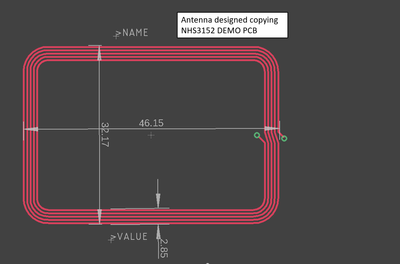
In the future i can iii) change the antenna to a smaller Class4 antenna without attaching a capacitor.
NHS3152 PACKAGE
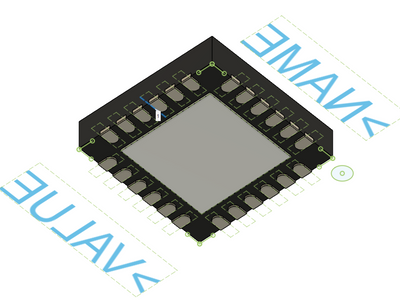
I Designed the NHS3152 casign and footprint in Fusion360, using a QFN Package with 24 pins and a thermal pad. iv) Dimension taken from Therapy adherence resistive monitor (nxp.com)

3D package view.
CONNECTIONS:
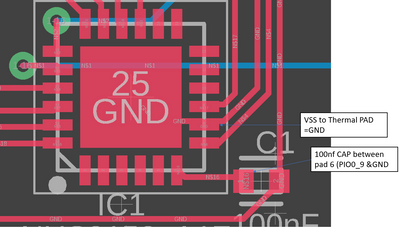
I have considered the v) Thermal pad as GND and connected VSS to it.
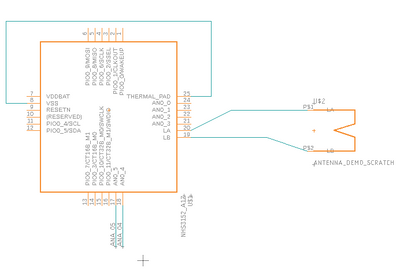
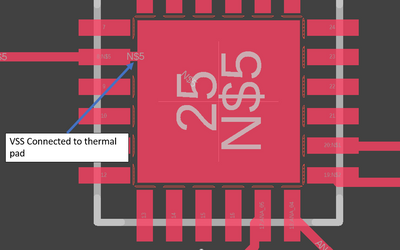
I placed vi) NHS3152 inside the antenna area, extended some wires out so that i can connect my sensor.
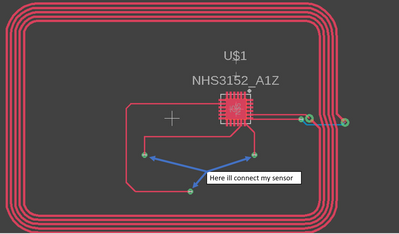
CODE UPLOAD
When the completed PCB + NHS3152 (I will ask for assembly) is here, i can upload the code to NHS3152 following this asnwer Re: Program NHS3152 via NFC field? - NXP Community.
By using the the vii) NHS31xx NFC program Loader app: NHS31xx NFC Program Loader – Apps on Google Play
(I still haven't tested this out!)
-------
Is there any glaring errors with any of the parts metioned above?
i) attach an antenna directly without a capacitor.
ii) Design antenna dimensions similar to NHS3152DEMOBOARD
iii) (future) change the antenna to a smaller Class4 antenna without attaching a capacitor.
iv) NHS3152 Package Dimension taken from Therapy adherence resistive monitor (nxp.com)
v) Thermal pad as GND and connected VSS to it.
vi) NHS3152 Package inside the antenna area, extended some wires out so that i can connect my sensor.
vii) Upload custom code via NHS31xx NFC program Loader app: NHS31xx NFC Program Loader – Apps on Google Play
------
I've attached the gerber & pick and place files for completeness.
Thanks,
Leo
已解决! 转到解答。


My apologies for the late response regarding this matter.
Here are the listed answers our experts did help us answer:
i) attach an antenna directly without a capacitor.
--> on FR4 the demo board antenna in combination with the NHS3152 resonates at about 14.1MHz, which is fine.
If the antenna is mounted close to metal, there will be losses and the resonant frequency shifts up. This can be compensated by adding extra capacitance parallel to the antenna
If the antenna is mounted close to ferrite material, the resonance frequency shifts down. If it shifts down too much, the antenna needs less windings or a smaller size.
iii) (future) change the antenna to a smaller Class4 antenna without attaching a capacitor.
--> If the antenna inductance is lower and the resonance frequency shifts too high, you need a parallel cap to bring it down to 13.56MHz ... 14.5MHz
v) Thermal pad as GND and connected VSS to it.
OK
vi) NHS3152 Package inside the antenna area, extended some wires out so that i can connect my sensor.
OK
vii) Upload custom code via NHS31xx NFC program Loader app: NHS31xx NFC Program Loader – Apps on Google Play
--> ATTENTION ATTENTION: to program the NHS3153 via NFC, an external power source connected to VDDBAT IS NEEDED!
I suggest to provide testpads on VDDBAT, GND to allow this temporary connection during programming.
I also suggest to provide testpads on RESETN, PIO0_10 and PIO0_11 (SWD lines) to enable reprogramming via LPCLINK2 (NFC loading is one-time)
Since the application works solely on NFC power, I also suggest to provide a 100nF capacitor from a PIO pin other than PIO0_4, PIO0_5 to VSS.
This capacitor can deliver energy to the chip during the 3us pauses in the NFC field when the reader is communicating with the tag.
Fabian
**Please let me know if its better if I upload the gerber instead of the images of the improvements i've made**
Thanks @Fabian_R , in V2 of design I've adressed your improvements please let me know if It is fit for manufacturing (or you have other suggestions) and i'll have it made rigth away:
i) Deliver energy to the chip during the 3[us] pauses in the NFC field attach 100nF capacitor from PIO pin (not 04 or 05) to VSS
I have attached 100nF capacitor from PIO0_9 to VSS.(VSS also at GND )
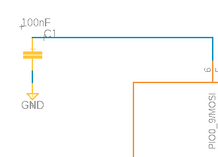
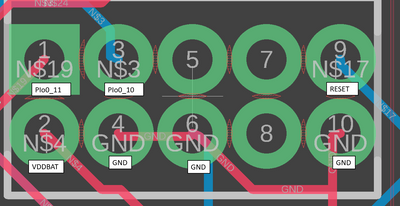
ii) Provide Testpads on VDDBAT, GND, connect to RESETN, PIO0_10 and PIO0_11 (SWD lines) and enable reprogramming via LPCLINK2 (since NFC loading is one time - like this you can reuse)
I have copied the J2 connection provided for NHS3152 Demo PCB - Like this I can conenct to LPCLINK2.
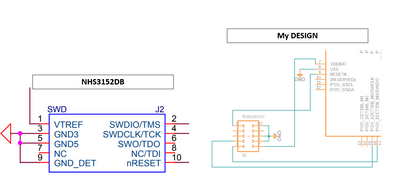
The rest are my connetions to my sensors through pins ANA0 to ANA5.
PIN CONNECTION
From | TO | Verified |
|
VSS | GND | Yes |
|
Thermal Pad | GND | Yes |
|
LA-LB | Antenna | Yes |
|
J2 connections – Copy the J2 connection of NHS3152DB – so I can connect to LPCLINK | |||
9 | RESTET | No |
|
[10-6-4] | GND | No |
|
1 | PIO0_11 | No |
|
3 | PIO0_10 | No |
|
2 | VDDBAT | No |
|
PIO0_9 | VSS (GND) | No |
|
Source connector to CHIP Connections | |||
ANA_0 | Source | Measure Resistance between Source and any of D9-5 (use DAQ-ADC-12C between these ) | |
ANA_1 | D9 | ||
ANA_2 | D8 | ||
ANA_3 | D7 | ||
ANA_4 | D6 | ||
ANA_5 | D5 | ||
Antenna param
ANTENNA | |
MODEL | NHS3152 Demo PCB |
Pitch | 0.6[mm] |
Gap between tracks | 0.3[mm] |
Track width | 0.3[mm] |
Track thickness | 0.035 [mm] (EDIT Corrected) |
Nc Number of turns | 5 |
a_0 , b_0 | 46.3, 32.3 |
PCB LAYOUT
The final design looks a bit crowded (needed space for my R&D prototype sensors sample) - here are some immages of the design:
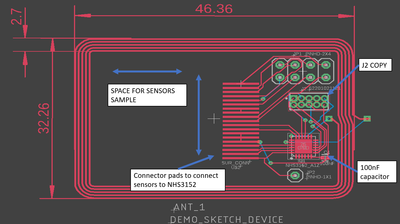
thanks for your help,
leo
You are welcome!! I believe that if you followed our recommendations there isn´t anything we can add.
Please let us know if your PCB design works properly as it should. If you have any issues please let us know so we can help you figure things out.
Have a great day!!
Fabian
My apologies for the late response regarding this matter.
Here are the listed answers our experts did help us answer:
i) attach an antenna directly without a capacitor.
--> on FR4 the demo board antenna in combination with the NHS3152 resonates at about 14.1MHz, which is fine.
If the antenna is mounted close to metal, there will be losses and the resonant frequency shifts up. This can be compensated by adding extra capacitance parallel to the antenna
If the antenna is mounted close to ferrite material, the resonance frequency shifts down. If it shifts down too much, the antenna needs less windings or a smaller size.
iii) (future) change the antenna to a smaller Class4 antenna without attaching a capacitor.
--> If the antenna inductance is lower and the resonance frequency shifts too high, you need a parallel cap to bring it down to 13.56MHz ... 14.5MHz
v) Thermal pad as GND and connected VSS to it.
OK
vi) NHS3152 Package inside the antenna area, extended some wires out so that i can connect my sensor.
OK
vii) Upload custom code via NHS31xx NFC program Loader app: NHS31xx NFC Program Loader – Apps on Google Play
--> ATTENTION ATTENTION: to program the NHS3153 via NFC, an external power source connected to VDDBAT IS NEEDED!
I suggest to provide testpads on VDDBAT, GND to allow this temporary connection during programming.
I also suggest to provide testpads on RESETN, PIO0_10 and PIO0_11 (SWD lines) to enable reprogramming via LPCLINK2 (NFC loading is one-time)
Since the application works solely on NFC power, I also suggest to provide a 100nF capacitor from a PIO pin other than PIO0_4, PIO0_5 to VSS.
This capacitor can deliver energy to the chip during the 3us pauses in the NFC field when the reader is communicating with the tag.
Fabian
