
- Forums
- Product Forums
- General Purpose MicrocontrollersGeneral Purpose Microcontrollers
- i.MX Forumsi.MX Forums
- QorIQ Processing PlatformsQorIQ Processing Platforms
- Identification and SecurityIdentification and Security
- Power ManagementPower Management
- Wireless ConnectivityWireless Connectivity
- RFID / NFCRFID / NFC
- Advanced AnalogAdvanced Analog
- Neural Processing UnitsNeural Processing Units
- MCX Microcontrollers
- S32G
- S32K
- S32V
- MPC5xxx
- Other NXP Products
- S12 / MagniV Microcontrollers
- Powertrain and Electrification Analog Drivers
- Sensors
- Vybrid Processors
- Digital Signal Controllers
- 8-bit Microcontrollers
- ColdFire/68K Microcontrollers and Processors
- PowerQUICC Processors
- OSBDM and TBDML
- S32M
- S32Z/E
-
- Solution Forums
- Software Forums
- MCUXpresso Software and ToolsMCUXpresso Software and Tools
- CodeWarriorCodeWarrior
- MQX Software SolutionsMQX Software Solutions
- Model-Based Design Toolbox (MBDT)Model-Based Design Toolbox (MBDT)
- FreeMASTER
- eIQ Machine Learning Software
- Embedded Software and Tools Clinic
- S32 SDK
- S32 Design Studio
- GUI Guider
- Zephyr Project
- Voice Technology
- Application Software Packs
- Secure Provisioning SDK (SPSDK)
- Processor Expert Software
- Generative AI & LLMs
-
- Topics
- Mobile Robotics - Drones and RoversMobile Robotics - Drones and Rovers
- NXP Training ContentNXP Training Content
- University ProgramsUniversity Programs
- Rapid IoT
- NXP Designs
- SafeAssure-Community
- OSS Security & Maintenance
- Using Our Community
-
- Cloud Lab Forums
-
- Knowledge Bases
- ARM Microcontrollers
- i.MX Processors
- Identification and Security
- Model-Based Design Toolbox (MBDT)
- QorIQ Processing Platforms
- S32 Automotive Processing Platform
- Wireless Connectivity
- CodeWarrior
- MCUXpresso Suite of Software and Tools
- MQX Software Solutions
- RFID / NFC
- Advanced Analog
- Neural Processing Units
-
- NXP Tech Blogs
- Home
- :
- モデルベース・デザイン・ツールボックス(MBDT)
- :
- モデルベース・デザイン・ツールボックス(MBDT)
- :
- MBDT LIN compile error
MBDT LIN compile error
- RSS フィードを購読する
- トピックを新着としてマーク
- トピックを既読としてマーク
- このトピックを現在のユーザーにフロートします
- ブックマーク
- 購読
- ミュート
- 印刷用ページ
MBDT LIN compile error

- 新着としてマーク
- ブックマーク
- 購読
- ミュート
- RSS フィードを購読する
- ハイライト
- 印刷
- 不適切なコンテンツを報告
I'm running into some unexpected errors when trying to use the MBDT LIN blocks with the S32K142.
The LIN master example compile without issue but when I try to use the LIN blocks into my own model I'm getting errors that both LIN_XCVR_ENABLE_GPIO_PORT and LIN_XCVR_ENABLE_MASK are undefined:
error: 'LIN_XCVR_ENABLE_GPIO_PORT' undeclared (first use in this function) PINS_DRV_SetPinsDirection(LIN_XCVR_ENABLE_GPIO_PORT, LIN_XCVR_ENABLE_MASK);
When I look at the C code that gets generated from the lin_master_s32k14x.slx example I see these #defines:
34	#define LIN_XCVR_ENABLE_PIN            (9UL)
35	#define LIN_XCVR_ENABLE_MASK           (0x1u << LIN_XCVR_ENABLE_PIN)
36	#define LIN_XCVR_ENABLE_GPIO_PORT      (PTE)
These same #define statements are not present in the C code that gets generated from my model that's using the same LIN blocks.
A couple questions:
- What in the Simulink model for the example project is generating these #define statements? There is nothing in the GUI for any of the blocks to specify a GPIO pin to use for LIN Transceiver Enable.
- My hardware does not need a LIN Transceiver Enable pin. How can I get the code to compile without attempting to initialize a GPIO pin for this function? Again, there is nothing in the Simulink blocks related to this at all (just the TX and RX pins, as I would expect).
Thanks,
Andy
- 新着としてマーク
- ブックマーク
- 購読
- ミュート
- RSS フィードを購読する
- ハイライト
- 印刷
- 不適切なコンテンツを報告
I was able to work around the compiler error by adding the missing #defines into the Custom Code section of the Simulink model configuration.
This is a bit of a hack though, and I'd still like to understand the answers to the two questions in the post above.

I'm now experiencing a different issue.
When acting as a LIN master, I can successfully send messages to and receive data from slaves if the slaves are all connected and working properly. However, if I send a message header to get data from a slave that isn't present and the slave doesn't respond, the LIN_ReceiveFrameData seems to be blocking and doesn't allow transmission of any additional headers via the LIN_Master_Send_Header block if it never receives any frame data from the slave. Is there a way to address this? I don't see any timeout values in any of the LIN blocks, nor do I see a timeout in the LIN events that can be generated by the LIN_ISR block.
Any advice would be appreciated.
- 新着としてマーク
- ブックマーク
- 購読
- ミュート
- RSS フィードを購読する
- ハイライト
- 印刷
- 不適切なコンテンツを報告
I think I've figured out what's causing the "blocking" behavior if a Slave never sends the data that the Master S32K1xxx is expecting.
The LIN receive Simulink block calls the LIN_LPUART_DRV_RecvFrmData() function, which is technically non-blocking (LIN_LPUART_DRV_RecvFrmDataBlocking() is the blocking version), but it does set the linCurrentState->isBusBusy flag to true, which effectively prevents the other LIN blocks from using the bus.

The LIN_LPUART_DRV_MasterSendHeader() function called by the LIN_Master_Send_Header block checks to see if the linCurrentState->isBusBusy flag is true and if it is, returns without sending the header.
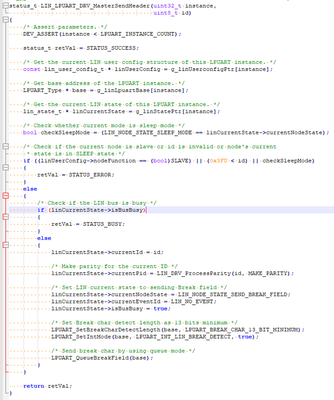
If the Master never completes receiving data from the Slave (slave goes offline, etc.), the linCurrentState->isBusBusy flag never gets reset and the Master can't send any more headers.
Allowing a bad slave to prevent further action by the Master is probably not a great idea.
I modified the lin_lpuart_driver.c file as shown below as a hacky workaround, but modifying the NXP driver source code files is not an ideal long-term solution.

A better solution may be to add some checks of the linUserConfig->nodeFunction (MASTER/SLAVE) flag in various places where it makes sense for a Master to do things regardless of slave behavior, but I haven't fully thought through where all of those checks would need to be.
I'd appreciate any insight into other possible solutions or more "correct" workarounds for this issue.
