
- Forums
- Product Forums
- General Purpose MicrocontrollersGeneral Purpose Microcontrollers
- i.MX Forumsi.MX Forums
- QorIQ Processing PlatformsQorIQ Processing Platforms
- Identification and SecurityIdentification and Security
- Power ManagementPower Management
- Wireless ConnectivityWireless Connectivity
- RFID / NFCRFID / NFC
- Advanced AnalogAdvanced Analog
- Neural Processing UnitsNeural Processing Units
- MCX Microcontrollers
- S32G
- S32K
- S32V
- MPC5xxx
- Other NXP Products
- S12 / MagniV Microcontrollers
- Powertrain and Electrification Analog Drivers
- Sensors
- Vybrid Processors
- Digital Signal Controllers
- 8-bit Microcontrollers
- ColdFire/68K Microcontrollers and Processors
- PowerQUICC Processors
- OSBDM and TBDML
- S32M
- S32Z/E
-
- Solution Forums
- Software Forums
- MCUXpresso Software and ToolsMCUXpresso Software and Tools
- CodeWarriorCodeWarrior
- MQX Software SolutionsMQX Software Solutions
- Model-Based Design Toolbox (MBDT)Model-Based Design Toolbox (MBDT)
- FreeMASTER
- eIQ Machine Learning Software
- Embedded Software and Tools Clinic
- S32 SDK
- S32 Design Studio
- GUI Guider
- Zephyr Project
- Voice Technology
- Application Software Packs
- Secure Provisioning SDK (SPSDK)
- Processor Expert Software
- Generative AI & LLMs
-
- Topics
- Mobile Robotics - Drones and RoversMobile Robotics - Drones and Rovers
- NXP Training ContentNXP Training Content
- University ProgramsUniversity Programs
- Rapid IoT
- NXP Designs
- SafeAssure-Community
- OSS Security & Maintenance
- Using Our Community
-
- Cloud Lab Forums
-
- Knowledge Bases
- ARM Microcontrollers
- i.MX Processors
- Identification and Security
- Model-Based Design Toolbox (MBDT)
- QorIQ Processing Platforms
- S32 Automotive Processing Platform
- Wireless Connectivity
- CodeWarrior
- MCUXpresso Suite of Software and Tools
- MQX Software Solutions
- RFID / NFC
- Advanced Analog
- Neural Processing Units
-
- NXP Tech Blogs
- Home
- :
- Product Forums
- :
- MPC5xxx
- :
- I2C STOP mode generation problem
I2C STOP mode generation problem
- Subscribe to RSS Feed
- Mark Topic as New
- Mark Topic as Read
- Float this Topic for Current User
- Bookmark
- Subscribe
- Mute
- Printer Friendly Page
I2C STOP mode generation problem

- Mark as New
- Bookmark
- Subscribe
- Mute
- Subscribe to RSS Feed
- Permalink
- Report Inappropriate Content
Hi, everybody!
When I want to generate a stop signal in I2C of MPC5748G, there is something puzzle me.
In master transmiting and slave receiving mode
(I2C_2 is the master node, I2C_3 is the slave node),
the stop signal can be generated right by
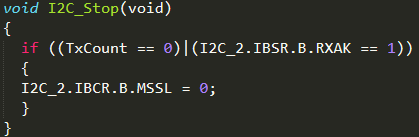
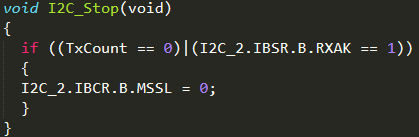
Here's the question,
In master receiving and slave transmiting mode
(I2C_2 is the master node, I2C_3 is the slave node),
why the stop signal can not be generated right by
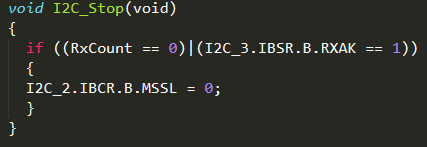
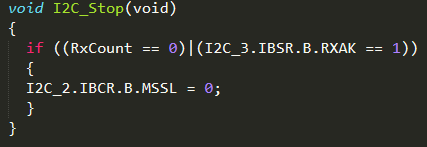
After I run this function, the IBB bit of IBCR register is still equals to 1, which means the bus is busy, the stop signal isn't generated. The whole program will stuck at
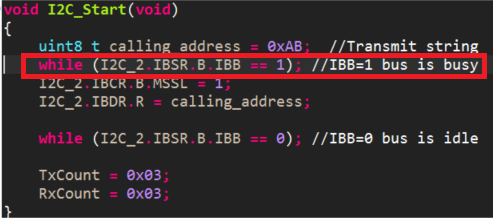
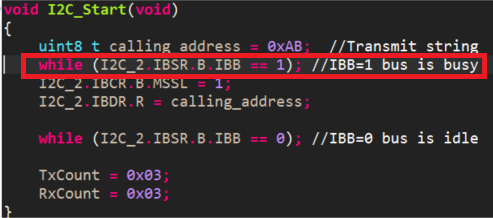
What should I do when I want to generate a stop signal in master receiving and slave transmiting mode?
Attachment is my program project for reference.
Thanks a lot!
Original Attachment has been moved to: mpc5748g_Z4_1.zip

 PetrS
PetrS
- Mark as New
- Bookmark
- Subscribe
- Mute
- Subscribe to RSS Feed
- Permalink
- Report Inappropriate Content
Hi,
You have to properly follow recommended interrupt service flow, as shown in Fig 44-13 of the RM.
So if a master receiver wants to terminate a data transfer, it must inform the slave transmitter by not
acknowledging the last byte of data which can be done by setting the NOACK bit before reading the 2nd last byte of data. This read initiates next byte (last) data receiving. In this case the slave transmits the byte (last) which is not acknowledged by master. In slave transmitter routine, the received acknowledge bit (RXAK) must be tested before transmitting the next byte of data. Setting RXAK means an 'end of data' signal from the master receiver, after which slave must be switched from transmitter mode to receiver mode by software. A dummy read then releases the SDA line so that the master can generate a STOP signal.
So your Slave_transmit and Master_Receive function should be modified little bit as
void I2C_Slave_Transmit(void)
{
uint8_t dummy;
//I2C_3.IBSR.B.IBIF = 0; // writing 0 have no effect
I2C_3.IBDR.R = TxData;
TxCount = TxCount - 1;
while (I2C_3.IBSR.B.IBIF == 0);
if (I2C_3.IBSR.B.RXAK == 1)
{
I2C_3.IBCR.B.TXRX = 0;
dummy = I2C_3.IBDR.R;
}
I2C_3.IBSR.B.IBIF = 1;
}
void I2C_Master_Receive(void)
{
uint8_t RxData;
// I2C_2.IBSR.B.IBIF = 0; // writing 0 have no effect
if (RxCount == 2)
{
I2C_2.IBCR.B.NOACK = 1;
}
if (RxCount == 1)
{
I2C_2.IBCR.B.MSSL = 0; // generate STOP
I2C_2.IBCR.B.NOACK = 0;
}
RxData = I2C_2.IBDR.R;
RxCount = RxCount - 1;
}
Then Stop function is not used in main().
BR, Petr
- Mark as New
- Bookmark
- Subscribe
- Mute
- Subscribe to RSS Feed
- Permalink
- Report Inappropriate Content
Hi Petr,
Thanks a lot for your answer.
I’ve tried your program but it still cannot work, and will be stuck at the same place. After one cycle transmit and receive, the IBB bit of IBSR register still equals to 1, which means there is not a stop signal generated, why?
Thanks a lot!
BR, Qiang
int main(void)
{
xcptn_xmpl (); //Configure and Enable Interrupts
peri_clock_gating(); //configure gating/enabling peri. clocks for modes
//configuraiton occurs after mode transition
system160mhz(); //sysclk=160MHz, dividers configured, mode trans
SIUL2_Init ();
INTC.PSR[444].R = 0x8001;
I2C_2_Init();
I2C_3_Init();
while(1)
{
I2C_Start();
I2C_Slave_Set();
for (i = 0; i <= 2; i++)
{
I2C_Slave_Transmit();
I2C_Master_Receive();
}
count = count + 1;
}
}
PetrS
- Mark as New
- Bookmark
- Subscribe
- Mute
- Subscribe to RSS Feed
- Permalink
- Report Inappropriate Content
Within a I2C_Start() you need to set "transmit" mode again as at the end a Master stays in "receive" mode.
Use
void I2C_Start(void)
{
uint8_t calling_address = 0xAB; //Transmit string
while (I2C_2.IBSR.B.IBB == 1); //IBB=1 bus is busy
I2C_2.IBCR.B.TXRX = 1; //Transmit/Receive mode 1 = Transmit 0 = Receive
I2C_2.IBCR.B.MSSL = 1; // generate Start
I2C_2.IBDR.R = calling_address;
....
BR, Petr
- Mark as New
- Bookmark
- Subscribe
- Mute
- Subscribe to RSS Feed
- Permalink
- Report Inappropriate Content
Hi, Petr
Thank you very much for your help! It can work now! THX!
Best Regards,
Qiang
