
- Forums
- Product Forums
- General Purpose MicrocontrollersGeneral Purpose Microcontrollers
- i.MX Forumsi.MX Forums
- QorIQ Processing PlatformsQorIQ Processing Platforms
- Identification and SecurityIdentification and Security
- Power ManagementPower Management
- Wireless ConnectivityWireless Connectivity
- RFID / NFCRFID / NFC
- Advanced AnalogAdvanced Analog
- Neural Processing UnitsNeural Processing Units
- MCX Microcontrollers
- S32G
- S32K
- S32V
- MPC5xxx
- Other NXP Products
- S12 / MagniV Microcontrollers
- Powertrain and Electrification Analog Drivers
- Sensors
- Vybrid Processors
- Digital Signal Controllers
- 8-bit Microcontrollers
- ColdFire/68K Microcontrollers and Processors
- PowerQUICC Processors
- OSBDM and TBDML
- S32M
- S32Z/E
-
- Solution Forums
- Software Forums
- MCUXpresso Software and ToolsMCUXpresso Software and Tools
- CodeWarriorCodeWarrior
- MQX Software SolutionsMQX Software Solutions
- Model-Based Design Toolbox (MBDT)Model-Based Design Toolbox (MBDT)
- FreeMASTER
- eIQ Machine Learning Software
- Embedded Software and Tools Clinic
- S32 SDK
- S32 Design Studio
- GUI Guider
- Zephyr Project
- Voice Technology
- Application Software Packs
- Secure Provisioning SDK (SPSDK)
- Processor Expert Software
- Generative AI & LLMs
-
- Topics
- Mobile Robotics - Drones and RoversMobile Robotics - Drones and Rovers
- NXP Training ContentNXP Training Content
- University ProgramsUniversity Programs
- Rapid IoT
- NXP Designs
- SafeAssure-Community
- OSS Security & Maintenance
- Using Our Community
-
- Cloud Lab Forums
-
- Knowledge Bases
- ARM Microcontrollers
- i.MX Processors
- Identification and Security
- Model-Based Design Toolbox (MBDT)
- QorIQ Processing Platforms
- S32 Automotive Processing Platform
- Wireless Connectivity
- CodeWarrior
- MCUXpresso Suite of Software and Tools
- MQX Software Solutions
- RFID / NFC
- Advanced Analog
- Neural Processing Units
-
- NXP Tech Blogs
- Home
- :
- MCUXpressoソフトウェアとツール
- :
- MCUXpresso SDK
- :
- Flashloader project for Adesto EcoXIP problem.
Flashloader project for Adesto EcoXIP problem.
- RSS フィードを購読する
- トピックを新着としてマーク
- トピックを既読としてマーク
- このトピックを現在のユーザーにフロートします
- ブックマーク
- 購読
- ミュート
- 印刷用ページ
Flashloader project for Adesto EcoXIP problem.

- 新着としてマーク
- ブックマーク
- 購読
- ミュート
- RSS フィードを購読する
- ハイライト
- 印刷
- 不適切なコンテンツを報告
Hello,
I am trying to use the NXP Secure Provisioning Tool v2.1 to upload an XIP application to an Embedded Artists i.MX RT1062 board which uses the Adesto EcoXIP (ATXP032) for Flash.
Using MCUXpresso (and J-Link debugger) the application uploads and runs fine.
Switching to Secure Provisioning Tool (or NXP MCUBootUtility) the application uploads, but cannot execute.
I am using the flashloader that comes with Secure Provisioning Tool and I have also tried using a custom flashloader.bin based on the MCUboot SDK example in MCUXpresso SDK 2.8.6
I used MCUBootUtility to read out the flash memory (from location 0x60000000) to compare the two binary images.
There are some substantial differences between the two methods.
Specifically, the Flash Device Config Block (which starts at 0x60000000) is different. Then the IVT, Boot Data and DCD sections (which start at 0x60001000) are also very different.
It seems that these differences cause the application to fail to run. I manually removed the boot header from an MCUExpresso based binary image and loaded it using Secure Provisioning Tool directly, and it did successfully execute from Flash (although very slowly). But this doesn't fix the FDCB section, which seems cause the poor execution performance.
It looks like the flashloader function "flexspi_nor_generate_config_block_adesto_octalflash" is responsible for setting up the FDCB section, these settings are different than the MCUXpresso settings which seem to be set by "evkmimxrt1060_flexspi_nor_config.c"
Is it possible that the FDCB configuration for the Adesto Octal flash is incorrect or hasn't been updated in the SDK example for the flashloader and the flashloader included with Secure Provisioning Tool / MCUBootUtility?
Here are some screenshots highlighting my findings:
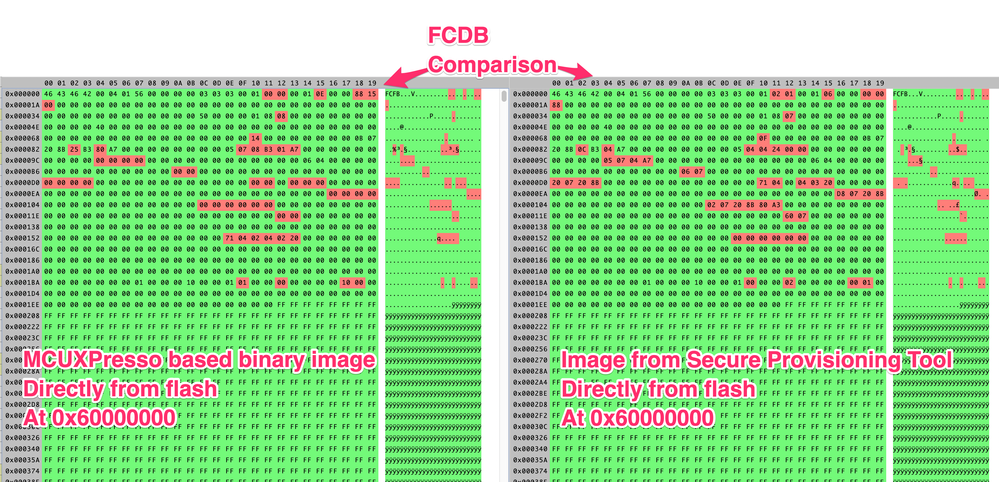

This is the flash config for xip in an MCUXpresso application project:
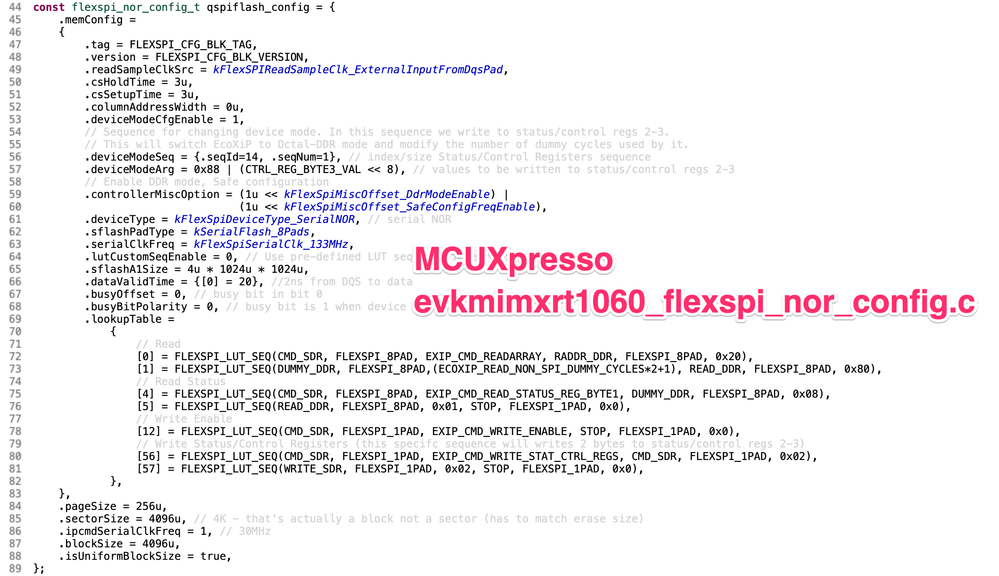
This looks to be the corresponding flash configuration in the flashloader code:

thanks

 gusarambula
- 新着としてマーク
- ブックマーク
- 購読
- ミュート
- RSS フィードを購読する
- ハイライト
- 印刷
- 不適切なコンテンツを報告
Hello Jackking,
This is an interesting analysis, although I cannot confirm if that would be the case as I’m not familiar with this board. The Embedded Artists i.MX RT1062 OEM board is manufactured and supported by Embedded Artists. They do provide a customized SDK
https://www.embeddedartists.com/products/imx-rt1062-oem/
Was the FDCB comparison from this SDK? If that’s the case I would suggest contacting Embedded Artists for support on their SDK customizations.
My apologies for the inconvenience.
Regards,
Gustavo
- 新着としてマーク
- ブックマーク
- 購読
- ミュート
- RSS フィードを購読する
- ハイライト
- 印刷
- 不適切なコンテンツを報告
I will ask EA, but the SDK is the standard NXP SDK, Embedded Artists just provides a few patch files for the standard NXP SDK (on Mac).
The flashloader example includes Adesto EcoXIP code directly from NXP (not provided by Embedded Artists).
I did a diff on the Windows version of the EA SDK and there aren't any core differences in the mcu-boot project
- 新着としてマーク
- ブックマーク
- 購読
- ミュート
- RSS フィードを購読する
- ハイライト
- 印刷
- 不適切なコンテンツを報告
Hi @jackking . Did you get any answers from Embedded Artists? I think I have the same issue here: https://community.nxp.com/t5/i-MX-RT/Run-bootloader-from-application-rt1062/m-p/1282335#M14372
- 新着としてマーク
- ブックマーク
- 購読
- ミュート
- RSS フィードを購読する
- ハイライト
- 印刷
- 不適切なコンテンツを報告
No, I did not. I just switched to using the binary image directly from MCUXpresso IDE, instead of creating it in Secure Provisioning.
You can load a raw binary in Secure Provisioning so I just avoid the issue altogether, although it would be great if this were fixed.
 marek-trmac
- 新着としてマーク
- ブックマーク
- 購読
- ミュート
- RSS フィードを購読する
- ハイライト
- 印刷
- 不適切なコンテンツを報告
Hi jackking,
we are planning to support bootable image produced by MCU IDE/Keil/IAR as input for Build in Secure Provisioning Tool. FCB specified in the image shall be reusable in Secure Provisioning Tool too.
Regards
Marek
Marek
NOTE: If you find the answer useful, kindly click on [ACCEPT AS SOLUTION] button
- 新着としてマーク
- ブックマーク
- 購読
- ミュート
- RSS フィードを購読する
- ハイライト
- 印刷
- 不適切なコンテンツを報告
Thanks, but I am still having problems (error message kStatus_FlexSPINOR_SFDP_NotFound) when using the raw binary from the MCU IDE. Is there some other problem with the FCB for the Adesto Flash?
gusarambula
- 新着としてマーク
- ブックマーク
- 購読
- ミュート
- RSS フィードを購読する
- ハイライト
- 印刷
- 不適切なコンテンツを報告
Hello Jackking,
My apologies, you are right. There was support for some of Adesto’s Serial Flash memories, but chances are these haven’t been updated on the SDK example or some of the latest releases of the tools.
https://www.nxp.com/docs/en/white-paper/NXPADESTOWP.pdf
Regards,
Gustavo
