
- Forums
- Product Forums
- General Purpose MicrocontrollersGeneral Purpose Microcontrollers
- i.MX Forumsi.MX Forums
- QorIQ Processing PlatformsQorIQ Processing Platforms
- Identification and SecurityIdentification and Security
- Power ManagementPower Management
- Wireless ConnectivityWireless Connectivity
- RFID / NFCRFID / NFC
- Advanced AnalogAdvanced Analog
- Neural Processing UnitsNeural Processing Units
- MCX Microcontrollers
- S32G
- S32K
- S32V
- MPC5xxx
- Other NXP Products
- S12 / MagniV Microcontrollers
- Powertrain and Electrification Analog Drivers
- Sensors
- Vybrid Processors
- Digital Signal Controllers
- 8-bit Microcontrollers
- ColdFire/68K Microcontrollers and Processors
- PowerQUICC Processors
- OSBDM and TBDML
- S32M
- S32Z/E
-
- Solution Forums
- Software Forums
- MCUXpresso Software and ToolsMCUXpresso Software and Tools
- CodeWarriorCodeWarrior
- MQX Software SolutionsMQX Software Solutions
- Model-Based Design Toolbox (MBDT)Model-Based Design Toolbox (MBDT)
- FreeMASTER
- eIQ Machine Learning Software
- Embedded Software and Tools Clinic
- S32 SDK
- S32 Design Studio
- GUI Guider
- Zephyr Project
- Voice Technology
- Application Software Packs
- Secure Provisioning SDK (SPSDK)
- Processor Expert Software
- Generative AI & LLMs
-
- Topics
- Mobile Robotics - Drones and RoversMobile Robotics - Drones and Rovers
- NXP Training ContentNXP Training Content
- University ProgramsUniversity Programs
- Rapid IoT
- NXP Designs
- SafeAssure-Community
- OSS Security & Maintenance
- Using Our Community
-
- Cloud Lab Forums
-
- Knowledge Bases
- ARM Microcontrollers
- i.MX Processors
- Identification and Security
- Model-Based Design Toolbox (MBDT)
- QorIQ Processing Platforms
- S32 Automotive Processing Platform
- Wireless Connectivity
- CodeWarrior
- MCUXpresso Suite of Software and Tools
- MQX Software Solutions
- RFID / NFC
- Advanced Analog
- Neural Processing Units
-
- NXP Tech Blogs
- Home
- :
- 汎用マイクロコントローラ
- :
- Kinetisモータ・スイート
- :
- KMS BLDC sensorless control
KMS BLDC sensorless control
- RSS フィードを購読する
- トピックを新着としてマーク
- トピックを既読としてマーク
- このトピックを現在のユーザーにフロートします
- ブックマーク
- 購読
- ミュート
- 印刷用ページ

- 新着としてマーク
- ブックマーク
- 購読
- ミュート
- RSS フィードを購読する
- ハイライト
- 印刷
- 不適切なコンテンツを報告
Hello,
I have a customer who is interested in using KMS to speed up his time to market for a BLDC motor control. But, as we opened KMS, we ran into a problem: there is no option for sensorless BLDC motor control. Is there a workaround for that or KMS really doesn't support sensorless BLDC control?
Thanks,
Marco Coelho
Siletec Eletronica
解決済! 解決策の投稿を見る。

- 新着としてマーク
- ブックマーク
- 購読
- ミュート
- RSS フィードを購読する
- ハイライト
- 印刷
- 不適切なコンテンツを報告
Marco,
You are correct in that BLDC motors typically expect a trapezoidal driving waveform, but they can still be controlled using sine waves.
BLDC motors are simply a subset of PMSM motors where the windings are concentrated instead of distributed.
In fact, you can often control a BLDC motor more efficiently using sine wave control than trapezoidal control.

 philip_drake
- 新着としてマーク
- ブックマーク
- 購読
- ミュート
- RSS フィードを購読する
- ハイライト
- 印刷
- 不適切なコンテンツを報告
A BLDC motor can be driven very effectively from KMS. Use the PMSM option. Instead of hall sensor or sensorless BLDC control KMS will control the motor with Field Oriented Control (FOC) .
I hope this helps.
Philip

- 新着としてマーク
- ブックマーク
- 購読
- ミュート
- RSS フィードを購読する
- ハイライト
- 印刷
- 不適切なコンテンツを報告
Hi Philip,
I´m the customer who Marco Aurelio introduced in this first post.
My project will be an air conditioner compressor BLDC sensorless power driver up to 2000W 220V 120Hz. I already have my own power module that can work with up to 15kHz and now I will buy one FRDM-KV31F to generate the PWM pulses and connect to my power module. This compressor motor don´t need change the speed too fast, it is always slow to increase and decrease the speed. The gas will be slowly compressed and the load of the motor will be slowly increased too.
I´m a little bit confused about classify this kind of BLDC/PMSM sensorless motor.
I´ve seen your presentation and you told it is possible to use this MCU families:
KV1x for BLDC entry-level PMSM
KV3x for mid-range PMSM
KV4 high perfromace...
The fact is that the KV31 cost $4 and becomes expensive for this project.
ok, now I will start with FRDM-KV31F. And in the definitive prototype, what KVxx can I use?
Luciano
philip_drake
- 新着としてマーク
- ブックマーク
- 購読
- ミュート
- RSS フィードを購読する
- ハイライト
- 印刷
- 不適切なコンテンツを報告
Glad to meet you Luciano,
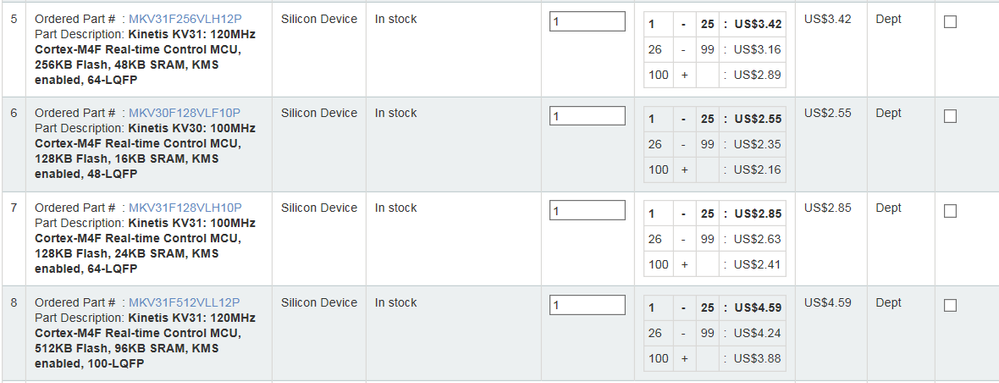
The KV series of MCUs including the three you mentioned, the KV1x, the KV3x, and the KV4x MCUs call all drive a BLDC or PMSM motor. The BLDC motor, as Adam mentioned can be driven with a standard 6-step commutation algorythm or a sensorless (back EMF) method or with sensorless FOC. There are two basic motor control options from NXP, 1) the Kinetis Motor Suite - which uses a sensorless FOC algorythm or 2) a Kinetis Motor control reference design. For people without a lot of motor control expertise the KMS offers a tuning ability to get the motor running.
The KV3x MCU family includes four devices ranging in size and speed from a 512K flash 120Mhz part down to a 64K flash 100 MHz part. Any of them can be used with KMS. The MKV31F512xxx12 is what is used on the MCU evaluation boards as a superset part of the MCU family. In you end application you can utilize any one of the four MCU parts.
The
MKV31F256VLH12P , or the
Your choice of the most expensive of these, the 512K part would only be driven if your application code, added to the motor control reference project (KMS takes approximately ~64K), takes up the rest of the flash.
If your code was very small and it and the KMS software fit into the less expensive 128K flash MCU.
There are instructions in the KMS documentation as to how to change the reference project to the other devices.
Since your application is a High voltage application, you could use the design of the HVP KV31 board for your testing. Those boards include the same KV31F512 with KMS pre-programmed on it. One of the key differences is the opto-isolation between the MCU drive and the debugger hardware on the board. You can see this HVP platform here
, The part number of the KV31 controller card is HVP-KV31F120M, it's available from nxp.com for $79.00, with a User's Guide and the design files and schematics available in the HVP download tab.
I hope this helps.
Best Regards,
Philip
- 新着としてマーク
- ブックマーク
- 購読
- ミュート
- RSS フィードを購読する
- ハイライト
- 印刷
- 不適切なコンテンツを報告
Hi Philip,
I see the KMS generate 64k bytes.
Why did you recommend MKV30F128VLF10P instead of some KV10?
My code will be too small and I maybe I can use 64k in my end application.
KV10 are cheaper than KV30.
What do you think about use KV10 in my end application?
Thank you for your help!
Luciano
philip_drake
- 新着としてマーク
- ブックマーク
- 購読
- ミュート
- RSS フィードを購読する
- ハイライト
- 印刷
- 不適切なコンテンツを報告
The KV30 is available now, the KV10 and KV11 derivatives will be introduced in the 2nd Qtr of this year. You can start with your testing with a FRDM-KV11Z board after that introduction. KMS is also being revised to inlcude the KV1x MCUs. If you want to get started now use the FRDM-KV31F and the FRDM-MC-LVPMSM shield. Then when you get the FRDM-KV11 you can use it with the same FRDM-MC-LVPMSM shield.
There will be 128K and 64KB flash sizes in the KV10 and KV11. If your code is small then yes, you could use a KV11.
If your motor control PWM frequency exceeds 20KHz then you should consider the Cortex M4 based KV3x MCU. The KV1x MCU is a Cortex M0+ with a maximum 75 MHz clock speed.
I hope that helps.
Philip
- 新着としてマーク
- ブックマーク
- 購読
- ミュート
- RSS フィードを購読する
- ハイライト
- 印刷
- 不適切なコンテンツを報告
Hello Philip,
I bought one FRDM-KV31F and I am trying to connect on my own BLDC HV power stage. It should be sensorless with BEMF references. Now I realize the FRDM don´t receive the BEMF from motor. How can it works sensorless without measuring the BEMF?
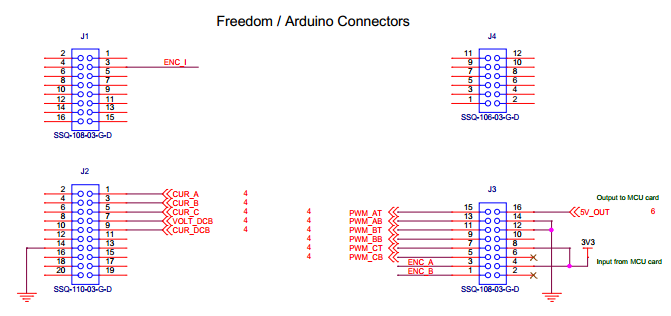
Do you think I can make one prototype for HV using FRDM-KV31F generation code through KMS (KV31/Freedom/Sensorless Velocity/PMSM/...)? or can I generate other code like Tower and can run on FRDM?
Luciano
philip_drake
- 新着としてマーク
- ブックマーク
- 購読
- ミュート
- RSS フィードを購読する
- ハイライト
- 印刷
- 不適切なコンテンツを報告
If you purchased the FRDM-MC-LVPMSM power stage board then the CUR stands for current. The motor control method in use is Field Oriented Control, which does not use BEMF feedback but uses phase current for controlling the motor. You can turn a BLDC motor(which is a category of PMSM motors) with the LVPMSM power stage and KMS.
Philip Drake – Systems Engineer
Microcontrollers | NXP
Tel: +1 (512) 895 2522
Email: [email protected]<mailto:[email protected]>
www.nxp.com/kinetis/vseries<http://www.nxp.com/kinetis/vseries>;

- 新着としてマーク
- ブックマーク
- 購読
- ミュート
- RSS フィードを購読する
- ハイライト
- 印刷
- 不適切なコンテンツを報告
The problem is that I need make a high voltage bldc and I don't know if it works with freedom board because it doesn't use BEMF.
-
On Tue, 21 Mar 2017 14:57:27 -0700 [email protected] wrote -
NXP Community
Re: KMS BLDC sensorless control
reply from Philip Drake in Kinetis Motor Suite - View the full discussion
If you purchased the FRDM-MC-LVPMSM power stage board then the CUR stands for current. The motor control method in use is Field Oriented Control, which does not use BEMF feedback but uses phase current for controlling the motor. You can turn a BLDC motor(which is a category of PMSM motors) with the LVPMSM power stage and KMS.
Philip Drake – Systems Engineer
Microcontrollers | NXP
Tel: +1 (512) 895 2522
Email: [email protected]<mailto:[email protected]>
Reply to this message by replying to this email, or go to the message on NXP Community
Start a new discussion in Kinetis Motor Suite by email or at NXP Community
Following Re: KMS BLDC sensorless control in these streams: Inbox
This email was sent by NXP Community because you are a registered user.
You may unsubscribe instantly from NXP Community, or adjust email frequency in your email preferences
philip_drake
- 新着としてマーク
- ブックマーク
- 購読
- ミュート
- RSS フィードを購読する
- ハイライト
- 印刷
- 不適切なコンテンツを報告
Depends what you mean by high in high voltage.
The FRDM-MC-LVPMSM can cover up to 48V, above that you need a HVP and a processor daughter card. The HVP is designed for 70 to appx 400 V motor control.
Philip Drake – Systems Engineer
Microcontrollers | NXP
Tel: +1 (512) 895 2522
Email: [email protected]<mailto:[email protected]>
www.nxp.com/kinetis/vseries<http://www.nxp.com/kinetis/vseries>;

- 新着としてマーク
- ブックマーク
- 購読
- ミュート
- RSS フィードを購読する
- ハイライト
- 印刷
- 不適切なコンテンツを報告
Hi, Philip
You mean if I select PMSM sensorless option, I can drive a BLDC motor? The BLDC control signal waveform is trapezoidal, whereas PMSM control signal waveform is sinusoidal.
Isn't it necessary to change any settings?
Marco Coelho
- 新着としてマーク
- ブックマーク
- 購読
- ミュート
- RSS フィードを購読する
- ハイライト
- 印刷
- 不適切なコンテンツを報告
Marco,
You are correct in that BLDC motors typically expect a trapezoidal driving waveform, but they can still be controlled using sine waves.
BLDC motors are simply a subset of PMSM motors where the windings are concentrated instead of distributed.
In fact, you can often control a BLDC motor more efficiently using sine wave control than trapezoidal control.
 eduardo_viramon
- 新着としてマーク
- ブックマーク
- 購読
- ミュート
- RSS フィードを購読する
- ハイライト
- 印刷
- 不適切なコンテンツを報告
Marco,
KMS ONLY supports FOC control, not trapezoidal control.
If you need strictly trapezoidal control, you should look at our non-KMS trapezoidal BLDC reference design:
3-Phase Brushless DC Motor Control Design|NXP
Regards,
Eduardo
