
- Forums
- Product Forums
- General Purpose MicrocontrollersGeneral Purpose Microcontrollers
- i.MX Forumsi.MX Forums
- QorIQ Processing PlatformsQorIQ Processing Platforms
- Identification and SecurityIdentification and Security
- Power ManagementPower Management
- Wireless ConnectivityWireless Connectivity
- RFID / NFCRFID / NFC
- Advanced AnalogAdvanced Analog
- Neural Processing UnitsNeural Processing Units
- MCX Microcontrollers
- S32G
- S32K
- S32V
- MPC5xxx
- Other NXP Products
- S12 / MagniV Microcontrollers
- Powertrain and Electrification Analog Drivers
- Sensors
- Vybrid Processors
- Digital Signal Controllers
- 8-bit Microcontrollers
- ColdFire/68K Microcontrollers and Processors
- PowerQUICC Processors
- OSBDM and TBDML
- S32M
- S32Z/E
-
- Solution Forums
- Software Forums
- MCUXpresso Software and ToolsMCUXpresso Software and Tools
- CodeWarriorCodeWarrior
- MQX Software SolutionsMQX Software Solutions
- Model-Based Design Toolbox (MBDT)Model-Based Design Toolbox (MBDT)
- FreeMASTER
- eIQ Machine Learning Software
- Embedded Software and Tools Clinic
- S32 SDK
- S32 Design Studio
- GUI Guider
- Zephyr Project
- Voice Technology
- Application Software Packs
- Secure Provisioning SDK (SPSDK)
- Processor Expert Software
- Generative AI & LLMs
-
- Topics
- Mobile Robotics - Drones and RoversMobile Robotics - Drones and Rovers
- NXP Training ContentNXP Training Content
- University ProgramsUniversity Programs
- Rapid IoT
- NXP Designs
- SafeAssure-Community
- OSS Security & Maintenance
- Using Our Community
-
- Cloud Lab Forums
-
- Knowledge Bases
- ARM Microcontrollers
- i.MX Processors
- Identification and Security
- Model-Based Design Toolbox (MBDT)
- QorIQ Processing Platforms
- S32 Automotive Processing Platform
- Wireless Connectivity
- CodeWarrior
- MCUXpresso Suite of Software and Tools
- MQX Software Solutions
- RFID / NFC
- Advanced Analog
- Neural Processing Units
-
- NXP Tech Blogs
- Home
- :
- 汎用マイクロコントローラ
- :
- Kinetisマイクロコントローラ
- :
- Re: LPSPI in MKE18F512VLL16
LPSPI in MKE18F512VLL16
- RSS フィードを購読する
- トピックを新着としてマーク
- トピックを既読としてマーク
- このトピックを現在のユーザーにフロートします
- ブックマーク
- 購読
- ミュート
- 印刷用ページ
LPSPI in MKE18F512VLL16

- 新着としてマーク
- ブックマーク
- 購読
- ミュート
- RSS フィードを購読する
- ハイライト
- 印刷
- 不適切なコンテンツを報告
Hello friends,
I'm trying to use the LPSPI module of Kinetis MKE18F512VLL16 for making a single byte transfer function. I tried to drive the peripheral with both the CMSIS LPSPI driver as well as the NXP Peripheral SDK Library. Tried example codes for both of the libraries with transfer size set to 1. Every time when I run the code, the data transfer function got stuck in the below mentioned while loop and it's not going forward.
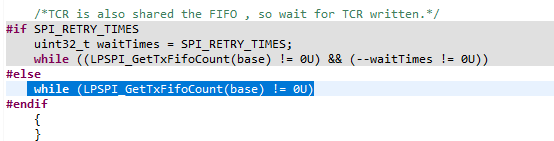
I tried debugging step by step, but couldn't find a solution. So I went forward and wrote a bare-metal driver for LPSPI from scratch and that didn't worked either. The bare- metal driver is as follows.
1. What could be the reason behind the NXP LPSPI SDK peripheral library example code getting stuck in the above mentioned while loop for checking FIFO.
2. What could be wrong in the bare metal code which was written for a single byte transfer.
Thank you,
Prasanth K S
Prasanth

- 新着としてマーク
- ブックマーク
- 購読
- ミュート
- RSS フィードを購読する
- ハイライト
- 印刷
- 不適切なコンテンツを報告
Hi!
I was testing the MKE18F512XXX16 LPSPI example but in a custom MKE16F512XXX16 board (MKE16 SDK didn't came with an example so I copied the example for a TWR board).
I was having the same issue that you, my LPSPI_MasterTransferNonBlocking function got stucked everytime in that exact place
while (LPSPI_GetTxFifoCount(base) != 0U)
I was debugging and detected that base->TCR had a value of 1 and wasnt changing.
At the end I discovered that it was a problem of my clock configuration because the SPI wasn't running.
If the SPI clock isnt configured correctly it wont run.
At the beginning of my example code I had this:
srcClock_Hz = LPSPI_MASTER_CLK_FREQ;
LPSPI_MasterInit(EXAMPLE_LPSPI_MASTER_BASEADDR, &masterConfig, srcClock_Hz);
And I found that srcClock_Hz got loaded with 0 instead of the real value.
All I did was checking my clock and preescaler config so it is running at correct speed.
This is my configuration:
/*******************************************************************************
* Definitions
******************************************************************************/
#define EXAMPLE_LPSPI_MASTER_BASEADDR LPSPI0
#define EXAMPLE_LPSPI_MASTER_CLOCK_NAME kCLOCK_Lpspi0
#define LPSPI_MASTER_CLK_FREQ (CLOCK_GetIpFreq(EXAMPLE_LPSPI_MASTER_CLOCK_NAME))
#define EXAMPLE_LPSPI_MASTER_CLOCK_SOURCE (kCLOCK_IpSrcSircAsync)
#define EXAMPLE_LPSPI_MASTER_PCS_FOR_INIT kLPSPI_Pcs2
#define EXAMPLE_LPSPI_MASTER_PCS_FOR_TRANSFER kLPSPI_MasterPcs2#define EXAMPLE_LPSPI_DEALY_COUNT 0xfffff
#define TRANSFER_SIZE 64U /*! Transfer dataSize */
#define TRANSFER_BAUDRATE 500000U /*! Transfer baudrate - 500k */
And my clock config:
SIRC DIV1 clock: 8MHz
SIRC DIV2 clock: 4MHz
Hope this helps.

 kerryzhou
- 新着としてマーク
- ブックマーク
- 購読
- ミュート
- RSS フィードを購読する
- ハイライト
- 印刷
- 不適切なコンテンツを報告
Hi @ArmandoPinedaM ,
Any new issues, please create the your own question post, then our kinetis engineer will help you.
Best Regards,
kerry
kerryzhou
- 新着としてマーク
- ブックマーク
- 購読
- ミュート
- RSS フィードを購読する
- ハイライト
- 印刷
- 不適切なコンテンツを報告
Hi CEPL_Dev,
Do you mean, just when you modify single byte transfer function in the SDK, you meet the stuck issues?
Do you test the SDK code:
SDK_2.8.0_TWR-KE18F\boards\twrke18f\driver_examples\lpspi\polling_b2b_transfer\master
directly? Any issues or not?
Today, I test our SDK code, just the above master project, I modify the renasfer size to 1 byte, it works Ok:
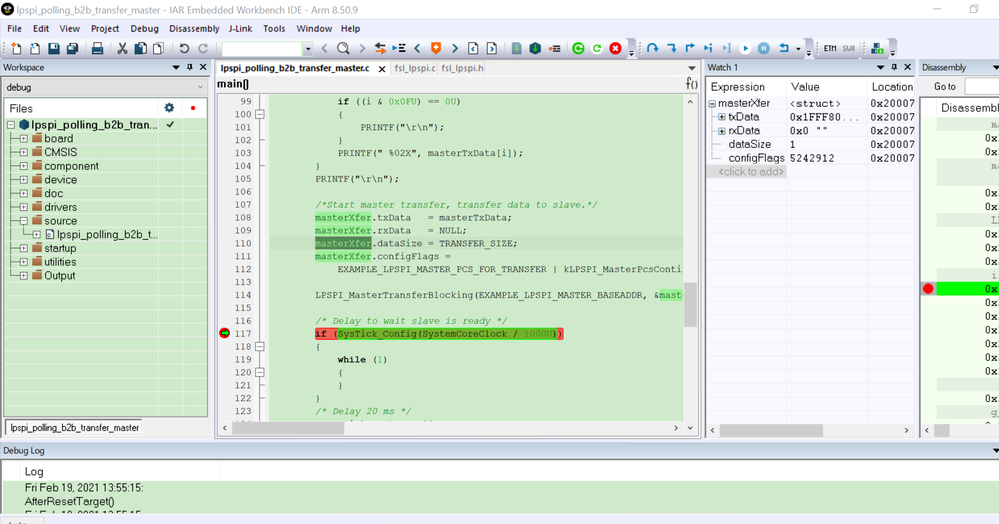
You can find, I run over LPSPI_MasterTransferBlocking :
while (LPSPI_GetTxFifoCount(base) == fifoSize)
{
}
BTW, I also test the interrupt code:
SDK_2.8.0_TWR-KE18F\boards\twrke18f\driver_examples\lpspi\interrupt_b2b\master
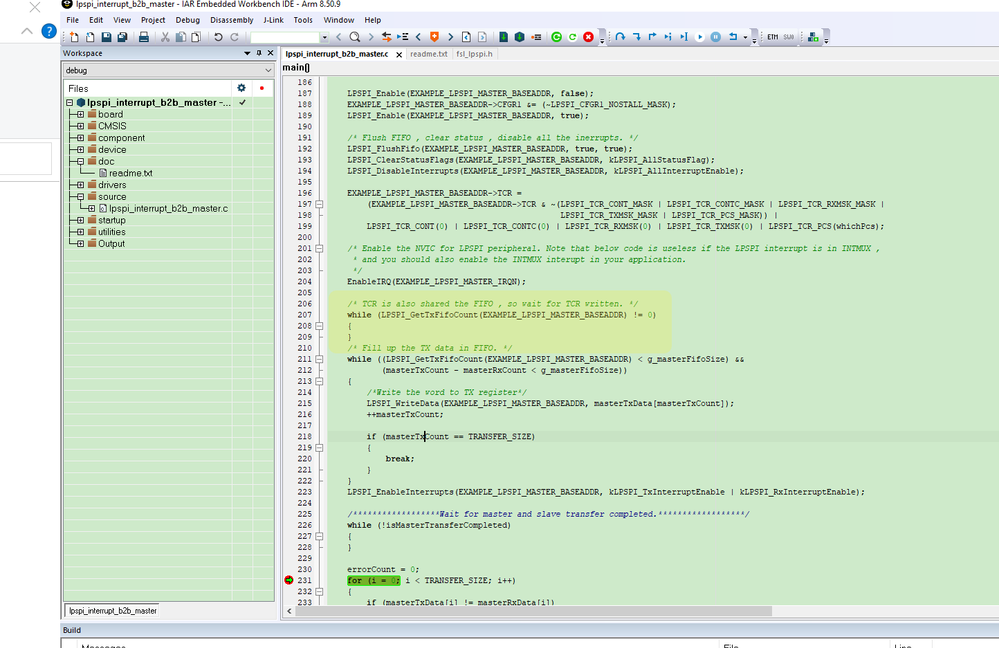
Even I modify the byte to 1, it also works OK.
So, you can try the SDK code directly.
If you still have questions about it, please kindly let me know.
Best Regards,
kerry
- 新着としてマーク
- ブックマーク
- 購読
- ミュート
- RSS フィードを購読する
- ハイライト
- 印刷
- 不適切なコンテンツを報告
Using '|=' almost everyplace is likely clearing some needed status bit.
NXP has a bad habit of using |= when it is not needed.
At best this wastes code space at worse it makes broken code.
