
- Forums
- Product Forums
- General Purpose MicrocontrollersGeneral Purpose Microcontrollers
- i.MX Forumsi.MX Forums
- QorIQ Processing PlatformsQorIQ Processing Platforms
- Identification and SecurityIdentification and Security
- Power ManagementPower Management
- Wireless ConnectivityWireless Connectivity
- RFID / NFCRFID / NFC
- Advanced AnalogAdvanced Analog
- Neural Processing UnitsNeural Processing Units
- MCX Microcontrollers
- S32G
- S32K
- S32V
- MPC5xxx
- Other NXP Products
- S12 / MagniV Microcontrollers
- Powertrain and Electrification Analog Drivers
- Sensors
- Vybrid Processors
- Digital Signal Controllers
- 8-bit Microcontrollers
- ColdFire/68K Microcontrollers and Processors
- PowerQUICC Processors
- OSBDM and TBDML
- S32M
- S32Z/E
-
- Solution Forums
- Software Forums
- MCUXpresso Software and ToolsMCUXpresso Software and Tools
- CodeWarriorCodeWarrior
- MQX Software SolutionsMQX Software Solutions
- Model-Based Design Toolbox (MBDT)Model-Based Design Toolbox (MBDT)
- FreeMASTER
- eIQ Machine Learning Software
- Embedded Software and Tools Clinic
- S32 SDK
- S32 Design Studio
- GUI Guider
- Zephyr Project
- Voice Technology
- Application Software Packs
- Secure Provisioning SDK (SPSDK)
- Processor Expert Software
- Generative AI & LLMs
-
- Topics
- Mobile Robotics - Drones and RoversMobile Robotics - Drones and Rovers
- NXP Training ContentNXP Training Content
- University ProgramsUniversity Programs
- Rapid IoT
- NXP Designs
- SafeAssure-Community
- OSS Security & Maintenance
- Using Our Community
-
- Cloud Lab Forums
-
- Knowledge Bases
- ARM Microcontrollers
- i.MX Processors
- Identification and Security
- Model-Based Design Toolbox (MBDT)
- QorIQ Processing Platforms
- S32 Automotive Processing Platform
- Wireless Connectivity
- CodeWarrior
- MCUXpresso Suite of Software and Tools
- MQX Software Solutions
- RFID / NFC
- Advanced Analog
- Neural Processing Units
-
- NXP Tech Blogs
- Home
- :
- 通用微控制器
- :
- Kinetis微控制器
- :
- FRDM-KL03Z in KDS: Difference between BWR & WR?
FRDM-KL03Z in KDS: Difference between BWR & WR?

In writing to the various registers, there appears to be two ways to do it, using BWR and WR. The same is true when reading from them. An example:
TPM_BWR_CONF_CSOO(tpmbase, 0);
TPM_WR_CONF_CSOO(tpmbase, 0);
What is the difference between these two lines? I don't see a difference in the debugger.
Thanks!
Sara
已解决! 转到解答。


Hi Sara Stout-Grandy,
Now let me tell you the details:
TPM_BWR_CONF_CSOO(tpmbase, 0);
TPM_WR_CONF_CSOO(tpmbase, 0);
All the above code is used to set the CSOO bit to a new value.
(1)TPM_WR_CONF_CSOO(tpmbase, 0);
#define TPM_WR_CONF_CSOO(base, value) (TPM_WR_CONF(base, (TPM_RD_CONF(base) & ~TPM_CONF_CSOO_MASK) | TPM_CONF_CSOO(value)))
#define TPM_WR_CONF(base, value) (TPM_CONF_REG(base) = (value))
Use normal C code to define the TPMx_CONF[CSOO] bit to a new value.
(2)TPM_WR_CONF_CSOO(tpmbase, 0);
#define TPM_BWR_CONF_CSOO(base, value) (BME_BFI32(&TPM_CONF_REG(base), ((uint32_t)(value) << TPM_CONF_CSOO_SHIFT), TPM_CONF_CSOO_SHIFT, TPM_CONF_CSOO_WIDTH))
#define BME_BFI32(addr, wdata, bit, width) (*(volatile uint32_t*)((uintptr_t)addr | BME_BFI_MASK(bit,width)) = wdata)
Use the BME code BFI function to define TPMx_CONF[CSOO] bit to a new value.
Normally, use BME code will caused less time than the Normal C code, you can run the KL25 BME code find the detail difference:
http://www.nxp.com/assets/downloads/data/en/lab-test-software/KL25_SC.exe
Folder: kl25_sc_rev10\klxx-sc-baremetal\build\iar\LQRUG_bme_ex1
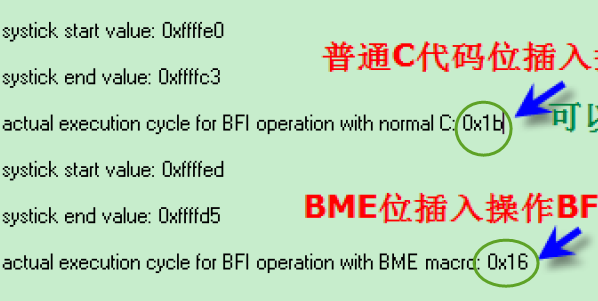
You can find, use the normally C, the same function will caused 0x1b systick counts, but use the BFI code, it only caused 0x16 sysick counts.
In conclusion, BME code save cpu execution time.
Wish it helps you!
Have a great day,
Kerry
-----------------------------------------------------------------------------------------------------------------------
Note: If this post answers your question, please click the Correct Answer button. Thank you!
-----------------------------------------------------------------------------------------------------------------------
Hi Sar Stout-Grandy,
Could you tell me where you find these two lines? The official code?
TPM_BWR_CONF_CSOO(tpmbase, 0);
TPM_WR_CONF_CSOO(tpmbase, 0);
You can open the function definition to check the difference.
You also can post these two function definition.
Have a great day,
Kerry
-----------------------------------------------------------------------------------------------------------------------
Note: If this post answers your question, please click the Correct Answer button. Thank you!
-----------------------------------------------------------------------------------------------------------------------
Hi Kerry,
These functions come from inside the MKL03Z4_extension.h file which is found in the C:\Freescale\KSDK_1.3.0\platform\devices\MKL03Z4\include directory. The way I understand it, these are the functions that you use if you don’t want to use the predefined higher level functions and would rather update the registers and bits yourself.
It appears that the BWR and BRD uses the BME macros to set the register instead of a direct setting of the register. Not sure what the difference is.
Any ideas?
Thanks,
Sara
Sara Stout-Grandy, M.Eng., Ph.D., P.Eng.
Senior Hardware Designer
20 Angus Morton Dr., Bedford,
NS, Canada, B4B 0L9
902-450-1700, x278


Hi Sara Stout-Grandy,
Now let me tell you the details:
TPM_BWR_CONF_CSOO(tpmbase, 0);
TPM_WR_CONF_CSOO(tpmbase, 0);
All the above code is used to set the CSOO bit to a new value.
(1)TPM_WR_CONF_CSOO(tpmbase, 0);
#define TPM_WR_CONF_CSOO(base, value) (TPM_WR_CONF(base, (TPM_RD_CONF(base) & ~TPM_CONF_CSOO_MASK) | TPM_CONF_CSOO(value)))
#define TPM_WR_CONF(base, value) (TPM_CONF_REG(base) = (value))
Use normal C code to define the TPMx_CONF[CSOO] bit to a new value.
(2)TPM_WR_CONF_CSOO(tpmbase, 0);
#define TPM_BWR_CONF_CSOO(base, value) (BME_BFI32(&TPM_CONF_REG(base), ((uint32_t)(value) << TPM_CONF_CSOO_SHIFT), TPM_CONF_CSOO_SHIFT, TPM_CONF_CSOO_WIDTH))
#define BME_BFI32(addr, wdata, bit, width) (*(volatile uint32_t*)((uintptr_t)addr | BME_BFI_MASK(bit,width)) = wdata)
Use the BME code BFI function to define TPMx_CONF[CSOO] bit to a new value.
Normally, use BME code will caused less time than the Normal C code, you can run the KL25 BME code find the detail difference:
http://www.nxp.com/assets/downloads/data/en/lab-test-software/KL25_SC.exe
Folder: kl25_sc_rev10\klxx-sc-baremetal\build\iar\LQRUG_bme_ex1
You can find, use the normally C, the same function will caused 0x1b systick counts, but use the BFI code, it only caused 0x16 sysick counts.
In conclusion, BME code save cpu execution time.
Wish it helps you!
Have a great day,
Kerry
-----------------------------------------------------------------------------------------------------------------------
Note: If this post answers your question, please click the Correct Answer button. Thank you!
-----------------------------------------------------------------------------------------------------------------------


Hi Sara Stout-Grandy,
OK, if your question is solved, please help to mark the correct answer, just to close this question.
Thank you!
Have a great day,
Kerry
-----------------------------------------------------------------------------------------------------------------------
Note: If this post answers your question, please click the Correct Answer button. Thank you!
-----------------------------------------------------------------------------------------------------------------------
