
- Forums
- Product Forums
- General Purpose MicrocontrollersGeneral Purpose Microcontrollers
- i.MX Forumsi.MX Forums
- QorIQ Processing PlatformsQorIQ Processing Platforms
- Identification and SecurityIdentification and Security
- Power ManagementPower Management
- Wireless ConnectivityWireless Connectivity
- RFID / NFCRFID / NFC
- Advanced AnalogAdvanced Analog
- Neural Processing UnitsNeural Processing Units
- MCX Microcontrollers
- S32G
- S32K
- S32V
- MPC5xxx
- Other NXP Products
- S12 / MagniV Microcontrollers
- Powertrain and Electrification Analog Drivers
- Sensors
- Vybrid Processors
- Digital Signal Controllers
- 8-bit Microcontrollers
- ColdFire/68K Microcontrollers and Processors
- PowerQUICC Processors
- OSBDM and TBDML
- S32M
- S32Z/E
-
- Solution Forums
- Software Forums
- MCUXpresso Software and ToolsMCUXpresso Software and Tools
- CodeWarriorCodeWarrior
- MQX Software SolutionsMQX Software Solutions
- Model-Based Design Toolbox (MBDT)Model-Based Design Toolbox (MBDT)
- FreeMASTER
- eIQ Machine Learning Software
- Embedded Software and Tools Clinic
- S32 SDK
- S32 Design Studio
- GUI Guider
- Zephyr Project
- Voice Technology
- Application Software Packs
- Secure Provisioning SDK (SPSDK)
- Processor Expert Software
- Generative AI & LLMs
-
- Topics
- Mobile Robotics - Drones and RoversMobile Robotics - Drones and Rovers
- NXP Training ContentNXP Training Content
- University ProgramsUniversity Programs
- Rapid IoT
- NXP Designs
- SafeAssure-Community
- OSS Security & Maintenance
- Using Our Community
-
- Cloud Lab Forums
-
- Knowledge Bases
- ARM Microcontrollers
- i.MX Processors
- Identification and Security
- Model-Based Design Toolbox (MBDT)
- QorIQ Processing Platforms
- S32 Automotive Processing Platform
- Wireless Connectivity
- CodeWarrior
- MCUXpresso Suite of Software and Tools
- MQX Software Solutions
- RFID / NFC
- Advanced Analog
- Neural Processing Units
-
- NXP Tech Blogs
- Home
- :
- 汎用マイクロコントローラ
- :
- Kinetisマイクロコントローラ
- :
- Best practice for K8x QSPI Dual-Quad Address Ranges
Best practice for K8x QSPI Dual-Quad Address Ranges
- RSS フィードを購読する
- トピックを新着としてマーク
- トピックを既読としてマーク
- このトピックを現在のユーザーにフロートします
- ブックマーク
- 購読
- ミュート
- 印刷用ページ
Best practice for K8x QSPI Dual-Quad Address Ranges

- 新着としてマーク
- ブックマーク
- 購読
- ミュート
- RSS フィードを購読する
- ハイライト
- 印刷
- 不適切なコンテンツを報告
Though I'd share...
The K8x QSPI peripheral can accept one or two QSPI flash devices, or a dual-die device (which is really only two identical flash dies and one chip). Each can have a maximum size of 64MB.
In some NXP K8x QSPI peripheral examples the second die address range starts where the first ends. So for example:
2x 32MB dies would have:
Bank-A: 0x68000000-0x69FFFFFF
Bank-B: 0x6A000000-0x6BFFFFFF
and 2x 16MB dies would have:
Bank-A: 0x68000000-0x68FFFFFF
Bank-B: 0x69000000-0x69FFFFFF
This arrangement is no longer ideal with the latest Segger Flasher-ARM/J-Flash.
In earlier J-Flash versions (many moons ago) I recall the ability to change these addresses, but this is no longer allowed. Instead, the full 64MB is always allocated for each bank, and it cannot be changed.
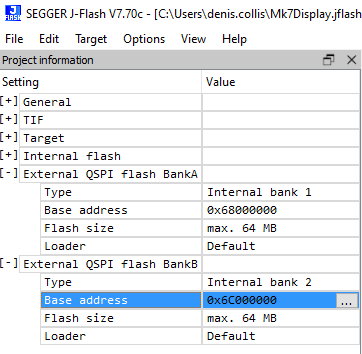
Bank-A now always starts at 0x68000000 and Bank-B always starts at 0x6C000000 and it then follows that in the examples above:
2x 32MB dies should have:
Bank-A: 0x68000000-0x69FFFFFF
Bank-B: 0x6C000000-0x6DFFFFFF
and 2x 16MB dies should have:
Bank-A: 0x68000000-0x68FFFFFF
Bank-B: 0x6C000000-0x6CFFFFFF
...which seems to be the best-practice is you want successful production programming of your products.
Cheers!
Denis
