
- Forums
- Product Forums
- General Purpose MicrocontrollersGeneral Purpose Microcontrollers
- i.MX Forumsi.MX Forums
- QorIQ Processing PlatformsQorIQ Processing Platforms
- Identification and SecurityIdentification and Security
- Power ManagementPower Management
- Wireless ConnectivityWireless Connectivity
- RFID / NFCRFID / NFC
- Advanced AnalogAdvanced Analog
- Neural Processing UnitsNeural Processing Units
- MCX Microcontrollers
- S32G
- S32K
- S32V
- MPC5xxx
- Other NXP Products
- S12 / MagniV Microcontrollers
- Powertrain and Electrification Analog Drivers
- Sensors
- Vybrid Processors
- Digital Signal Controllers
- 8-bit Microcontrollers
- ColdFire/68K Microcontrollers and Processors
- PowerQUICC Processors
- OSBDM and TBDML
- S32M
- S32Z/E
-
- Solution Forums
- Software Forums
- MCUXpresso Software and ToolsMCUXpresso Software and Tools
- CodeWarriorCodeWarrior
- MQX Software SolutionsMQX Software Solutions
- Model-Based Design Toolbox (MBDT)Model-Based Design Toolbox (MBDT)
- FreeMASTER
- eIQ Machine Learning Software
- Embedded Software and Tools Clinic
- S32 SDK
- S32 Design Studio
- GUI Guider
- Zephyr Project
- Voice Technology
- Application Software Packs
- Secure Provisioning SDK (SPSDK)
- Processor Expert Software
- Generative AI & LLMs
-
- Topics
- Mobile Robotics - Drones and RoversMobile Robotics - Drones and Rovers
- NXP Training ContentNXP Training Content
- University ProgramsUniversity Programs
- Rapid IoT
- NXP Designs
- SafeAssure-Community
- OSS Security & Maintenance
- Using Our Community
-
- Cloud Lab Forums
-
- Knowledge Bases
- ARM Microcontrollers
- i.MX Processors
- Identification and Security
- Model-Based Design Toolbox (MBDT)
- QorIQ Processing Platforms
- S32 Automotive Processing Platform
- Wireless Connectivity
- CodeWarrior
- MCUXpresso Suite of Software and Tools
- MQX Software Solutions
- RFID / NFC
- Advanced Analog
- Neural Processing Units
-
- NXP Tech Blogs
- Home
- :
- Product Forums
- :
- ColdFire/68K Microcontrollers and Processors
- :
- Reset configuration Pins on the MCF5485
Reset configuration Pins on the MCF5485
- Subscribe to RSS Feed
- Mark Topic as New
- Mark Topic as Read
- Float this Topic for Current User
- Bookmark
- Subscribe
- Mute
- Printer Friendly Page

- Mark as New
- Bookmark
- Subscribe
- Mute
- Subscribe to RSS Feed
- Permalink
- Report Inappropriate Content
I have a question about the Reset Configuration Pins section of the MCF5485 Reference Manual. Section 2.2.6 says AD[12:0] are read at reset to set up certain configurations.
Do I need to pull these pins to the correct configuration with pull up/down resistors? Are they not software configurable?
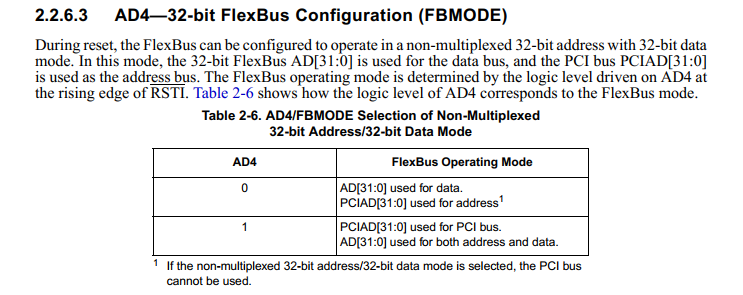
I'm particularly interested in the FBMODE(snippet below). Do I need to pull AD4 down to get the first configuration?Won't this effect data sent on AD4 once the MCF4585 is out of reset?
Solved! Go to Solution.

- Mark as New
- Bookmark
- Subscribe
- Mute
- Subscribe to RSS Feed
- Permalink
- Report Inappropriate Content
AD12-0 take on a different function during reset. The CPU reads those pins at the end of reset.
They can be "software configurable" when your code is running, but you can't do that during Reset.
Yes, you need resistor pullups or pulldowns on some or all of these pins (some may have pull resistors active during reset, make sure you look for this). This is a common feature of most MCF52, MCF53 and MCF54 parts. Some of the manuals say "don't use resistors, but use a tri-state driver enabled by RSTOUT" without really saying why. And then for the ones that say to do that you sometimes find that the Reference Boards are using pull-resistors anyway.
One of the reference design uses multiple buffers. They're on page 14-of-18 of the schematic PDF file in the following:
https://www.nxp.com/downloads/en/printed-circuit-boards/548X547XREF1B.zip
Why are you starting on a hardware design using a "Not Recommended for New Designs" part now?
Tom
- Mark as New
- Bookmark
- Subscribe
- Mute
- Subscribe to RSS Feed
- Permalink
- Report Inappropriate Content
AD12-0 take on a different function during reset. The CPU reads those pins at the end of reset.
They can be "software configurable" when your code is running, but you can't do that during Reset.
Yes, you need resistor pullups or pulldowns on some or all of these pins (some may have pull resistors active during reset, make sure you look for this). This is a common feature of most MCF52, MCF53 and MCF54 parts. Some of the manuals say "don't use resistors, but use a tri-state driver enabled by RSTOUT" without really saying why. And then for the ones that say to do that you sometimes find that the Reference Boards are using pull-resistors anyway.
One of the reference design uses multiple buffers. They're on page 14-of-18 of the schematic PDF file in the following:
https://www.nxp.com/downloads/en/printed-circuit-boards/548X547XREF1B.zip
Why are you starting on a hardware design using a "Not Recommended for New Designs" part now?
Tom
- Mark as New
- Bookmark
- Subscribe
- Mute
- Subscribe to RSS Feed
- Permalink
- Report Inappropriate Content
Thanks. I'll probably end up using jumpers.
It's for a research project. Trust me, it wasn't my first choice :smileywink:
- Mark as New
- Bookmark
- Subscribe
- Mute
- Subscribe to RSS Feed
- Permalink
- Report Inappropriate Content
The first Reference Design I looked at is a huge one. It has absolutely everything possible wired up, and "everything" is more than the CPU (and the other "everythings") can drive. So there are data and address buffers everywhere - about half of the board looks to be buffering. The RAM and FLASH chips are so big nowadays that you don't need that many of them, so unless you have strange requirements or a lot of I/O you can usually keep the design simple and do away with all the buffers. In that case you can probably use pull resistors on those pins. You shoudn't need jumpers if you know how you need the CPU set up. You know if you'll be using an 8/16/32 bit data bus for instance.
I always recommend stepping back from the current problems and reading the manual from cover to cover at least once, if not twice. You can skip the chapters for devices you're not using (like CAN or USB). At least that way when you are reading a section that doesn't make sense you have the chance of remembering "hey, that's explained better in this other chapter" and then search for that.
This is such an old chip that whatever problems you have, someone else is certain to have had before. And most likely posted about it in this forum. So use the search tools. Better still, search this forum with Google. It can often find things you can't find with NXP/s search. Do you know about limiting Google searches to a specific domain? Find out if you don't.
Tom
