
- Forums
- Product Forums
- General Purpose MicrocontrollersGeneral Purpose Microcontrollers
- i.MX Forumsi.MX Forums
- QorIQ Processing PlatformsQorIQ Processing Platforms
- Identification and SecurityIdentification and Security
- Power ManagementPower Management
- Wireless ConnectivityWireless Connectivity
- RFID / NFCRFID / NFC
- Advanced AnalogAdvanced Analog
- Neural Processing UnitsNeural Processing Units
- MCX Microcontrollers
- S32G
- S32K
- S32V
- MPC5xxx
- Other NXP Products
- S12 / MagniV Microcontrollers
- Powertrain and Electrification Analog Drivers
- Sensors
- Vybrid Processors
- Digital Signal Controllers
- 8-bit Microcontrollers
- ColdFire/68K Microcontrollers and Processors
- PowerQUICC Processors
- OSBDM and TBDML
- S32M
- S32Z/E
-
- Solution Forums
- Software Forums
- MCUXpresso Software and ToolsMCUXpresso Software and Tools
- CodeWarriorCodeWarrior
- MQX Software SolutionsMQX Software Solutions
- Model-Based Design Toolbox (MBDT)Model-Based Design Toolbox (MBDT)
- FreeMASTER
- eIQ Machine Learning Software
- Embedded Software and Tools Clinic
- S32 SDK
- S32 Design Studio
- GUI Guider
- Zephyr Project
- Voice Technology
- Application Software Packs
- Secure Provisioning SDK (SPSDK)
- Processor Expert Software
- Generative AI & LLMs
-
- Topics
- Mobile Robotics - Drones and RoversMobile Robotics - Drones and Rovers
- NXP Training ContentNXP Training Content
- University ProgramsUniversity Programs
- Rapid IoT
- NXP Designs
- SafeAssure-Community
- OSS Security & Maintenance
- Using Our Community
-
- Cloud Lab Forums
-
- Knowledge Bases
- ARM Microcontrollers
- i.MX Processors
- Identification and Security
- Model-Based Design Toolbox (MBDT)
- QorIQ Processing Platforms
- S32 Automotive Processing Platform
- Wireless Connectivity
- CodeWarrior
- MCUXpresso Suite of Software and Tools
- MQX Software Solutions
- RFID / NFC
- Advanced Analog
- Neural Processing Units
-
- NXP Tech Blogs
- Home
- :
- 製品フォーラム
- :
- ColdFire/68Kマイクロコントローラとプロセッサ
- :
- Need help identifying evaluation board EST Wind River 5307
Need help identifying evaluation board EST Wind River 5307
- RSS フィードを購読する
- トピックを新着としてマーク
- トピックを既読としてマーク
- このトピックを現在のユーザーにフロートします
- ブックマーク
- 購読
- ミュート
- 印刷用ページ
Need help identifying evaluation board EST Wind River 5307

- 新着としてマーク
- ブックマーク
- 購読
- ミュート
- RSS フィードを購読する
- ハイライト
- 印刷
- 不適切なコンテンツを報告
Hello there.
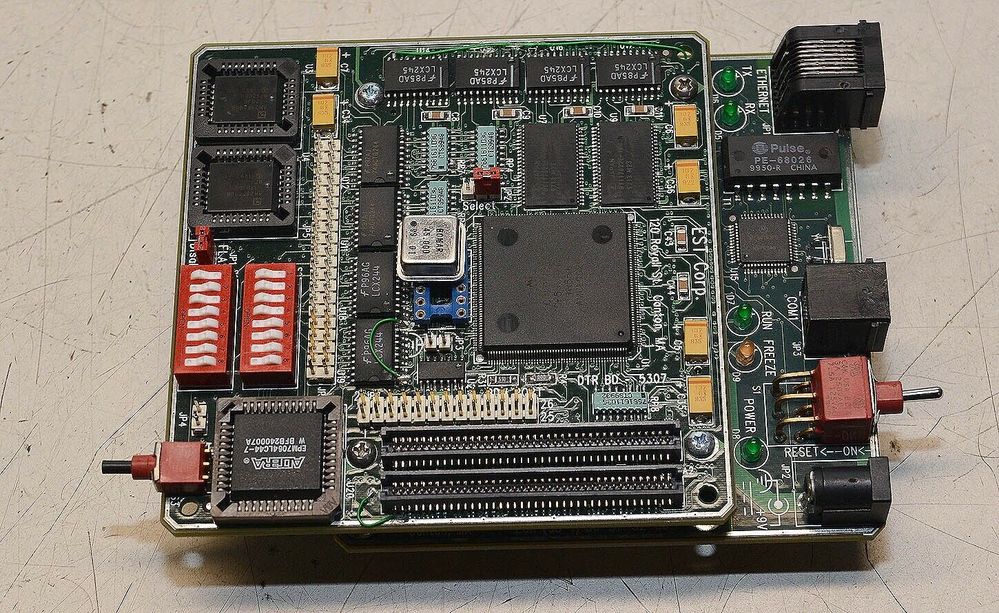
I was trying to get documentation and/or CD with contents (image or zipped file of that) for this particular 5307 Coldfire based board (PC104 format):
EST Wind River
Ref. MDPBAA-0649
Seems to use a base board named MDPBAA-0770 and daughter board interchangeable for several MCUs/processors, 5307 being one of them, I've seen also for MPC860 etc.
Any help or insight on how to use this board or locate its documentation and associated support files/CD will be appreciated.
Regards,
Moises
- 新着としてマーク
- ブックマーク
- 購読
- ミュート
- RSS フィードを購読する
- ハイライト
- 印刷
- 不適切なコンテンツを報告
Oh, btw, fiddling around with the FLEX BDM TOOLS I got a figure of very few MHZ for the CPU clock. I had thought the BDM Noral Flex Tools promised "real time" debug (if such thing exists philosophically speaking), but the (4-leg for DIP socket variety) clock module you can see in my picture at beginning of thread, is nominally 40MHz. Then I exchanged it for the similar DIP clock that was mounted on the 860-based board, I guess that's even slower, 25MHz?
I'm talking about the clock reading in one of the windows/menus inside the BDM Flex application.
It wouldn't matter much to me until my knowledge with this board use and configuration gets as far as eventually getting the temptation to drop a full DSP, FFT or such algorithm upon the dreaded undocumented silicon hehe....
Tom when we exchange more info privately (in order not to flood this thread) I'll let you know more details about which things I've tried which not.
Thanks again and regards
- 新着としてマーク
- ブックマーク
- 購読
- ミュート
- RSS フィードを購読する
- ハイライト
- 印刷
- 不適切なコンテンツを報告
Hi there again Tom.
Wow, it makes me marvel as the potential for this discussion board. Thanks again!
Now, I want to give you a very comprehensive and detailed response of my efforts so far. Just let me drop you a more detailed answer/ comment later on today.
Hopefully we can implement comunity-speaking this "hobby definition".
For me, part of my electronics hobby is to make this work.
I own several Arduino boards, I own several FPGA development boards (Spartan3, Cyclone IV, the like), I own DSP specialized for audio development board based on TMS32x high-end DSPs, I own all that.
I got this damned SBC5307 board and several related accesories for it, by eBay, yep I'm for the most part LEFT TO MY OWN DEVICES (PUN INTENDED! hehehehe), I won't let the technical quirks overcome my desire to LEARN and USE this platform.
Meaning, I am not total newbie for development boards, I know what BDM means, I know what a visionICE II is, I know what is a ColdFire 5307, I know my bits about electronics. It's the lack of documentation that is bothering me,
But I use BOTHER in the loose, terse sense. I really want to dig into this.
I don't care a s*** if it's 20+ years old. Man, I work my way around ZX Spectrum electronics too, not for a living obviously, but for my
I hate the dreaded programmed-obsolescence-driven "get a new XXXXX for $20 and program it directly in C++ with a virtual reality glass in which you take the chip by your virtual hand and put it into a virtual POD whatifnot and it automatically configures itself, then talk the kind of software you want into it and a Alexia/Google Home interface will make your wish come true."....
I know from your reply, you're a wizard yourself, you really like this kind of challengue....
I will let you know about all the efforts I've made so far about this, it's just too much for a signle post so I'll dump it into a NotePad and then copy-paste here... along with PDF with reference hardware info for said SBC5307 for us to browse.
I'll look into the MAX232 interface this board is using, and the Altera MAX chip contents (if I can via my own Altera-USB blaster JTAG debugger + XILINX ISE 11 on Windows XP), I'll do all my chores, believe me. I know we can do something to make it work.
If I have to code my own drivers I will. That's how I feel.
Besides, there's info I've gathered about making my P&E MultiLink USB work with ColdFire development but it's a bit of a fiddle and very customized-Linux oriented. If I have to jump thru that another hoop I will.
Will go on later with a detialed post. Until then, have a nice day!!! Thanks wholeheartly.
Moises

- 新着としてマーク
- ブックマーク
- 購読
- ミュート
- RSS フィードを購読する
- ハイライト
- 印刷
- 不適切なコンテンツを報告
> Just let me drop you a more detailed answer/ comment later on today.
Before posting a lot here, I suggest trying to work out how to send me a private message on this system. It used to be easy, but it now relies on you "following" me or me "following" you in order for that to be permitted. Find out what we have to do to get that to work and then we can exchange email address. I don't see this discussion being of general interest to the followers of this forum. As well, I might want to make some comments that I might be uncomfortable publishing in a fully public forum :-).
You should subscribe to the "comp.sys.m68k" Google Group, then post some questions there too:
> I hate the dreaded programmed-obsolescence-driven "get a new XXXXX for $20 and program it
I applaud that, but sometimes to "make something live forever" you had to be there at its birth, and not working with a shovel in the cemetery at midnight.
Also, if your first instinct when confronted with that RJ11-based serial port isn't to grab a multimeter and start probing, then that's a skill-set or mind-set that's worth developing for this project. Do you have an oscilloscope? If not, get one.
RJ11 to DB9 converters were very common 20 or more years ago. As you'd expect, there are more "standards" for the connection than there are pins. But here's two of them, together with somewhere you can buy them - but they're a "kit" so you have to plug the right wires into the right pins to match whatever you have:
https://allpinouts.org/pinouts/connectors/networking/db9-to-rj11/
https://www.amazon.com/Networx-Modular-Adapter-Kit-Female/dp/B0054RRCHI
If you don't like the IDEs that automatically connect to the pod and your device, and support compile-program-run-debug with one click, then you should try and get a set of Windows command-line tools to do that. You'll need a gcc-m68k compiler, gcc and a server that talks to the debug pod. Having a "flasher" that can run through the pod is OPTIONAL. You can always load a Bootstrap into RAM that then programs itself to FLASH. That can then load the real code over Ethernet using TFTP ... except that CPU doesn't have Ethernet, but the baseboard might. If that doesn't work, get a Linux machine or Virtual Machine and get the Linux toolsets.
Keep looking for bits, like this one. It might come with some documentation..
WIND RIVER SYSTEMS EST XPC860 Dev Board PC104 - $59.00 | PicClick
Here's 800 MPC860 boards with that motherboard *FOR $19 EACH*! It would be worth buying one or two of them to see if they come with any documentation that would help you with the MCF5307. Yes, I've worked on MPC860's. They make the MCF chips look really simple. It took me about a year to get the memory management system programmed properly in that chip (and we didn't want the MMU, but had to have it on for the cache to work).
https://www.clothingaccessorieswholesalestore.xyz/index.php?main_page=product_info&products_id=10485
I have no idea why an MPC860 is a "Clothing Accessory" or why it is a "Temperate Wind River Systems Est Xpc860 Dev Board Pc104 To Have A Unique National Style". Or why there are 800 of every unit listed there (makes me very suspicious about that site)... Make sure you look at the next item in that listing (52 of 53). It is a "Schreiber Hygrothermograph" for $19.
The Altera Max is probably converting the MCF5307 bus (and the MPC860 bus on that dev board) to the PC104 standard the baseboard uses.
Tom
- 新着としてマーク
- ブックマーク
- 購読
- ミュート
- RSS フィードを購読する
- ハイライト
- 印刷
- 不適切なコンテンツを報告
I tried to "Edit" this post to make some corrections, but the NXP Forum Web Interface just gave me a blank window to edit in with a few red squiggles visible. Highlighting showed that to be white text on a white background in raw HTML! So the editor is currently broken, so I'll have to make corrections to it in this reply.
> I have no idea why an MPC860 is a "Clothing Accessory" or why it is a
> "Temperate Wind River Systems Est Xpc860 Dev Board Pc104 To
> Have A Unique National Style". Or why there are 800 of every unit
Because that site looks to have been written by a "criminally minded robot". Those ads are fake and made up of "random words", one of which is "PC104". The board is not PC104 (and that's a good thing). That baseboard is solely power-supply and the RS232 connector. Other more expensive baseboards (20 years ago) might have provided more functionality.
> The Altera Max is probably converting the MCF5307 bus ... to the PC104
Certainly not doing that. I don't know what it is doing.
Tom
- 新着としてマーク
- ブックマーク
- 購読
- ミュート
- RSS フィードを購読する
- ハイライト
- 印刷
- 不適切なコンテンツを報告
> Before posting a lot here, I suggest trying to work out how to send me a private message on this system ..
> You should subscribe to the "comp.sys.m68k" Google Group, then post some questions there too:....
I'll try to do so, since I too think that this discussion can get long-winded and very technical pertaining just my particular efforts with a particular (and obsolete at that) product.
I look much forward to exchange some details and further info, thanks for the offer.
> I applaud that, but sometimes to "make something live forever" you had to be there at its birth, and not working with a shovel in the cemetery at midnight.
I LOL at that analogy and yes, it more or less describes how I feel sometimes with this :smileyhappy:
> Also, if your first instinct when confronted with that RJ11-based serial port isn't to grab a multimeter and start probing, then that's a skill-set or mind-set that's worth developing for this project. Do you have an oscilloscope? If not, get one.
It is, of course I figured that I needed to do that eventually but was too busy with getting a basic hardware info/ schematics first. Besides, as you later suggest, there might be a couple different ways to the pinout.
I own a multimeter and a function generator, an oscilloscope is out of the question (a good one I mean) for the moment and in fact I'm trying to get my head around a project which uses Spartan 3 board to give you one basic oscilloscope with Java interface and all that (I own several of these boards, quite cool hardware and easy to program with Xilinx ISE).
I think the multimeter will do (aided by my microscope since most of the signal to the busses etc are SMT). As I said I can guess it's not going to be the bottleneck here... when I have some definite info I'll let you know.
> If you don't like the IDEs that automatically connect to the pod and your device, and support compile-program-run-debug with one click, then you should try and get a set of Windows command-line tools to do that. You'll need a gcc-m68k...
I already did my homework here, at least following the excellent tutorial/ info on:
ColdFire Development Resources - GNU C
which applies to ColdFire, I was able to successfully build my own cross-compiler able for 5307 using that info.
BTW, there's similar approach tailored to the MPC8xx (I guess you already knew about this):
http://www.connotech.com/gcc_mpc8xx/powerpc_eabi_mpc850.htm
Regarding this see my next response too.
> Keep looking for bits, like this one. It might come with some documentation..
WIND RIVER SYSTEMS EST XPC860 Dev Board PC104 - $59.00 | PicClick
Alas, man, that's incredible as I got one of those precisely, too, along with the MDPBAA+ICM307 (Integrated CPU Module), in fact it was the same US-based guy who sold me those.
I've always wondered btw, how on earth do these guys get so many boards and development systems? Most of them admit, it's from dismantled Univ. labs and the like. Hey, I got myself a MPLAB ICE 4000 complete IN THE BOX never used, just a couple weeks ago!!! (now I just have to buy some headers and adapters for using this, LOL, but the prospect of this platform is excellent I really love and dig this platform!).
But I digress. BOTH my SBC5307 (=MDPBAA+ICM307) and my MPC860 (MDPBAA+daughterboard with MPC860 on it) came without any information, documentation or stuff. Cmon, if you get this as obsolete/ expurged material from an Univ. Lab, then how come they don't get the full boxes????
(Btw, I tried the old trick of using Wayback machine to restore/browse older versions of some EE courses deasling with Motorolas/FReescales ColdFires, see if they have even some Lab doc sheets or soemthing for any Lab that used the SBC5307, to no avail up to now..... :smileysad:) very sad indeed....
Since those two (SBC5307 and the 860-based board) share same base board, documentation of one would apply to the other. I see you insist that I try and get some inspection/ further info on the base board first. I second that, of course, just I don't have as many spare time as I'd like, so with these (multiple) platforms I advance slowly (but regularly).
If you use a MPC860 MDP by the Wind River (more on their support policy for obsolete products when we chat privately you can be sure), and can offer additional info or insight. We can work together and benefit from the bits each other finds out.
To sum up, too, a brief enumeration of current "obsolete parafernalia" I'd love to get up and running:
- SBC5307 (the Wind River PC104 MDPBAA+ICM307, not the Arnswesh brand)
- The BDM for this (Noral Flex Tool BDM) Alas, came too without any support, software or anything. Go figure, the guy who sold me said "I don't know what it is" in the official description hehehehe. But I could not pass on this...
- Software for above I got from another seller. Turned out it was HCS12 version. I'm "trying" to adapt it since Wind River doesn't care s*** about supporting this, and I understand.
- MPLAB ICE 4000 -that's to take on another free evening. Let's figure out first the 5307 bits.
- The board same as you mentioned, with 860 on it (Wind River with same base board)
- An old visionICE II unit, but the socket is for MIPS processor. It's easy to get the ColdFire socket individually later on. Not a priority right now, I'd prefer to get the FLEX BDM tools or the P&E environment and/or C toolset working first.
> I have no idea why an MPC860 is a "Clothing Accessory" or why it is a "Temperate Wind River Systems Est Xpc860 Dev Board Pc104 To Have A Unique National Style". Or why there are 800 of every unit listed there (makes me very suspicious about that site)... Make sure you look at the next item in that listing (52 of 53). It is a "Schreiber Hygrothermograph" for $19.
Now this is really funny, it's nearly a miracle that we can end up with the tidbits we need to sniff for to eventually get this running. Besides, as I said before, sellers are not that interested. If someone you know at an University offers you to go there unload a full drawer of development boards equipment for a Lab, just because they updated the Syllabus to the newest flashy (pun intended) platform, for free, then you have a huge money gain just by dropping some eBay adds with "I don't know what to do" or "What you see" descriptions.
If it were not for poor us crazy freaks, they wouldn't get their bucks. It would not compensate their truck loading much less any profit.
> The Altera Max is probably converting the MCF5307 bus (and the MPC860 bus on that dev board) to the PC104 standard the baseboard uses.
Yes I know that most Altera FPGAs/CPLDs I see around there in develipment boards are for glue logic. I've also seen a lot of professional audio products embed these for same purpose. But, is it viable that
If the only task it does is MUXing busses and the like, it's not worth the effort. I mean, I don't really need to know how the, say, memory busses are set up, I just wish to declare/ use them for my firmware, know their addresses, their CS spaces, how to configure and access them, all that rigmarole.
I'll try to contact you privately and to suscribe to the aforementioned Google Group.
As always, thanks so much for your help and your share.
- 新着としてマーク
- ブックマーク
- 購読
- ミュート
- RSS フィードを購読する
- ハイライト
- 印刷
- 不適切なコンテンツを報告
Is that a "9950" datecode on the Ethernet Transformer? 20 years old!
The earliest dated document I have on the MCF5307 is "MCF5307ER" which lists previous revisions starting in September 1999. Sp 20 year old technology. You don't have much hope. The only way you're going to find out anything is if that board you have is in a box with all the original documentation and software. Which would probably be on floppy disks. And would need to run on a Windows 95 machine.
Wind River acquired EST Corp in early 2000:
TMF: Aquisition-Embedded Support Tools / Wind River Systems, Inc.
Here's something that looks pretty close to your board:
Wind River - Early Development Solutions for Hardware/Software Integration
Here's an earlier page mentioning the 5307 support, and the product page for that board:
ColdFire Platform Tools from EST Corp.
The "Specification" and PDF links don't work. That's a dead end.
Tom
- 新着としてマーク
- ブックマーク
- 購読
- ミュート
- RSS フィードを購読する
- ハイライト
- 印刷
- 不適切なコンテンツを報告
First of all thanks to all people reading this and helping me...
Now, I don't reallty want to give up on using this "unknown" board with all the platforms either old or modern I can apply to it.
My essential doubts and difficulties at a practical level to do so are basically the following:
-TomE pointed out to the "9950 datecode on the Ethernet Transformer".
But specs say Ethernet is not implemented. How come?
-Anyway, I don't know how to implement serial interface over the supplied RJ11 connector. What's the probable pinout? I'm only used to "usual" DB9 serial ports.
-Best to use "CodeWarrior 6.2 for ColdFire Architectures" or some other more recent CW version?
-Lack of BSP and EST Wind River support. This is a real PITA to get, I have contacted Wind River support a lot by email and up to now they just provided me with a single PDF succintly describing the product and it's e.g. DIP switch configuration. Not all the info I think I'd need to properly implement something on it...
-When trying to make it work with a P&E MultiLink USB BDM, I tried to "decipher" the .CFP file that this platform uses to implement the Flash algorithm needed (this Wind River SBC5307 has 1MB Flash in 16-bit words confguration). It is mentioned a "source code" that one can adapt in order to properly implement the Flash stuff in order to dump something on it. Since people here mentioned the P&E route as being the most promising, can you please guide me on this issue?
-How to bootload this board? Or, how to start working with it? Where to look? Would I need full schematics? I'm at a loss...
THANKS SO MUCH again, to all you people. Please I know we can make this work! I just need some orientation... I promise to share here all the findings I myself can gather on my tryings.
Any further info/ advice/ documentation/ support will be very appreciated.
-Moises
- 新着としてマーク
- ブックマーク
- 購読
- ミュート
- RSS フィードを購読する
- ハイライト
- 印刷
- 不適切なコンテンツを報告
> -TomE pointed out to the "9950 datecode on the Ethernet Transformer".
> But specs say Ethernet is not implemented. How come?
Two possibilities. There are two boards. The lower one allows different CPU boards to be plugged into it. Maybe One of the other Daughterboards had a CPU that had an internal Ethernet controller. There's a lot of stuff I can't see on the Motherboard that is hidden by the Daughterboard. Maybe there's an Ethernet Controller chip on the Motherboard. Have you pulled the Daughterboard off to see what's there? Have you looked at the part number on U15 which is next to the Ethernet Transformer?
> -Anyway, I don't know how to implement serial interface over the supplied RJ11 connector.
Do you have a multimeter? You can use that to find which pin on the RJ is ground. There should be a MAX232 chip there somewhere. See which pins on the RJ connect to which pins on that chip. That will give you RX and TX (and maybe a few others). From the Debugger you can program up the serial port (or ports) and write characters into the transmitter, and then see which pin wiggles. Very basic reverse engineering.
In order to program the Flash, the debugger has to load a program into RAM (somewhere, this chip has 16k internal). The debugger or that program has to set up the bus controller properly. Then that program has to be the right one for the right chips connected in whatever width. Then the debugger writes blocks of data to RAM and runs that program to write it into the FLASH. Usually you tell the debugger "I'm using this development board" and it sets it all up for you. If the debugger hasn't been set up for your board - well, you're on your own, and it probably is more trouble than it's worth to allow for "custom setups" like this. Better to focus on the 99% of people who have just board a new board that P&E know about.
You can of course write a program like this from scratch yourself and manually load it into RAM and then talk to it.
> -How to bootload this board? Or, how to start working with it? Where to look? Would I need full schematics?
Schematics would help, but aren't sufficient. Have you any idea what that Altera chip is doing?
What you should do is exactly what you've done. You've asked this forum, which is your best chance for a response of "I've had this in the cupboard for 20 years with all software and documentation and you can have it".
A 20 year old system would probably need a 20 year old debug pod with 20 year old support software (that understood that board) running on a 20 year old operating system (Windows 95) on a 20 year old computer.
USB 2.0 dates from 2001, so the debugger probably runs from a parallel port or a serial port (very slowly).
A modern pod will talk to it, but you're going to have to do all the Flash-writing yourself. Starting with writing very low-level Flash-programming code. Or adapting someone else's source code. Nobody who is sane has written any of this for 20 years, because you get all that functionality "for free" with a debug pod that supports your board.
> I know we can make this work!
Why? Working on this board matches Aldo Leopold's definition of a "Hobby":
https://www.goodreads.com/quotes/tag/hobbies
What can this do that a Raspberry Pi couldn't do a lot better?
It is 20 years too late to be starting on that board, and 10 years too late for any other Coldfire development boards. The MCF5275 board is "current", but was released in 2009 and Digikey shows a stock level of zero. Digikey lists 17 Coldfire Development Boards. 16 are "Obsolete, zero stock" and only the "MCF523X EVAL BRD" is listed as available with a 10 week lead time and a price of $738.54.
The recommendation for the last 10 years is to start with the Kinetis (ARM) range. Digikey lists nearly 100 Kinetis development boards starting from $14, including Teensy boards which are well supported and easy to use. You can get a K66 board for $32 which runs faster than the one you have (180MHz vs 167MHz).
Tom

 Hui_Ma
- 新着としてマーク
- ブックマーク
- 購読
- ミュート
- RSS フィードを購読する
- ハイライト
- 印刷
- 不適切なコンテンツを報告
Hi,
Sorry, I have no idea about this board. Thanks.
best regards,
Mike
